

Beyond the Obvious
Discover More
Seine River Cruise: Spend the Week Downstream, Not in Paris

Co-Founder & Travel Advisor, Dorian Destinations · Published October 21, 2026 · ET
Plan a Seine river cruise around the Normandy end →
The city every ship stops at is not a World Heritage site. The beaches most passengers reach by coach became one this year.
That is the whole argument for booking a Seine river cruise the way we book one, and it is the opposite of the way the week is usually sold.
Look at what the register actually holds along this river and the brochure order inverts itself. UNESCO inscribed Paris, Banks of the Seine in 1991 — a property of 538 hectares running from the Pont de Sully to the Pont d’Iéna, with the Île de la Cité and the Île Saint-Louis inside it. That is the part of the river a Seine river cruise is sold on, and it is the smallest thing on the itinerary. Downstream, the Beaches of the D-Day Landings, Normandy, 1944 were inscribed in 2026 across 4,228.68 hectares and six separate component parts. The brochure gives that one afternoon.
Every figure below — inscription year, criteria, property area, buffer-zone area, component count — comes from the UNESCO World Heritage Centre’s own property records, which we fetched and read for this piece rather than quoting at second hand. Where a place is not inscribed, that is the register speaking too: Rouen sits on France’s Tentative List and has done since 20 September 1996.
What UNESCO does not publish is a running order. The register records boundaries, not itineraries, and it has nothing to say about which stop deserves two nights. So the sequence of the seven stops below, the time we would give each one, and every judgment about when to go are ours, drawn from the way we build trips rather than from any document. We have labelled them as judgment wherever they appear.
We also quote no fares, no sailing dates and no operator’s itinerary, because we did not fetch any. Which reaches of the river a given fleet serves in a given season is a question for the operator, and we would rather say so than guess at it in print.
In paying tribute to the victims of the confrontation, the Beaches of the D-Day Landings have also become a place of reconciliation between former belligerents.
— UNESCO World Heritage Centre, property 1581
Why the register reorders a Seine river cruise
A river is not a list of sights, it is a sequence, and the thing that makes a Seine river cruise unusual is how lopsided that sequence has become. Upstream you have one inscribed property, 538 hectares of quayside, bridges and two islands, surrounded by a buffer zone of 3,194 hectares. Downstream you have a serial property of six parts strung along roughly 80 kilometres of coast, sitting inside a buffer zone of 294,749 hectares — a protective envelope almost seventy times the size of the thing it protects.
Between the two sits Rouen, which has every ingredient the Convention usually rewards and none of the status. France’s state-party record lists 56 inscribed properties. Rouen is not among them. It has been on the Tentative List since September 1996, under a name that lists its timber-framed townscape, its cathedral, Saint-Ouen and Saint-Maclou in a single breath, and in thirty years nothing has moved. Ships tie up there anyway, which tells you something true about how heritage status and travel value come apart.
So the seven stops below run in the order we would actually give them, not the order the river gives them. That ordering is judgment, and the reasoning is in each entry.
1. Paris, Banks of the Seine — the smallest property on the week
Inscribed in 1991 under criteria (i), (ii) and (iv), with a minor boundary modification as recently as 2024. The property is 538 hectares: the quays and bridges between the Pont de Sully and the Pont d’Iéna, plus the Île de la Cité and the Île Saint-Louis. UNESCO’s synthesis describes it as an ensemble in which the layers of the city’s history are “harmoniously superposed” — which is exactly right, and also exactly why one careful day reads it better than three distracted ones.
The mistake we see most often is treating Paris as the destination and the rest of the Seine river cruise as an add-on. Reverse it. Arrive a day early, walk the inscribed stretch on foot while you still have energy for it, and let the boat be the thing that takes you away from the city rather than the thing that shows it to you.
Best for: Travellers who want the city on foot before the Seine river cruise starts, not from a rail with a drink in hand.
Go when: A day or two ahead of embarkation, and early. Our judgment, not UNESCO’s — the record sets boundaries, not opening hours.
2. Versailles — the excursion that outweighs the river
Inscribed in 1979 under criteria (i), (ii) and (vi), with a boundary modification in 2007. The property runs to 1,070 hectares inside a buffer zone of 9,467. Set that against the 538 hectares of inscribed riverbank in central Paris and the arithmetic is blunt: the standard half-day coach trip is twice the size of the river property the whole week is named after.
We are not against Versailles. We are against spending the Paris end of a Seine river cruise on two enormous indoor set-pieces and then treating Normandy as the part where you rest. If you take Versailles, take it instead of a second Paris day, not instead of a Normandy one.
Best for: First-time visitors extending a Seine river cruise who would rather see one great interior properly than three in a blur.
Go when: Weekday mornings in shoulder season, in our experience. The register is silent on crowding; this is a planning call, not a sourced one.
3. Rouen — thirty years on the Tentative List
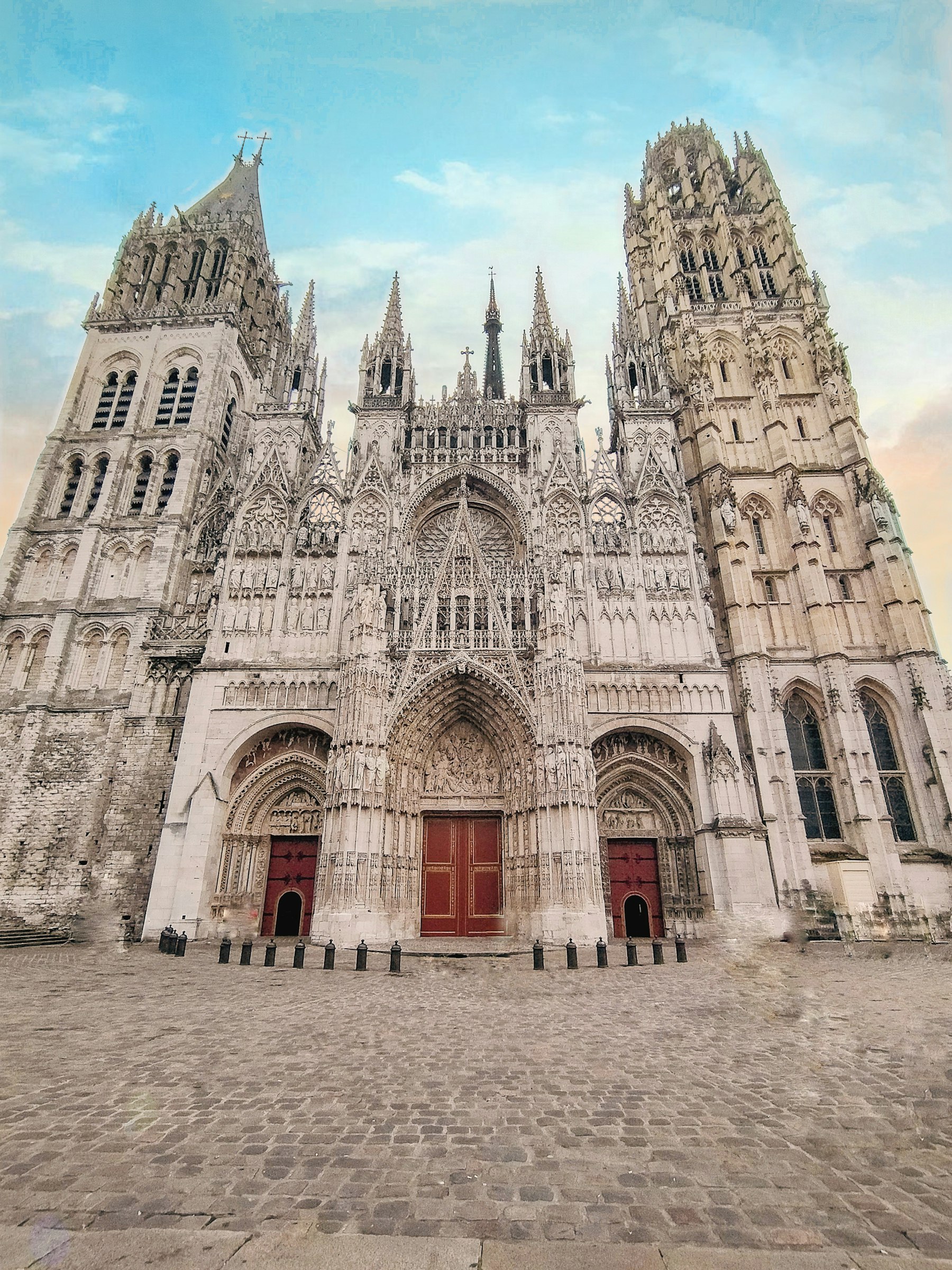
This is the hinge of the whole week and the reason we argue the case at all. Rouen is the natural mid-river day on a Seine river cruise, and it is not a World Heritage site. France submitted it to the Tentative List on 20 September 1996 as an urban ensemble — the timber-framed streets, the cathedral, Saint-Ouen and Saint-Maclou — and the file has sat there ever since.
Nothing about that makes the day less worth having. It makes the inscribed list a poorer guide than people assume, and it is a useful corrective to carry for the rest of the trip: the register is a record of what has been nominated and argued through a committee, not a ranking of what is worth your time.
Best for: Anyone who wants the medieval city and the much-painted cathedral front in one walk on a Seine river cruise, and who likes a great place with no plaque.
Go when: A full day of the Seine river cruise, not a morning. Our call — the Tentative List entry records a submission date and a category, and nothing about how long the walk takes.
4. The Beaches of the D-Day Landings — the heart of a Seine River Cruise
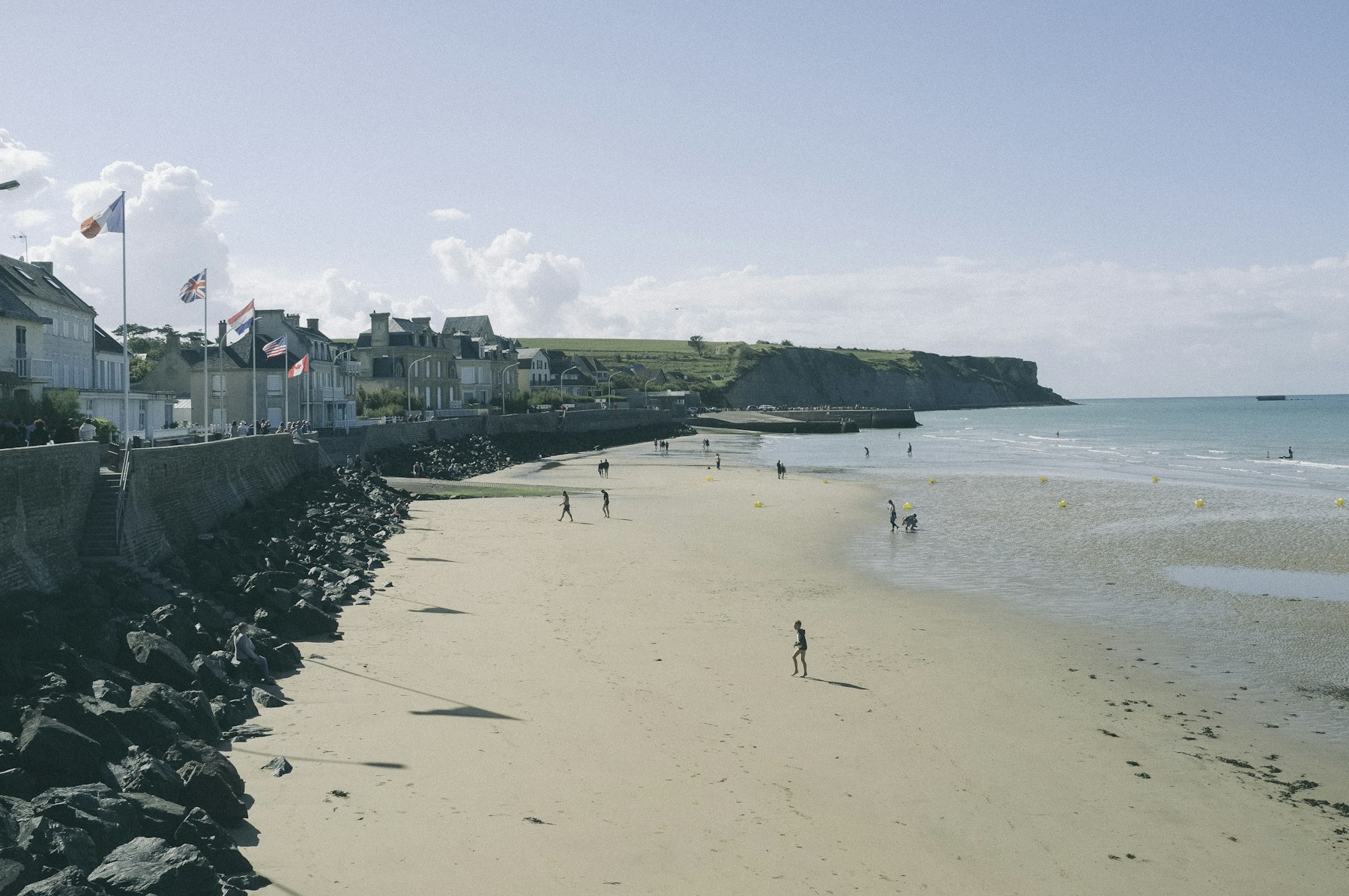
This is the newest thing on the river and the reason to rebuild a Seine river cruise around its downstream half. UNESCO inscribed the Beaches of the D-Day Landings, Normandy, 1944 in 2026 under criterion (vi) alone — the associative criterion, for places directly associated with events and traditions of outstanding universal significance. It is a serial property of six component parts running along roughly 80 kilometres of coast: Utah, Omaha, Gold, Juno and Sword, plus Pointe du Hoc, the sixth amphibious assault site.
The record is specific about what is being protected, and it is not only sand. The property takes in the remains of the artificial harbour known as Mulberry B, surviving elements of the German Atlantic Wall — casemates, artillery batteries, fire-control posts, resistance nests — traces left in the landscape and deliberately kept, memorial sites built since 1944, and the American Military Cemetery at Colleville-sur-Mer beside Omaha Beach. The inscribed area is 4,228.68 hectares. The buffer zone around it is 294,749.
That ratio is the fact we would build the week on. A buffer almost seventy times the property means the thing being protected is not a set of monuments but a stretch of inhabited, working coastline that happens to carry the evidence. UNESCO’s own integrity assessment says as much, calling the landscape integrity “satisfactory” while flagging urban and tourism pressure on some component parts and asking for coastal change and renewable-energy infrastructure to be watched. You cannot see that in an afternoon, and a single afternoon excursion is what a Seine river cruise usually leaves room for.
Give it two full days. One for the western end — Pointe du Hoc, Omaha, the cemetery — and one for the eastern beaches, where the argument shifts from assault to logistics and the surviving harbour works are the subject. Six component parts over 80 kilometres is a driving distance, not a stroll, and the thing that makes the second day worth it is that the first one teaches you what you are looking at.
Best for: Travellers who would rather understand one coastline than tick five beaches, and anyone on a Seine river cruise who finds a cemetery more legible than a museum.
Go when: Two days of the Seine river cruise, and preferably outside the June anniversary window. The two-day figure is our judgment; the six components and the 80 kilometres are UNESCO’s.
5. Le Havre — the concrete city at the river mouth
Inscribed in 2005 under criteria (ii) and (iv). The property is 133 hectares and the buffer zone is 114 — the only property on this list where the protected area is larger than the ring around it, which tells you it is a city centre and not a landscape. The record calls Le Havre “exceptional for its unity and integrity” among reconstructed cities, built to a plan led by Auguste Perret between 1945 and 1964 on a modular grid, in prefabricated concrete.
In our experience passengers see it as the place the Seine river cruise ends and the transfer begins. That is a waste of the one stop on the whole week that is about the twentieth century on its own terms rather than as damage to something older. Walk the grid for two hours before you leave.
Best for: Anyone interested in how Europe rebuilt itself, and Seine river cruise passengers who have had enough cathedrals by day five.
Go when: The morning of disembarkation, which is the only window most itineraries leave. Our reading of a typical schedule, not an operator’s.
6. Mont-Saint-Michel and its Bay — the far end of the Seine river cruise
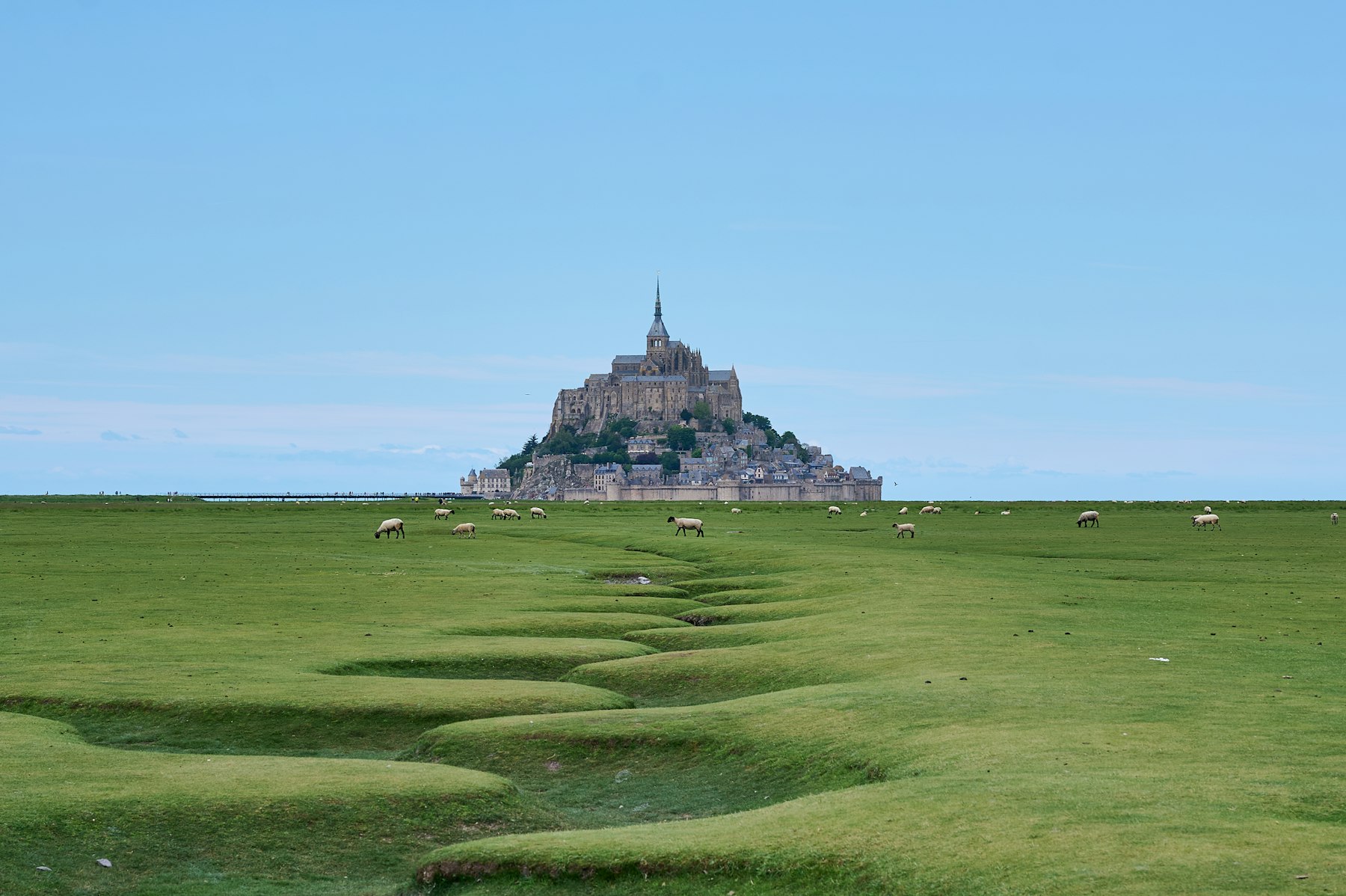
Inscribed in 1979 under criteria (i), (iii) and (vi), with minor boundary modifications in 2007 and 2018. The property covers 6,560 hectares inside a buffer zone of 191,858 — more than twelve times the inscribed area of the Paris riverbank, and the name is the point. It is the abbey and its bay: the sandbanks, the tides, the grazed marsh.
It is a long day out from the Seine river cruise and we still think it earns its place, provided you treat the crossing and the marshes as the subject rather than as the approach to the abbey. Arrive for a tide you have checked, and give the bay as much attention as the building.
Best for: Travellers who would rather see a landscape that produced a building than the building alone.
Go when: Around a high spring tide, and never as a same-day round trip from the ship if you can avoid it. Tide tables are published; the recommendation is ours.
7. Fontainebleau — proof the register is still moving
Inscribed in 1981 under criteria (ii) and (vi), with a minor boundary modification as recently as 2025. The property is 144 hectares, sitting inside a buffer zone of 17,463 in Seine-et-Marne. It is the smallest entry on this list and the easiest to skip, and we include it for one reason: it shows the Committee editing the Paris end of the Seine basin in 2025 while Rouen’s 1996 file sits untouched downstream.
That is not a scandal, it is how the Convention works — a State Party nominates, and nothing happens until it does. But it is worth knowing before you let an inscribed-sites list set the shape of a Seine river cruise. The list is a record of effort, not of merit.
Best for: Travellers extending a Seine river cruise at the Paris end who want somewhere with a fraction of the Versailles crowd.
Go when: As a day either side of the sailing rather than mid-week. Entirely our scheduling judgment.
MORE: This piece grew out of one numbered stop in our guide to choosing a European river cruise by the river rather than the ship, which ranks seven rivers and gives the Seine a single paragraph. Start there if you have not picked a river yet.
What the register holds within reach of a Seine River Cruise
| Property | Inscribed | Criteria | Property (ha) | Buffer zone (ha) |
|---|---|---|---|---|
| Paris, Banks of the Seine | 1991 (mod. 2024) | (i)(ii)(iv) | 538 | 3,194 |
| Palace and Park of Versailles | 1979 (mod. 2007) | (i)(ii)(vi) | 1,070 | 9,467 |
| Palace and Park of Fontainebleau | 1981 (mod. 2025) | (ii)(vi) | 144 | 17,463 |
| Beaches of the D-Day Landings, Normandy, 1944 | 2026 | (vi) | 4,228.68 | 294,749 |
| Le Havre, the City Rebuilt by Auguste Perret | 2005 | (ii)(iv) | 133 | 114 |
| Mont-Saint-Michel and its Bay | 1979 (mod. 2007, 2018) | (i)(iii)(vi) | 6,560 | 191,858 |
| Rouen — urban ensemble, cathedral, Saint-Ouen, Saint-Maclou | Not inscribed · Tentative List, 20 Sep 1996 | — | — | — |
Every figure in this table is taken from the UNESCO World Heritage Centre property record for the entry named, and the Rouen row from France’s Tentative List. Inscription years, boundary-modification years, criteria and areas are UNESCO’s. Which of these a given sailing reaches, and in what order, is not — that varies by operator and season, and we have not quoted any operator here.
Building a Seine River Cruise around the downstream half
Put the two Normandy days in before you choose a sailing
Work backwards. Decide you want two full days on the inscribed coast, then look for a schedule that can carry them, extending at Le Havre or Caen if it cannot. In our experience a Seine river cruise treats the beaches as one excursion because one excursion fits the timetable, not because one is enough for a serial property spread over 80 kilometres.
Treat Rouen as a city, not a port call
A day that starts and ends at the gangway gives you the cathedral and the market square. A day that starts early and wanders gives you the timber-framed streets the Tentative List file is actually about. The second costs nothing extra.
Check the tide before you commit to Mont-Saint-Michel
The bay is the property, and the bay is a tidal system. Published tide tables will tell you which day of your week is worth the drive; nothing in the inscription will. If the tides are wrong, spend the day in Bayeux instead and feel no regret.
Do not let an inscribed-sites list write your itinerary
Rouen is the proof. A Seine river cruise planned strictly off the World Heritage list would skip the stop we think most people remember. Use the register for what it is good at — boundaries, areas, what is actually protected — and use somebody who knows the river for the running order.
Have us read the itinerary before you pay the deposit →
Frequently Asked Questions
Is a Seine river cruise mostly about Paris?
A Seine river cruise is usually sold that way, but the weight of the week sits downstream. The inscribed Paris riverbank is 538 hectares; the D-Day beaches inscribed in 2026 cover 4,228.68 hectares across six component parts. We would give Paris one careful day and Normandy two.
Are the D-Day beaches a World Heritage site?
Yes, since 2026. UNESCO inscribed them under criterion (vi) as a serial property of six parts — Utah, Omaha, Gold, Juno, Sword and Pointe du Hoc — along roughly 80 kilometres of Normandy coast, including the Mulberry B harbour remains and the American Military Cemetery at Colleville-sur-Mer.
Why is Rouen not a World Heritage site?
Because it has never been inscribed. France placed it on the Tentative List on 20 September 1996 as an urban ensemble with its cathedral, Saint-Ouen and Saint-Maclou, and the nomination has not progressed since. A Tentative List entry is a declaration of intent, not a status.
How many days do you need in Normandy on a Seine river cruise?
Two full days, in our judgment. One for the western beaches and the cemetery, one for the eastern end where the surviving harbour works are. Six components over 80 kilometres is a driving itinerary, and the second day is when the first one starts to make sense.
Is Mont-Saint-Michel worth the day trip from the river?
Yes, if you go for the bay rather than only the abbey. The inscribed property is 6,560 hectares and most of it is tidal flat and salt marsh. Check a tide table first — that is our advice, not UNESCO’s, since the record sets boundaries and says nothing about when to visit.
The Dorian Destinations Verdict
The Seine is the one major European river where the register and the brochure disagree outright, and the register has the better case. Paris is 538 inscribed hectares you can walk in a morning. Normandy is a 2026 inscription spread over six component parts and 80 kilometres of coast, wrapped in a buffer zone almost seventy times its own size.
So the Seine river cruise we would build runs light at the top and heavy at the bottom: one day in Paris on foot, one unhurried day in Rouen, and two in Normandy rather than the single afternoon most schedules allow. Le Havre gets its two hours on the way out, and Mont-Saint-Michel gets a tide-checked day or nothing at all.
And keep Rouen in mind as the corrective. The best day of the week is in a city the list has never got round to, which is the most useful thing a Seine river cruise can teach you about heritage status: it records what somebody bothered to nominate, not what is worth your time.
Talk to a specialist who has built this week before →
Sources: UNESCO World Heritage Centre — Paris, Banks of the Seine (600); Beaches of the D-Day Landings, Normandy, 1944 (1581); Le Havre, the City Rebuilt by Auguste Perret (1181); Mont-Saint-Michel and its Bay (80); Palace and Park of Versailles (83); Palace and Park of Fontainebleau (160); Rouen, Tentative List entry 231; France, State Party record. Photographs via Unsplash. Running order, day counts and all seasonal advice are Dorian Destinations’ own judgment.
River Cruises · France · Europe · Cultural Travel