

Beyond the Obvious
Discover More
European River Cruise: Choose the River Before the Ship

Co-Founder & Travel Advisor, Dorian Destinations · Published October 7, 2026 · ET
Plan a European river cruise around the river, not the ship →
Europe has lost exactly one river landscape from the World Heritage List. The bridge that cost it is still standing, and the ships still sail past it.
Nearly everybody shopping for a European river cruise starts in the wrong place. They start with the ship — the balcony, the line, the year it was refitted, the restaurant that takes no supplement. I understand why. The ship is what the brochure photographs, and it is the only part of the week with a price attached. But a river vessel is a hotel that moves at walking pace, and after four days aboard any of them you stop noticing the carpet. What you never stop noticing is what is sliding past the window.
So the useful question on a European river cruise is not which ship. It is which river, and which stretch of it. And for that there is a better reference than any cruise line’s own itinerary map: UNESCO has spent forty years deciding, stretch by stretch, which pieces of European riverbank are worth protecting, and publishing exactly where the boundaries fall.
Everything factual below comes from UNESCO’s World Heritage Centre — the individual property records, the state-party listings for Germany, Austria, France, Hungary and Portugal, and the Committee’s own 2009 news release on the Dresden deletion. Inscription years and areas are quoted from each property’s data box. UNESCO’s descriptive text is published under CC-BY-SA IGO 3.0; it is quoted here and attributed, never reproduced wholesale.
The ordering is ours, and it is judgment, not data. UNESCO publishes no ranking of rivers and no opinion whatsoever about cruising. We have sorted these seven by how hard the commercial fleet works each one, from the river it has saturated to the river it cannot physically reach, because that gap is the single most useful thing a first-time river traveller can understand. Every line below marked Go when: is seasonal judgment from our own planning, and is labelled as such.
And the limit, plainly: we are travel advisors, not a cruise line. We own no vessels, we hold no cabin allocation on any river in Europe, and we cannot conjure a Wachau sailing in the second week of May that somebody else booked eleven months ago.
“Thanks to the relatively modest leeway given by the natural landscape of the Middle Rhine Valley to the people inhabiting it, this section of the river has undergone fewer changes than others.” — UNESCO, on the Upper Middle Rhine Valley
Why a European river cruise is a riverbank decision, not a ship decision
Here is the thing the European river cruise brochures bury. The inscribed stretches are short. The Upper Middle Rhine Valley runs 65 kilometres. Paris, Banks of the Seine covers 538 hectares. Avignon’s property is 8.2 hectares — a palace, a cathedral and half a bridge. These are not regions. They are specific, measured pieces of riverbank, and a week on the water either spends real time inside them or it does not.
Once you see it that way the whole category reorganises itself. Two European river cruise sailings on the same river, at the same price, on near-identical ships, can differ enormously in how many daylight hours they spend in the part anybody would cross a continent for. That is the variable worth optimising. The ship is not.
1. The Rhine: the 65 kilometres every European river cruise is built around
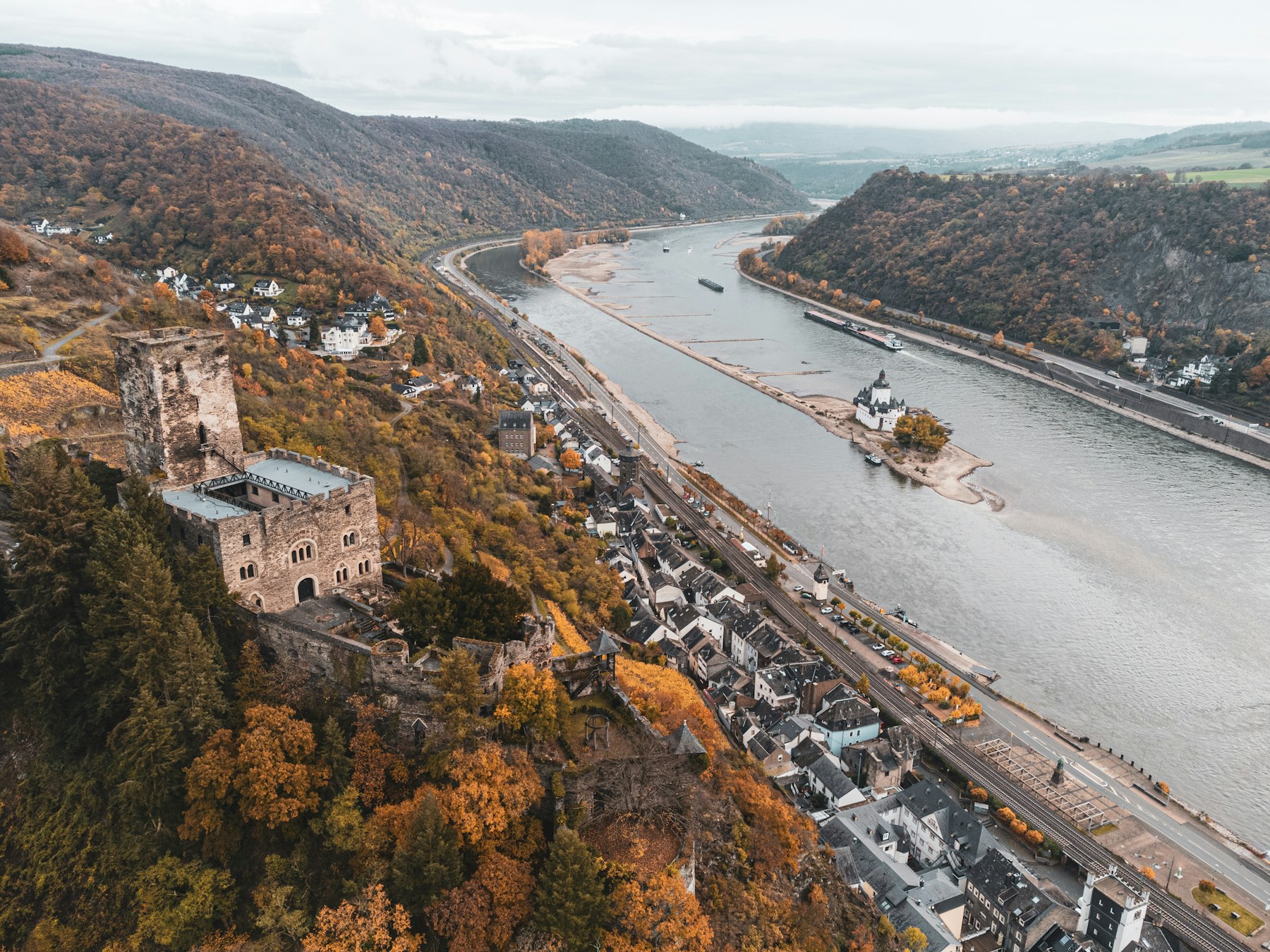
The Upper Middle Rhine Valley was inscribed in 2002 and covers 27,250 hectares. UNESCO describes a “dramatic 65km stretch” between Bingen, Rüdesheim and Koblenz, reflected in “its sixty small towns, the extensive terraced vineyards and the ruins of castles that once defended its trade.” The river breaks through the Rhenish Slate Mountains, narrowing at the Loreley to no more than 130 metres wide and 20 metres deep — the deepest point on the Middle Rhine.
That is a genuinely extraordinary 65 kilometres, and it is also the most heavily sold European river cruise water on the continent. Be clear-eyed about what comes with it. UNESCO’s own authenticity assessment notes that “the railways that run along the valley contribute to the noise pollution in the Valley which is a problem that needs to be mitigated.” You can see both tracks in the photograph at the top of this page. The castles are real; so are the freight trains at six in the morning.
Best for: a first European river cruise, and for anyone who wants the postcard without apology.
Go when: late September into October, our judgment — the vineyard terraces turn and the high-summer European river cruise convoy thins out.
We have written the Rhine up properly elsewhere, stop by stop: seven places to get off the ship on a Rhine river cruise.
2. The Danube: two inscriptions, and most weeks only reach one
The Danube carries two separate World Heritage properties on the reach the fleet actually works. The Wachau Cultural Landscape, inscribed in 2000 at 18,462 hectares, is the stretch between Melk and Krems, which UNESCO credits with “high visual and landscape qualities” and traces of continuous settlement since prehistory — the terraced vines there were laid out by Bavarian and Salzburg monasteries from around the year 800. Downstream, Budapest and the banks of the Danube were inscribed back in 1987, 476 hectares covering Buda’s castle spur and the Pest plain opposite.
Both are magnificent and both are on virtually every standard European river cruise sailing. What almost nobody sells you is the river beyond Budapest, which is where the Danube stops being a corridor between capitals and becomes something stranger.
Best for: travellers who want a European river cruise built around cities, and who want two very different ones in the same week.
Go when: May or late September, our judgment — the Wachau is at its best either side of the heat.
The argument for keeping going is one we have made at length: why the Danube does not end at Budapest.
3. The Douro: the smallest fleet and the steepest banks in Europe
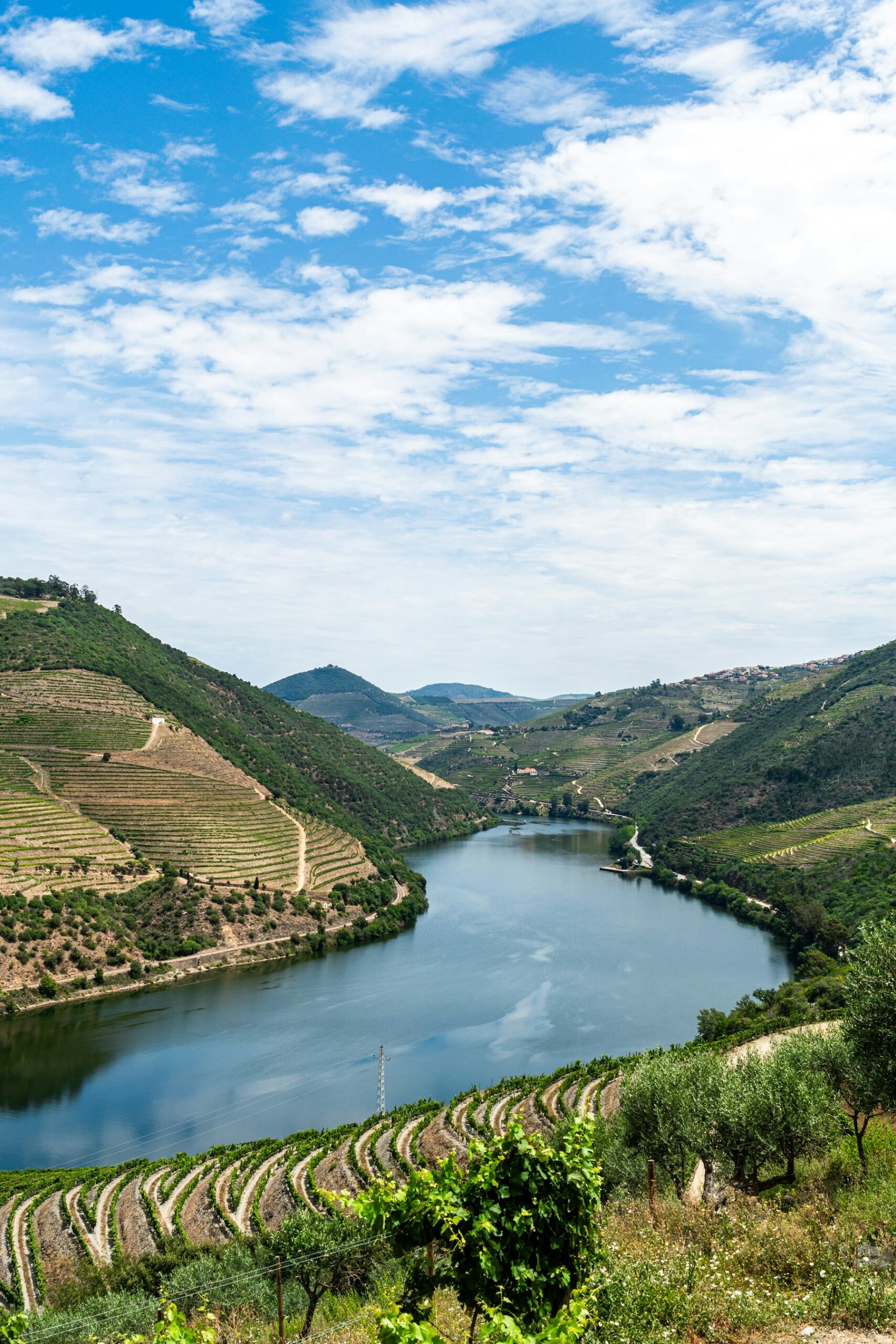
The Alto Douro Wine Region was inscribed in 2001 and covers 24,600 hectares. UNESCO’s record is unusually concrete about why: wine has been made here “by traditional landholders… for some 2,000 years”, and Port has been “defined and regulated since 1756”. The terraces themselves are the monument. The oldest, the pre-phylloxera socalcos, are narrow and irregular, buttressed by schist walls, and carry one or two rows of vines apiece.
The Douro is the shortest European river cruise route on this list and it has the smallest fleet, which is precisely its advantage. Vessels are capped by the lock chambers, so a Douro ship is a genuinely small ship, and a week on it feels nothing like a week on the Rhine.
Best for: a second or third European river cruise, and for anybody who found the Rhine too busy.
Go when: September into early October for the harvest, our judgment, and the best fortnight of the European river cruise year.
Our full write-up: what a Douro river cruise actually involves.
4. The Rhône: the heritage sits in the cities, not the banks
The Rhône is the one river here whose World Heritage is not a landscape at all. Lyon was inscribed in 1998 — 427 hectares at the confluence of the Saône and the Rhône, a city whose layers run from Roman Lugdunum through the medieval slopes of Fourvière to Renaissance Vieux-Lyon. Avignon followed, inscribed in 1995 at a mere 8.2 hectares: the Papal Palace, the episcopal ensemble and the bridge, on a river UNESCO names directly in its description.
So the Rhône rewards a different kind of traveller. Nobody sails it for the banks. You sail it because it delivers you into two of the most concentrated historic centres in France without an airport in between, and because Provence happens to start where the ship stops.
Best for: a European river cruise about food, wine and cities, and for travellers who would rather walk a town than photograph a gorge.
Go when: late April to mid-June, our judgment — before the mistral-and-heat combination of high summer.
The caveat we would raise first is in our Rhône piece: who should not book a Rhône sailing at all.
5. The Seine: the shortest World Heritage reach on any European river cruise map
Paris, Banks of the Seine was inscribed in 1991 and covers 538 hectares. UNESCO draws the boundary precisely: the bridges, quays and banks “between the Pont de Sully and the Pont d’Iéna”, plus the Île de la Cité and the Île Saint-Louis. That is roughly a four-kilometre reach. You can walk the whole inscribed property between breakfast and lunch.
This matters more than it sounds, because a European river cruise on the Seine is sold on the strength of Paris and then spends five of its seven days in Normandy — Rouen, Les Andelys, Honfleur, the landing beaches. Those are good days. They are simply not the days the brochure cover is selling, and travellers who booked for the river through Paris are often quietly surprised.
Best for: a European river cruise that is really about Normandy as much as Paris, booked by somebody who knows that.
Go when: May or September, our judgment — the Normandy light is the reason to go, and it is best either side of August.
6. The Elbe: the river that lost its World Heritage status
This is the stop that changed how I talk to clients about rivers, and it is the reason this piece exists at all.
The Dresden Elbe Valley was inscribed as a cultural landscape in 2004. It stretched, in UNESCO’s description, “some 18 km along the river from Übigau Palace and Ostragehege fields in the north-west to the Pillnitz Palace and the Elbe River Island in the south-east” — low meadows, parks and monuments from the 16th to the 20th centuries, crowned by Pillnitz. In 2006 it was placed on the List of World Heritage in Danger because of a planned four-lane crossing, the Waldschlösschen Bridge. The Committee warned, then warned again.
On a Thursday in June 2009, at its 33rd session in Seville, the World Heritage Committee removed it. The property, it ruled, had failed to keep its “outstanding universal value as inscribed”. Dresden was only the second property ever struck from the list, after Oman’s Arabian Oryx Sanctuary in 2007. The Committee added that Germany could renominate Dresden in future, but only “under different criteria and boundaries”.
The bridge was built. The city is still beautiful — the Frauenkirche and the Zwinger were never the issue, and they are not on the river meadows that were. But the Elbe is now the one major European river cruise route you can sail without passing a single World Heritage property on its banks, and it got there by deliberate municipal choice.
I do not think that makes the Elbe a bad week. I think it makes it an honest one, and the only river on this list where you can see exactly what the designation was protecting by looking at what replaced it.
Best for: a second or third European river cruise, and anyone more interested in how places are governed than in how they photograph.
Go when: late spring, our judgment — and check water levels before you commit, because the Elbe is the shallowest river on this list and the one most often disrupted.
7. The Loire: the river landscape no European river cruise can reach
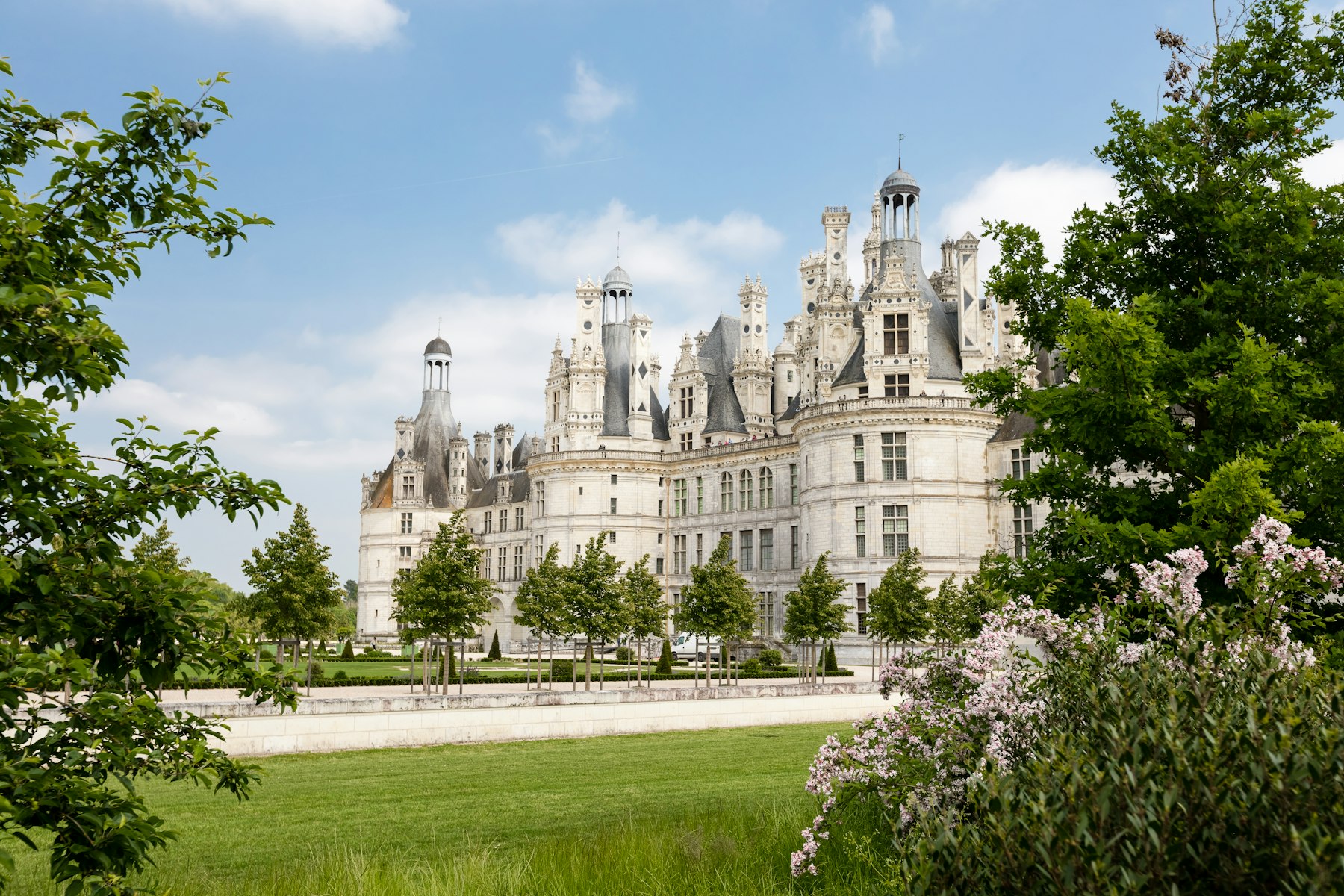
The Loire Valley between Sully-sur-Loire and Chalonnes was inscribed in 2000 and covers 86,021 hectares. That is more than three times the Upper Middle Rhine Valley and roughly 160 times the inscribed banks of the Seine. UNESCO calls it “an outstanding cultural landscape of great beauty, containing historic towns and villages, great architectural monuments (the châteaux), and cultivated lands formed by many centuries of interaction between their population and the physical environment, primarily the river Loire itself”.
And there is no European river cruise fleet. The Loire is braided, shallow and sandbanked, and no commercial cruise vessel works it. The largest inscribed river landscape in Europe is reached by car, by bicycle along the Loire à Vélo, or not at all.
I include it deliberately, because it is the cleanest proof of the argument. If the ship were the product, the Loire would be worthless. It is instead the most generously inscribed river valley on the continent, and the week you would spend there is excellent. It simply is not a cruise.
Best for: travellers who thought they wanted a European river cruise and actually want a river region.
Go when: late May to June, our judgment — the gardens are at their peak and the châteaux have not filled up.
More from this series: the Danube is the river most people book and least people finish. Keep going past Budapest to the sea is the companion piece to this one.
| River | World Heritage property | Inscribed | Area | Fleet reaches it? |
|---|---|---|---|---|
| Rhine | Upper Middle Rhine Valley | 2002 | 27,250 ha | Constantly |
| Danube | Wachau Cultural Landscape | 2000 | 18,462 ha | Every standard sailing |
| Danube | Budapest, Banks of the Danube | 1987 | 476 ha | Every standard sailing |
| Douro | Alto Douro Wine Region | 2001 | 24,600 ha | Small fleet, lock-capped |
| Rhône | Historic Site of Lyon | 1998 | 427 ha | Yes, as a city call |
| Rhône | Historic Centre of Avignon | 1995 | 8.2 ha | Yes, as a city call |
| Seine | Paris, Banks of the Seine | 1991 | 538 ha | Yes — briefly |
| Elbe | Dresden Elbe Valley | 2004, deleted 2009 | — | Sails past, nothing inscribed |
| Loire | Sully-sur-Loire to Chalonnes | 2000 | 86,021 ha | No fleet at all |
Years and areas are quoted from each property’s UNESCO data box; the Dresden figures come from the Committee’s 2009 deletion release. Areas span more than four orders of magnitude, so read the column as “what was inscribed” rather than “how much there is to see”. The final column is our own assessment of commercial sailing patterns, not a UNESCO judgment.
How to read a sailing itinerary before you book
Once you accept that the riverbank is the product, an itinerary becomes readable in about four minutes. Three things to do with it:
Count the daylight hours inside the inscribed reach
Not the ports of call — the cruising hours. A Rhine sailing that transits the Bingen-to-Koblenz stretch at two in the morning has technically delivered the gorge and actually delivered nothing. Ask the operator, in writing, what time the ship is scheduled through it.
Ask which nights are spent moored, and where
A ship tied up at an industrial quay two kilometres from a town centre is a different holiday from one moored in the middle of it. Operators know exactly which berths they hold and will tell you if asked directly.
Ask the second question too
First: what time do we transit the best reach? Then: what happens if low water forces a coach transfer, and who decides? The answer to the second question tells you more about the company than the first one does.
Have us read the itinerary before you pay the deposit →
Frequently Asked Questions
Which European river cruise is best for first-timers?
The Rhine, on the evidence, and we recommend it as a first European river cruise without much enthusiasm. Its inscribed 65-kilometre reach is the most dramatic scenery on any mainstream route, the infrastructure is excellent and sailings run from March to December. It is also the busiest water in Europe, which is the trade you are making.
What is the most underrated river in Europe for a cruise?
The Douro. Its lock chambers cap vessel size, so the ships are genuinely small, and the 24,600 hectares of terraced vineyard UNESCO inscribed in 2001 sit directly above the water rather than an hour inland. It is the river people book second and wish they had booked first.
Why did Dresden lose its World Heritage status?
The World Heritage Committee deleted the Dresden Elbe Valley in June 2009 at its 33rd session in Seville, after a four-lane bridge was built through the cultural landscape. The property had been on the Danger list since 2006. It was only the second site ever removed from the list.
Can you take a river cruise on the Loire?
No. The Loire is braided, shallow and sandbanked, and no commercial cruise fleet operates on it, despite its 86,021-hectare valley being the largest inscribed river landscape in Europe. It is a driving or cycling region, and an outstanding one.
How long should a European river cruise be?
Seven nights is the European river cruise industry standard and it is usually right for a single river. Our judgment is that the longer sailings only earn their price when they cross between genuinely different reaches — a lower-Danube week, say — rather than simply adding ports on the same stretch.
The Dorian Destinations Verdict
Do not make the Rhine your first European river cruise. That is the opposite of what the industry will tell you, and it is the opposite of what is easy for us to sell: the Rhine week is the simplest river booking in the business, it is available at every price point, and nobody has ever rung me up annoyed that their first river trip was the famous one.
But a first European river cruise sets your baseline, and the Rhine sets it at full volume — convoys of identical hulls, a gorge shared with a freight railway on both banks. Start on the Douro or the Rhône, where the scale is human and the ship is small enough that the river still feels larger than the hotel. Come to the Rhine third, when you have something to measure it against. You will like it more, and you will understand why 65 kilometres of German riverbank are protected.
And if the answer turns out to be the Loire — the largest inscribed river valley in Europe, with no ship on it at all — then take that answer. We will plan it, and it will not be a cruise, and that is fine.
Talk to a Dorian Destinations advisor →
Sources: UNESCO World Heritage Centre property records for the Upper Middle Rhine Valley, the Wachau Cultural Landscape, Budapest and the Banks of the Danube, the Alto Douro Wine Region, the Historic Site of Lyon, the Historic Centre of Avignon, Paris, Banks of the Seine and the Loire Valley between Sully-sur-Loire and Chalonnes; and the World Heritage Committee’s 2009 announcement of the Dresden deletion. UNESCO descriptive text is published under CC-BY-SA IGO 3.0 and is quoted here with attribution. Seasonal and itinerary judgments are our own.
River Cruises · Europe · Cultural Travel · Luxury Travel