

Beyond the Obvious
What Most Itineraries Miss
Kusatsu Onsen: 5,000 Litres a Minute and Three Free Baths

Co-Founder & Travel Advisor, Dorian Destinations · Published October 28, 2026 · ET
Have us build this into your Japan trip →
Five thousand litres a minute. That is the number that should decide where you go for hot water in Japan, and it belongs to a town almost no foreign itinerary includes.
Kusatsu Onsen sits at 1,200 metres in the mountains of Gunma Prefecture, three to four hours from Tokyo depending on which of three routes you take. Its central hot water field, the Yubatake, delivers around 5,000 litres a minute at more than 70°C — among the most productive single hot spring sources in the country, and the reason the town has the largest natural flow of hot spring water in Japan.
Most visitors from abroad go to Hakone instead, because Hakone is ninety minutes from Tokyo and has a famous loop. That is a reasonable trade of water for convenience. It is also, we think, the wrong one if you have a spare night.
What follows is the practical case for Kusatsu Onsen: what the water actually does, which three big baths are worth the admission, which three are free, how to get there from Tokyo on each of the three routes, and when to go.
Two things to say plainly. Every figure below — flow rates, temperatures, opening hours, admissions, fares, journey times — comes from japan-guide.com’s own pages on the town, read in October 2026 and linked at the foot of this article. Prices and timetables change, and the source itself notes that fares and schedules may change; confirm before you book.
And the limit on what we do: we are travel advisors. We hold no allocation in any ryokan named or unnamed here, we are paid nothing by anyone in this article, and we have no commercial relationship with the town or with our sources.
“Said to cure every illness but lovesickness.” — the local claim about the water at Kusatsu Onsen, repeated for centuries and still printed on the tourist literature
Why Kusatsu Onsen instead of Hakone
Hakone is an easy day from Tokyo and it is full. Kusatsu Onsen is harder to reach and, for that reason, is largely a domestic destination — the Japanese rank it at or near the top of their own hot spring lists, and foreign visitors mostly do not go.
The difference you actually feel is the water itself. Kusatsu Onsen’s springs are sulfurous and highly acidic, and the town does not have to dilute or reheat anything, because it has more water than it can use. Several ryokan and bath houses are fed straight from the source. That is not a marketing position; it is a plumbing fact, and it is unusual.
The second difference is price. Three of the town’s bath houses are open to tourists and cost nothing. The three large public baths cost between 800 and 1,100 yen. You can bathe properly in Kusatsu Onsen for a day on less than the price of a Tokyo lunch.
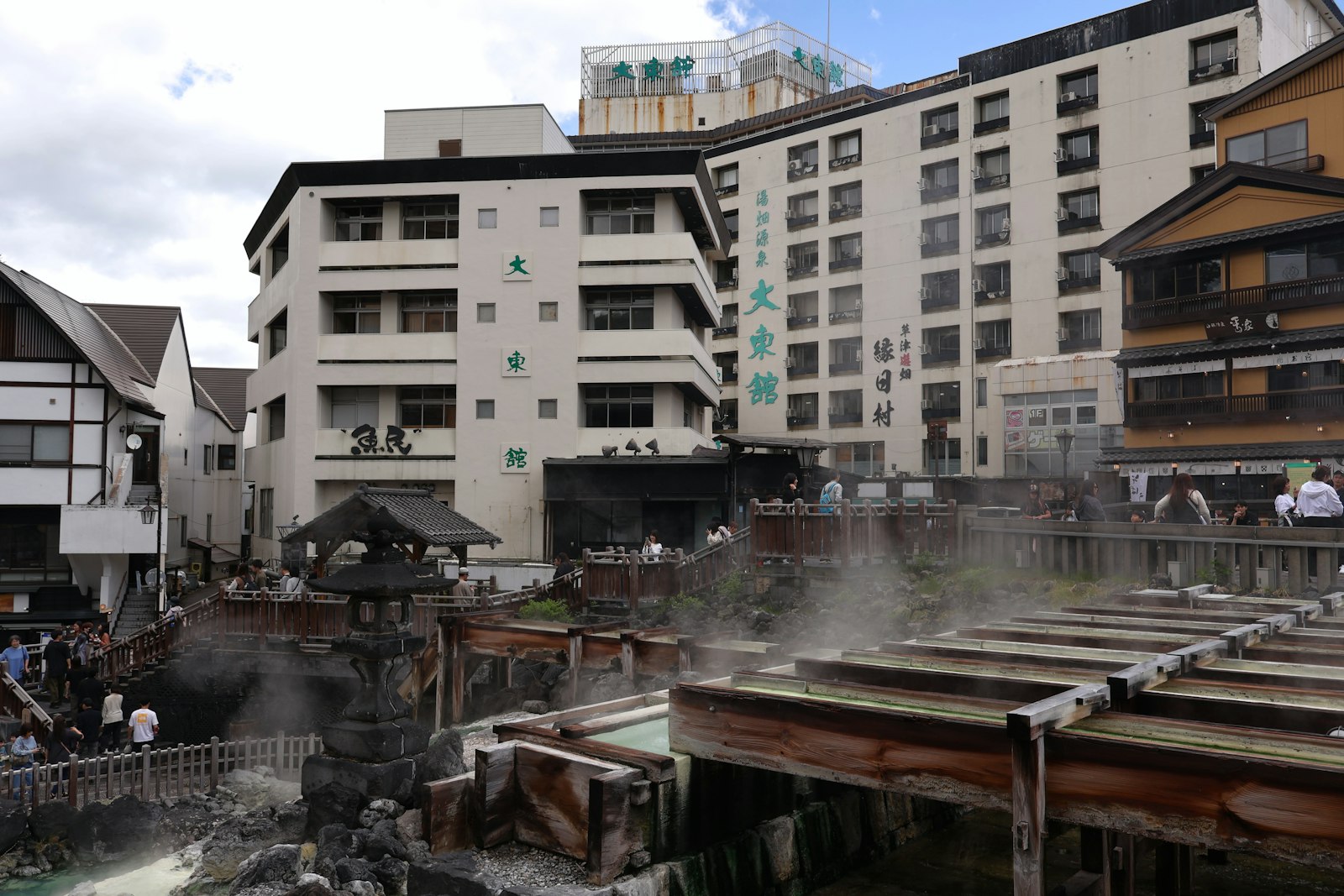
The Yubatake at Kusatsu Onsen: what 5,000 litres a minute looks like
The Yubatake — the hot water field — sits in the middle of the town and is the thing everyone photographs, but the photograph misses the point. It is not a decorative feature. It is infrastructure.
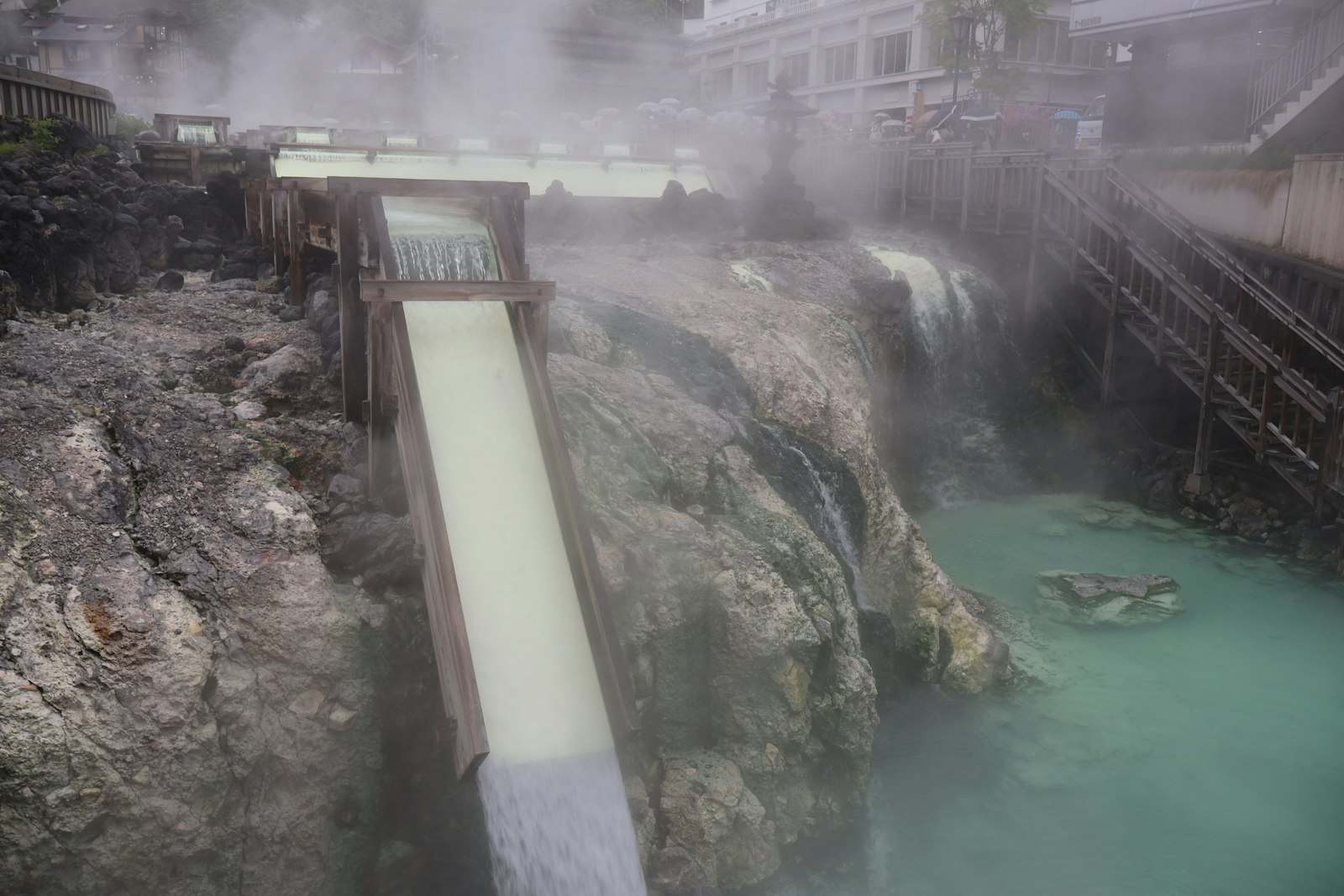
Water surfaces here at more than 70°C, which is too hot to bathe in, and runs along a bank of open wooden channels that cool it by a few degrees before it is piped out to the ryokan and the public baths. That is the whole mechanism of Kusatsu Onsen in one view: source, cooling, distribution, all of it outdoors and all of it visible.
Sulfuric sediment called yunohana — “hot water flowers” — builds up in the conduits over time. It is harvested periodically and sold in the shops around the square as bath salt, which is the most honest souvenir in Japanese tourism: the thing itself, scraped off the pipe.
There is a free foot bath beside the Yubatake. Use it before you commit to anything hotter — it tells you quickly what this water is like.
The three big baths at Kusatsu Onsen, and which to pick
Three large public baths carry Kusatsu Onsen. They are genuinely different from one another, and the order you do them in matters more than most guides admit.
Sainokawara Rotenburo — 800 yen
A fifteen-minute walk from the Yubatake, through Sainokawara Park. It is one of the largest open-air baths in Japan and is wide enough for more than a hundred bathers, which sounds like a crowd problem and in practice means space. Open 7:00 to 20:00, from 9:00 between December and March, last entry 19:30, no closing days.
Go at the end of the day, and go in winter if you can. The point of this one is the surrounding view — autumn colour, then snow.
Otakinoyu — 1,100 yen
Five minutes from the Yubatake and the most expensive of the three, which is correct. The attraction is Awaseyu: a row of wooden indoor tubs running from 38°C to 46°C, and you work along them in order. Open 9:00 to 21:00, last entry 20:00, no closing days.
This is the one to do properly rather than quickly. The whole design assumes you will spend an hour.
Gozanoyu — 800 yen
Next to the Yubatake, opened in 2013, and the easiest to fit into a short stay. One stone bath and one wooden bath, switched between genders daily, each with two pools fed by different thermal waters. Open 7:00 to 21:00, from 8:00 between December and March, last entry 20:30. A private tatami room is 2,000 yen an hour.
Our order: Gozanoyu first thing in the morning, Otakinoyu in the afternoon with time to spare, Sainokawara last, outdoors, as the light goes. If you only have time for one, make it Otakinoyu.
| Bath | Admission | Hours | What it is for |
|---|---|---|---|
| Sainokawara Rotenburo | 800 yen | 7:00–20:00 (9:00 Dec–Mar) | Huge open-air bath, 100+ capacity |
| Otakinoyu | 1,100 yen | 9:00–21:00 | Awaseyu tubs, 38°C to 46°C |
| Gozanoyu | 800 yen | 7:00–21:00 (8:00 Dec–Mar) | Two waters, central, opened 2013 |
| Shirohatanoyu | Free | 8:00–23:00 | Two small baths, straight from the spring |
| Jizonoyu | Free | 8:00–22:00 | Timed Jikanyu bathing sessions |
Hours, admissions and capacities are japan-guide.com’s. The right-hand column is our characterisation. Confirm before travelling.
The three free baths most visitors never find
More than a dozen small community bath houses sit in the side streets of Kusatsu Onsen. Most are for residents only. Three are open to tourists, all three are free, and they are the closest thing the town has to a secret in plain sight.
Shirohatanoyu is next to the Yubatake and Gozanoyu, open 8:00 to 23:00, and closed briefly for cleaning around 8:00. Two small baths, two to four people each, water arriving straight from the spring. It is very hot. That is not a complaint, it is the warning.
Jizonoyu is five minutes away along the side streets, open 8:00 to 22:00, gender-segregated, four to six people a side, fed by the spring in front of the building. It also runs Jikanyu — timed bathing therapy sessions, done to a clock rather than to taste.
Chiyonoyu is the third, and our source names it without further detail. We are not going to invent hours for it.
There are also three free foot baths open to anyone: beside the Yubatake, just outside the bus terminal building, and a large one in Sainokawara Park. Between the free bath houses and the free foot baths, a full day in Kusatsu Onsen can cost you nothing but the journey.
One practical note. These community baths are small, hot, and primarily local. Wash before entering, keep it brief, and do not treat them as an attraction to be photographed. They are somebody’s bathroom.
Yumomi: cooling the water by hand
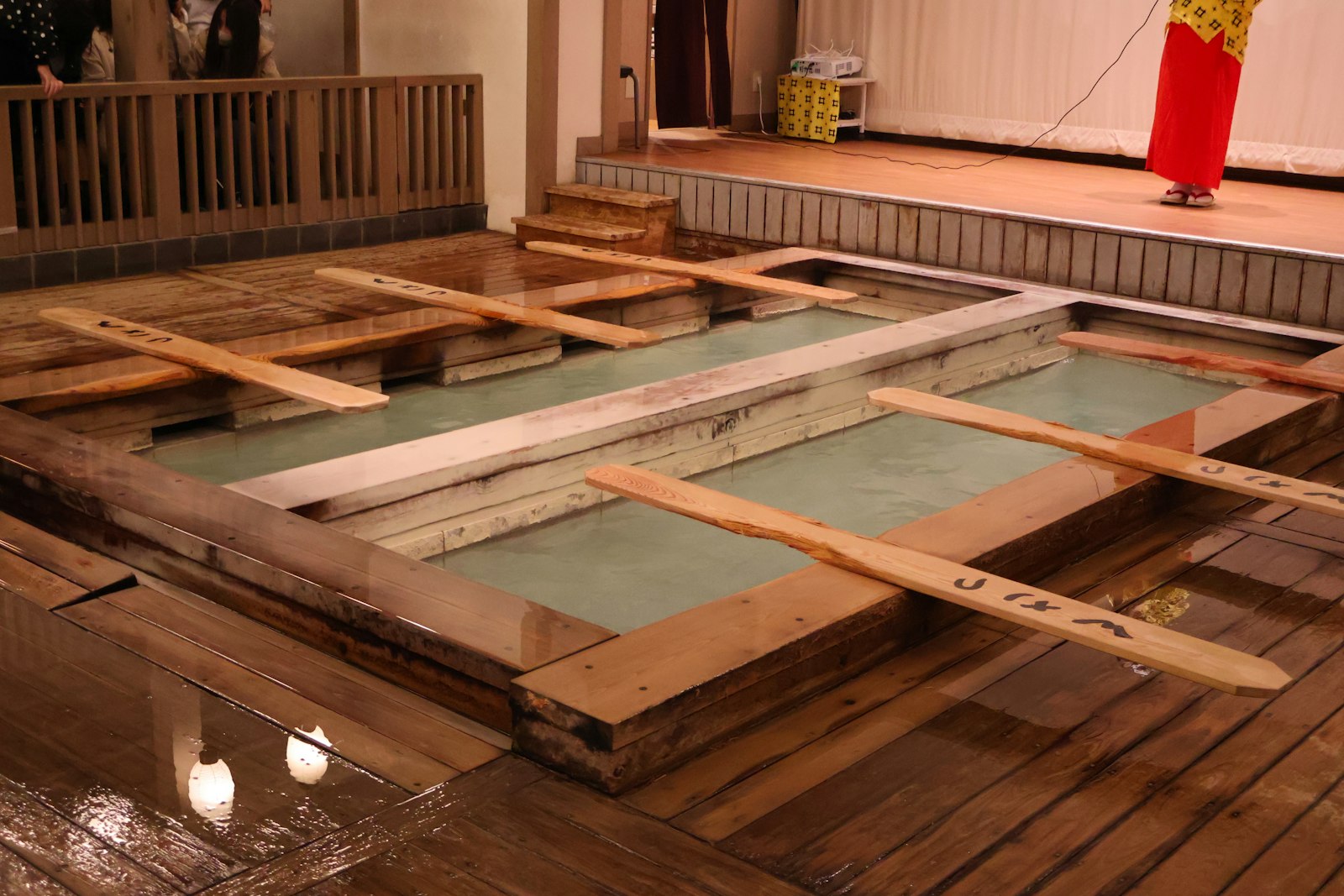
Because the water surfaces above bathing temperature and the town refuses to dilute it, Kusatsu Onsen cools it the old way: long wooden paddles worked through the water by hand, with singing, a practice called yumomi. It is performed daily at Netsunoyu.
Treat it as what it is — a working technique that became a performance, rather than a performance invented for visitors. It takes twenty minutes and it explains the wooden channels you have already walked past.
Getting to Kusatsu Onsen from Tokyo: three routes
This is where most people give up, so here are all three with real numbers attached. Our source gives headline totals that do not always add up to the sum of their legs, and we have said so rather than tidied it away.
Route 1. Train and JR bus via Naganohara — about 3.5 hours, around 6,000 yen
The direct limited express from Ueno to Naganohara-Kusatsuguchi takes 2.5 hours and costs 5,480 yen one way, but runs only around three round trips a day. The local train from Tokyo takes about four hours at 3,190 yen with a change at Takasaki. From the station, the JR bus to the Kusatsu Onsen bus terminal is 30 minutes and 780 yen.
This is the Japan Rail Pass route. The train is covered by the Japan Rail Pass, the JR Tokyo Wide Pass, the JR East Pass and the JR East South Hokkaido Pass; the bus is covered only by the Japan Rail Pass and the JR East Pass. Through October 2026 one round trip a day also serves selected hotels for 1,000 yen one way.
Route 2. Shinkansen and bus via Karuizawa — about 3 hours, around 8,500 yen
Hokuriku Shinkansen from Tokyo to Karuizawa, 70 minutes, around 6,000 yen. Then the Kusakaru Kotsu bus, 80 minutes, 2,240 yen. JR passes are not valid on that bus.
The fastest route and the most expensive. It also lets you put a night in Karuizawa on the front of the trip, which is why we usually choose it.
Route 3. Highway bus — about 4 hours, 3,500 to 4,000 yen
JR highway buses run several times a day from Busta Shinjuku, about four hours, 3,500 to 4,000 yen depending on the date. Other operators run from Shibuya Mark City in 4.5 hours at 3,600 yen. JR passes are not valid on any of them.
The cheapest and the simplest — one vehicle, no transfers. If you are not carrying a rail pass, this is the route to take to Kusatsu Onsen.
| Route | Time | Cost | Rail pass |
|---|---|---|---|
| Train + JR bus via Naganohara | ~3.5 h | ~6,000 yen | Covered |
| Shinkansen + bus via Karuizawa | ~3 h | ~8,500 yen | Train only |
| Highway bus from Shinjuku | ~4 h | 3,500–4,000 yen | Not valid |
Times, fares and pass coverage are japan-guide.com’s, read October 2026. The source notes fares and schedules may change.
Getting around once you are there
You walk. Kusatsu Onsen is compact and built around the Yubatake, and the baths, ryokan and shops in the centre are all within a few minutes of each other on foot. Mount Shirane is about a 30-minute drive above the town, which is the one thing you would want a car or a tour for.
Some ryokan run free pickups from the bus terminal, but this varies by property and no general schedule exists. Ask when you book, not when you arrive.
When to go to Kusatsu Onsen
Kusatsu Onsen works all year, which is rare, and the water is the same temperature in August as in February. What changes is everything around it.
Winter is the argument. Sainokawara Rotenburo in snow is the single image this town trades on, and it is earned; the bath opens an hour later from December to March, so plan around a 9:00 start. Gunma gets proper winter and the ski resort is 1.1 km from the edge of the town centre.
Autumn is the other one. The park around Sainokawara turns, and because the bath is open-air and enormous, you are sitting inside the colour rather than looking at it.
Summer is the underrated option. At 1,200 metres, Kusatsu Onsen is markedly cooler than Tokyo in August, which is the month most visitors find Japan hardest. If your dates are fixed in high summer, this is a reason to come rather than a reason not to.
Spring is the quietest and the least photogenic, and therefore the cheapest and the easiest to book.
For the wider calendar, our month-by-month guide to the best time to visit Japan covers how this fits the rest of a trip.
Kusatsu Onsen FAQ
How long should you stay in Kusatsu Onsen?
One night is enough to do two of the three big baths and walk the town. Two nights is the right answer if you want all three plus Sainokawara at dusk, and it is what we book. A day trip from Tokyo is possible on the shinkansen route but means roughly six hours of travel for a few hours of bathing.
Is it worth it compared with Hakone?
If you want convenience, no — Hakone is much closer to Tokyo. If you want the water, yes. Kusatsu Onsen has the largest natural flow of hot spring water in Japan, around 5,000 litres a minute from the Yubatake alone, and the town is fed straight from the source rather than reheated.
Can you visit Kusatsu Onsen on a Japan Rail Pass?
Partly. The train to Naganohara-Kusatsuguchi is covered by the Japan Rail Pass, the JR Tokyo Wide Pass, the JR East Pass and the JR East South Hokkaido Pass. The connecting JR bus is covered only by the Japan Rail Pass and the JR East Pass. The Karuizawa bus and the highway buses are not covered at all.
Are the baths free?
Some of them. Three community bath houses — Shirohatanoyu, Jizonoyu and Chiyonoyu — are open to tourists at no charge, as are three foot baths. The three large public baths cost 800 to 1,100 yen. Ryokan baths are free to staying guests, and some ryokan admit non-guests during the day for roughly 500 to 1,500 yen.
How hot is the water?
It surfaces at more than 70°C and is cooled in the Yubatake’s wooden channels before distribution. The Awaseyu tubs at Otakinoyu run from 38°C to 46°C, which is the controlled version. The free community baths take their water closer to the source and are very hot.
The verdict
Kusatsu Onsen is the clearest case we know of a place being skipped for the wrong reason. It is not obscure, it is not difficult, and it is not expensive — it is simply three and a half hours from Tokyo instead of ninety minutes, and that is enough to keep most foreign itineraries away.
Go for two nights. Do Gozanoyu early, Otakinoyu slowly, Sainokawara at dusk, and at least one of the free community baths so you understand what the undiluted version feels like. Take the Karuizawa route if you want speed and a night on the front, the highway bus if you want simplicity, and the Naganohara train if you are carrying a rail pass.
It is the best hot water in Japan, and the reason you can still have it to yourself is a three-hour bus ride.
Five thousand litres a minute, and almost no one from abroad.
Sources: flow rates, temperatures, altitude, bath hours, admissions, routes, fares and pass coverage are from japan-guide.com’s Kusatsu Onsen pages, read in October 2026, together with its pages on the Yubatake, the hot spring baths and access. Background on the town’s geography is corroborated by Wikipedia’s entry on Kusatsu, Gunma. The ordering of the baths, the route recommendation and the seasonal advice are ours. The source itself notes that fares and schedules may change; confirm everything before booking.
Talk to a Dorian advisor about Japan →
Japan · Off The Beaten Path · Wellness Travel · Cultural Travel · Asia