

Adventure & Expedition Travel
Travel Beyond the Ordinary
Kilimanjaro Climb Tours: See All Seven Sites, Not Just One

Co-Founder & Travel Advisor, Dorian Destinations · Published September 24, 2026 · ET
Plan your Tanzania expedition with us
Tanzania has seven UNESCO World Heritage sites. One of them is a mountain you can walk up. Almost every itinerary sold as one of the headline Kilimanjaro climb tours will fly you straight past the other six.
There is an arithmetic to an East African trip that nobody prints in the brochure. The flight is the expensive part. The visa is the slow part. The mountain, for most people, is eight or nine days of walking very slowly uphill and one very long night. Everything else in the country — the craters, the plains, the coral-stone cities on the coast — is comparatively cheap once you have already paid to get there. And yet the way most Kilimanjaro climb tours are packaged, you land, you climb, you shower, you fly home.
Everything factual in this guide to Kilimanjaro climb tours comes from one place: the UNESCO World Heritage Centre’s own records for the United Republic of Tanzania, read property by property. Inscription dates, protected areas and the descriptions of what each site is are taken from those records rather than from any operator’s marketing.
What we cannot do: we are travel advisors, not mountain guides, and we hold no porter allocation, no park permits and no lodge inventory of our own in Tanzania. We quote no prices for Kilimanjaro climb tours here, because no authority publishes a stable one. Where we say a season is better or a leg needs an extra night, that is our planning judgment and the line says so. UNESCO descriptive text is used under CC-BY-SA IGO 3.0 and quoted rather than reproduced.
“A superlative natural phenomenon, standing in isolation above the surrounding plains overlooking the savannah.” — UNESCO World Heritage Centre, on Mount Kilimanjaro
Why Most Kilimanjaro Climb Tours Waste the Flight
Kilimanjaro National Park was inscribed in 1987 and covers some 75,575 hectares. It protects, in UNESCO’s words, the largest free-standing volcanic mass in the world and the highest mountain in Africa, rising 4,877 metres above the surrounding plains to 5,895 metres at its peak. That is the whole product most Kilimanjaro climb tours sell. It is a magnificent product. It is also one site out of seven.
The other six sites that Kilimanjaro climb tours skip are not consolation prizes. Ngorongoro and the Serengeti are two of the most consequential protected landscapes anywhere on earth. Selous is among the largest wilderness areas in Africa. Stone Town, Kilwa Kisiwani and the Kondoa rock shelters hold a millennium of Indian Ocean trade and several thousand years of painting between them.
Booked properly, Kilimanjaro climb tours stop being a ten-day trip and become the opening act of a three-week one. What follows is the seven, in the order we would actually route them. Each carries its inscription year and protected area from the UNESCO record, a line on who it suits, and a line on when to go — the last of which is our judgment, not UNESCO’s.
1. Kilimanjaro National Park — What Kilimanjaro Climb Tours Actually Sell
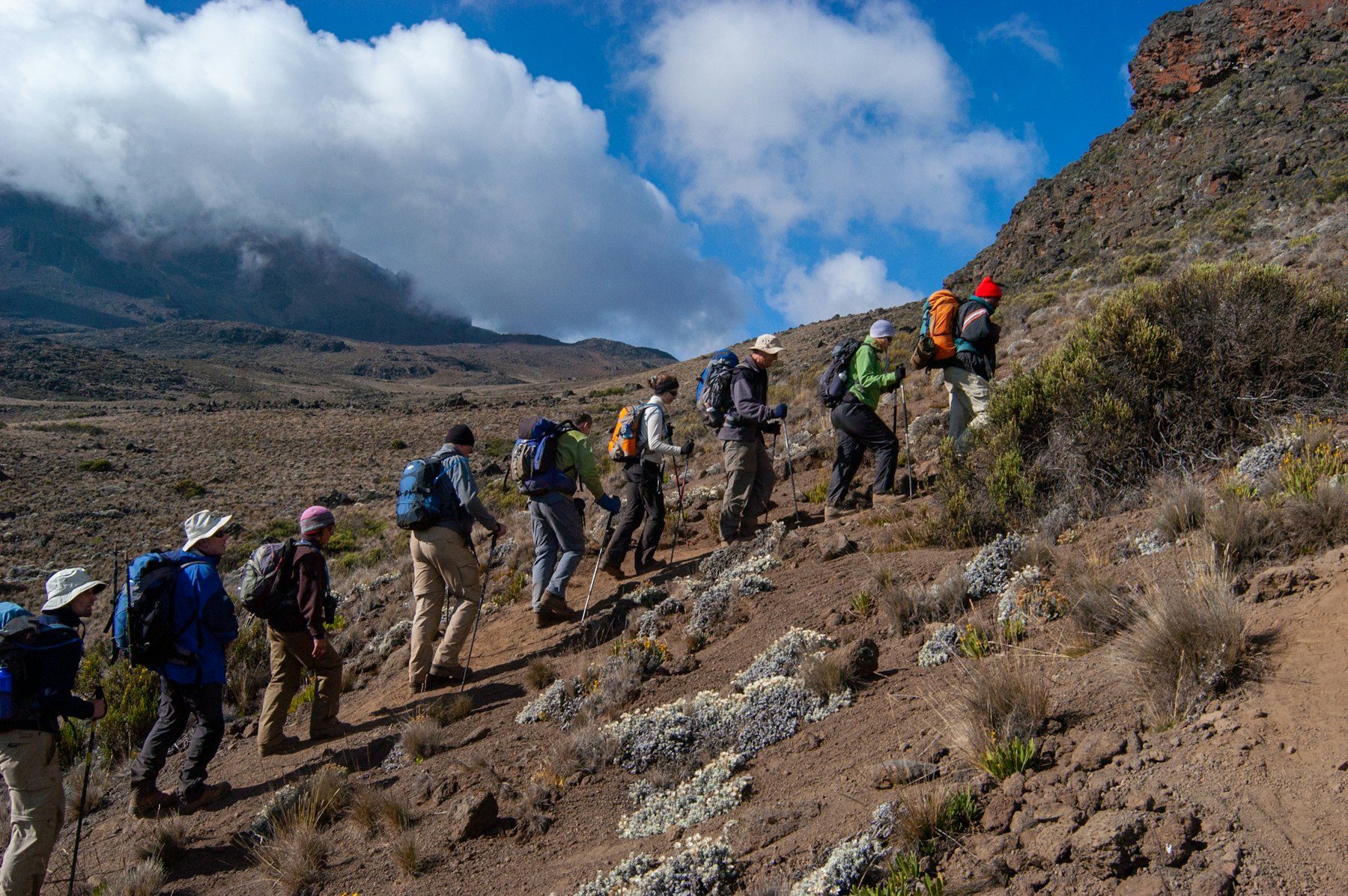
Inscribed 1987. 75,575 hectares. Three main volcanic peaks — Kibo, Mawenzi and Shira — and five vegetation zones stacked one on top of another: lower slopes, montane forest, heath and moorland, alpine desert, summit. You walk up through all five inside a week on most Kilimanjaro climb tours, which is about as close as the planet gets to letting you travel from the equator to the arctic on foot.
The park was established in 1973 and originally comprised the whole of the mountain above the tree line plus six forest corridors running down through the montane belt. That forest is the part almost nobody photographs, and the part UNESCO singles out as very rich in species, many of them endangered.
Now the warning, and it belongs on the best entry rather than the worst. The variable that decides whether you stand on the summit is nights, not fitness. Ask whoever is quoting Kilimanjaro climb tours exactly how many nights you sleep on the mountain before summit night, and treat a short answer as a red flag. That is a question an operator can answer precisely; it is not a number we would ever assert on their behalf.
Best for: Anyone who wants the altitude and will pay for the extra night that budget Kilimanjaro climb tours quietly shave off.
Go when: The long dry months, roughly late June into October, or the shorter window in January and February — our judgment on weather odds, not a UNESCO finding.
2. Ngorongoro Conservation Area
Inscribed 1979, and at 809,440 hectares it is the property whose scale almost nobody grasps before arriving. UNESCO describes highland plains, savanna, savanna woodlands and forest running from the Serengeti plains in the north-west down to the eastern arm of the Great Rift Valley. It was established in 1959 as a multiple land use area, with wildlife coexisting with semi-nomadic Maasai pastoralists practising traditional livestock grazing.
Inside it sit the Ngorongoro Crater, the world’s largest caldera, and Olduvai Gorge, a 14km ravine. The area has been under archaeological research for over eighty years and has yielded a sequence of evidence for human evolution spanning almost four million years — including the fossilised footprints at Laetoli, associated with the development of human bipedalism, and hominin species from Australopiths through Homo habilis and Homo erectus to us.
Best for: The traveller who wants one day that reframes the entire trip, and the obvious first addition to Kilimanjaro climb tours.
Go when: Straight off the mountain, while you are still acclimatised to altitude and to five o’clock starts — our sequencing judgment.
3. Serengeti National Park
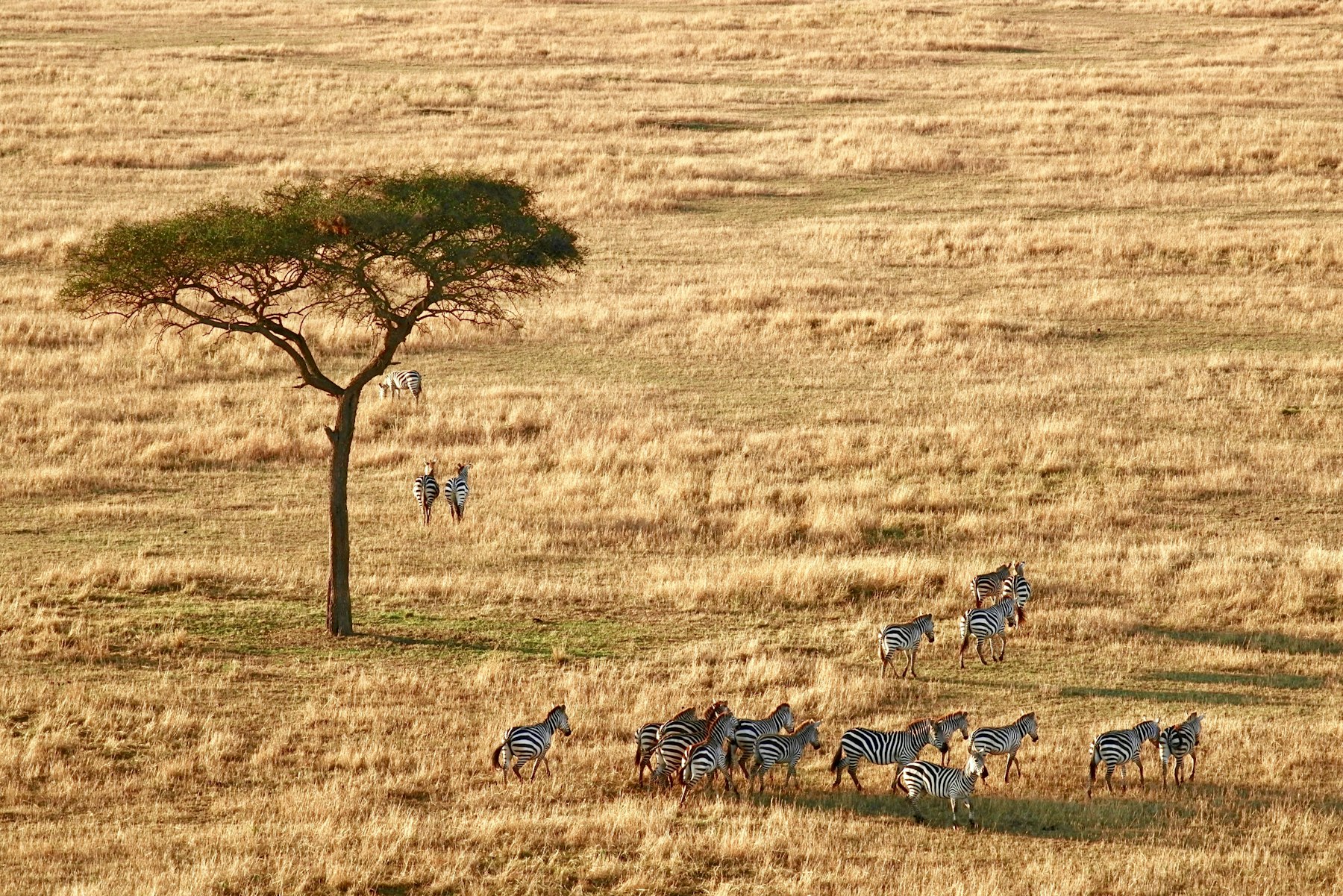
Inscribed 1981. 1,476,300 hectares. The number that matters is not the acreage but the herd: UNESCO records the annual migration of two million wildebeest plus hundreds of thousands of gazelles and zebras, followed by their predators, and calls it the largest remaining unaltered animal migration in the world.
The circuit runs roughly 1,000 kilometres a year across two countries, Tanzania and Kenya, over 25,000 square kilometres of treeless short-grass plains dotted with rocky outcrops. That single fact is the most useful thing a first-time visitor can hold on to. The migration is not in a place. It is in a different place every month, and a camp perfectly positioned in July can be an hour’s flight from the herds in November.
Best for: First-time safari travellers adding a week to their Kilimanjaro climb tours, who should not be talked out of the obvious choice.
Go when: Choose the month first and the camp second — the reverse of how it is usually sold to you. Our judgment, firmly held.
4. Selous Game Reserve
Inscribed 1982 and covering 50,000 square kilometres, Selous is among the largest protected areas in Africa and, in UNESCO’s phrase, relatively undisturbed by human impact. The record lists significant concentrations of elephant, black rhinoceros, cheetah, giraffe, hippopotamus and crocodile across miombo woodland, open grassland, riverine and ground-water forest, and swamp.
It is the entry on this list that feels genuinely empty. You will not share a sighting with nine other vehicles. The trade is comfort and convenience: fewer camps, longer transfers, more boat and walking safari, and far less of the smooth game-drive circuit the northern parks have spent decades perfecting.
Best for: Repeat travellers whose Kilimanjaro climb tours already covered the crater and the plains.
Go when: The drier months, when both the road network and the river channels are workable — our planning judgment rather than a published rule.
5. Stone Town of Zanzibar
Inscribed 2000. Ninety-six hectares, which makes it the smallest property on this list by a wide margin and the only one you can cross on foot in twenty minutes. UNESCO calls it an outstanding example of a Swahili trading town, its urban fabric and townscape virtually intact, built in coralline ragstone and mangrove timber set in thick lime mortar and then plastered and lime-washed.
What the record captures better than any guidebook is why it looks the way it does: a complex fusion of Swahili, Indian, Arab and European influences in building traditions and town planning, brought together and homogenised over more than a millennium into something that belongs to none of them separately.
Best for: The last four nights of long Kilimanjaro climb tours, when your legs are finished and you want a town rather than a landscape.
Go when: After the mountain and after the parks, never before. Our judgment, and it is about morale as much as logistics.
6. Ruins of Kilwa Kisiwani and Songo Mnara
Inscribed 1981, and the one we would genuinely call a discovery. Two island port cities lie close together off the coast about 300km south of Dar es Salaam. The larger, Kilwa Kisiwani, was occupied from the 9th to the 19th century and reached its peak of prosperity in the 13th and 14th. In 1331 to 1332 the traveller Ibn Battuta stopped here and described Kilwa as one of the most beautiful cities of the world.
That prosperity came from control of Indian Ocean trade with Arabia, India and China — gold and ivory out of the interior, traded for silver, carnelians, perfumes, Persian faience and Chinese porcelain. Kilwa minted its own currency from the 11th to the 14th centuries. The Portuguese built a fort on the island in the 16th century, and the decline of both islands began.
Best for: Travellers who would rather have a place to themselves than a photograph everybody recognises.
Go when: Bolt it onto the coastal leg rather than treating it as a separate trip — our judgment on how the logistics actually work.
7. Kondoa Rock-Art Sites
Inscribed 2006. 233,600 hectares on the eastern slopes of the Maasai escarpment above the Great Rift Valley, where overhanging slabs of sedimentary rock, fragmented by rift faults, gave people vertical surfaces to paint on for at least two millennia.
Nobody knows how many there are. UNESCO puts the estimate somewhere between 150 and 450 decorated shelters, caves and overhanging cliff faces, and states plainly that the exact number is not yet known. The paintings carry both hunter-gatherer and pastoralist cultures, and their distinctive streaky style and rare depiction of domesticated animals set them apart from the southern and central African traditions they otherwise resemble.
Best for: The second Tanzania trip, or anyone whose Kilimanjaro climb tours left them tired of wildlife.
Go when: Break the long drive between Arusha and the southern parks with it — our routing judgment.
| Site | Inscribed | Protected area | Why it earns a leg |
|---|---|---|---|
| Kilimanjaro National Park | 1987 | 75,575 ha | Highest mountain in Africa, 5,895 m; five vegetation zones |
| Ngorongoro Conservation Area | 1979 | 809,440 ha | World’s largest caldera; Olduvai Gorge and the Laetoli footprints |
| Serengeti National Park | 1981 | 1,476,300 ha | Two million wildebeest on a 1,000 km annual circuit |
| Selous Game Reserve | 1982 | 5,120,000 ha | 50,000 sq km of largely undisturbed wilderness |
| Stone Town of Zanzibar | 2000 | 96 ha | Swahili trading town, urban fabric virtually intact |
| Kilwa Kisiwani and Songo Mnara | 1981 | not stated in the record we read | Indian Ocean trading cities that minted their own currency |
| Kondoa Rock-Art Sites | 2006 | 233,600 ha | 150 to 450 painted shelters, two millennia of rock art |
Inscription years and protected areas are quoted from the UNESCO World Heritage Centre’s property records. The Kilwa record we read publishes no area figure, so the cell says so rather than showing a blank. The final column is our editorial summary, not UNESCO wording.
How to Build Kilimanjaro Climb Tours Worth the Airfare
Buy nights, not routes
Route names are marketing, and every operator selling Kilimanjaro climb tours has their own. The number of sleeps between the gate and summit night is the thing that changes your odds, and it is the line item operators compress first when they are competing on price. Get it in writing before anything else.
Fly the long legs
Tanzania is enormous and the properties are scattered across it. Selous is 50,000 square kilometres on its own and Kilwa sits 300km down the coast from Dar es Salaam. Driving all of it turns ambitious Kilimanjaro climb tours into a bus tour; light aircraft turn three separate holidays into one.
Put the coast last
Ninety-six hectares of Stone Town after nine days at altitude is the correct order and everybody who does it the other way regrets it. This is a judgment about stamina, not about weather.
Have us build the whole route, not just the climb
Frequently Asked Questions
How long do Kilimanjaro climb tours take?
Kilimanjaro climb tours sell the mountain in packages of roughly five to nine days on the hill, plus arrival and departure nights below it. We will not quote you a figure, because the honest answer is that it depends entirely on the route and the acclimatisation schedule your operator chooses. Ask them for the night count in writing.
Do you need to be fit to climb Kilimanjaro?
You need to be a competent long-distance walker, not an athlete. Kilimanjaro is a walk, not a technical climb. The hard part is 5,895 metres of altitude, which is a physiological problem that time solves and training does not. That is our view as planners, not medical advice.
Can you combine Kilimanjaro climb tours with a safari?
Yes, and this article argues you should. Ngorongoro and the Serengeti sit within reach of the same arrival airport as the mountain, and both are UNESCO World Heritage properties in their own right. Coming off the mountain already acclimatised to early starts makes the safari half markedly easier.
What is the best month to climb Kilimanjaro?
Our judgment, based on how we schedule clients rather than on any published ruling: the long dry stretch from late June into October gives the most reliable conditions, with a shorter window in January and February. Neither is a guarantee, and neither is a UNESCO finding.
How many UNESCO World Heritage sites does Tanzania have?
Seven. Kilimanjaro National Park, Ngorongoro Conservation Area, Serengeti National Park, Selous Game Reserve, Stone Town of Zanzibar, the Ruins of Kilwa Kisiwani and Songo Mnara, and the Kondoa Rock-Art Sites. They were inscribed between 1979 and 2006 and no two of them are remotely alike.
Is Zanzibar worth adding to a Kilimanjaro trip?
Stone Town is a World Heritage property of ninety-six hectares that you can walk across in twenty minutes, and it is the most humane place we know to end a hard trip. Add it at the end, not the beginning. We would give it four nights.
The Dorian Destinations Verdict
Book the mountain, then keep going. The single thing we most often talk clients out of is the tidy, cheap, climb-only version of Kilimanjaro climb tours — and we say that knowing full well that it is the easiest product on our shelf to sell and the fastest to price. A reader who adds Ngorongoro and Zanzibar to the front and back of a climb spends more with us and gets a better trip; a reader who books the bare mountain spends less and comes home having seen one seventh of what the flight paid for.
And the harder position, which costs us the climb booking outright: if what you actually want is Africa rather than altitude, skip the summit. Put those nine days into Ngorongoro, the Serengeti and Selous instead. Most people who tell us they want to climb Kilimanjaro want to have climbed Kilimanjaro, which is a different thing, and it is worth being honest with yourself about which one you are before you pay a deposit. If that sounds like you, our first-timer’s guide to luxury safari lodges is the better starting point.
If you do climb, and we hope you do, treat the summit as the first chapter. The best version of this trip that we build looks nothing like the Kilimanjaro climb tours on sale elsewhere. It looks like a mountain, a crater, a plain and a coral-stone town, in that order, over three weeks — and it is closer in spirit to our Patagonia trekking piece than to anything sold as a tour.
Talk to a Dorian travel specialist
Sources: UNESCO World Heritage Centre — United Republic of Tanzania, Kilimanjaro National Park, Ngorongoro Conservation Area, Serengeti National Park, Selous Game Reserve, Stone Town of Zanzibar, Ruins of Kilwa Kisiwani and Ruins of Songo Mnara and Kondoa Rock-Art Sites, all read September 24, 2026. UNESCO descriptive text is used under CC-BY-SA IGO 3.0 and quoted rather than reproduced. Photography via Unsplash.
Adventure Travel · Tanzania · Africa · National Parks