

The Perfect Itinerary
How Dorian Would Do It
Switzerland by Train: Ride the Timetable, Not the Panoramas

Co-Founder & Travel Advisor, Dorian Destinations · Published October 13, 2026 · ET
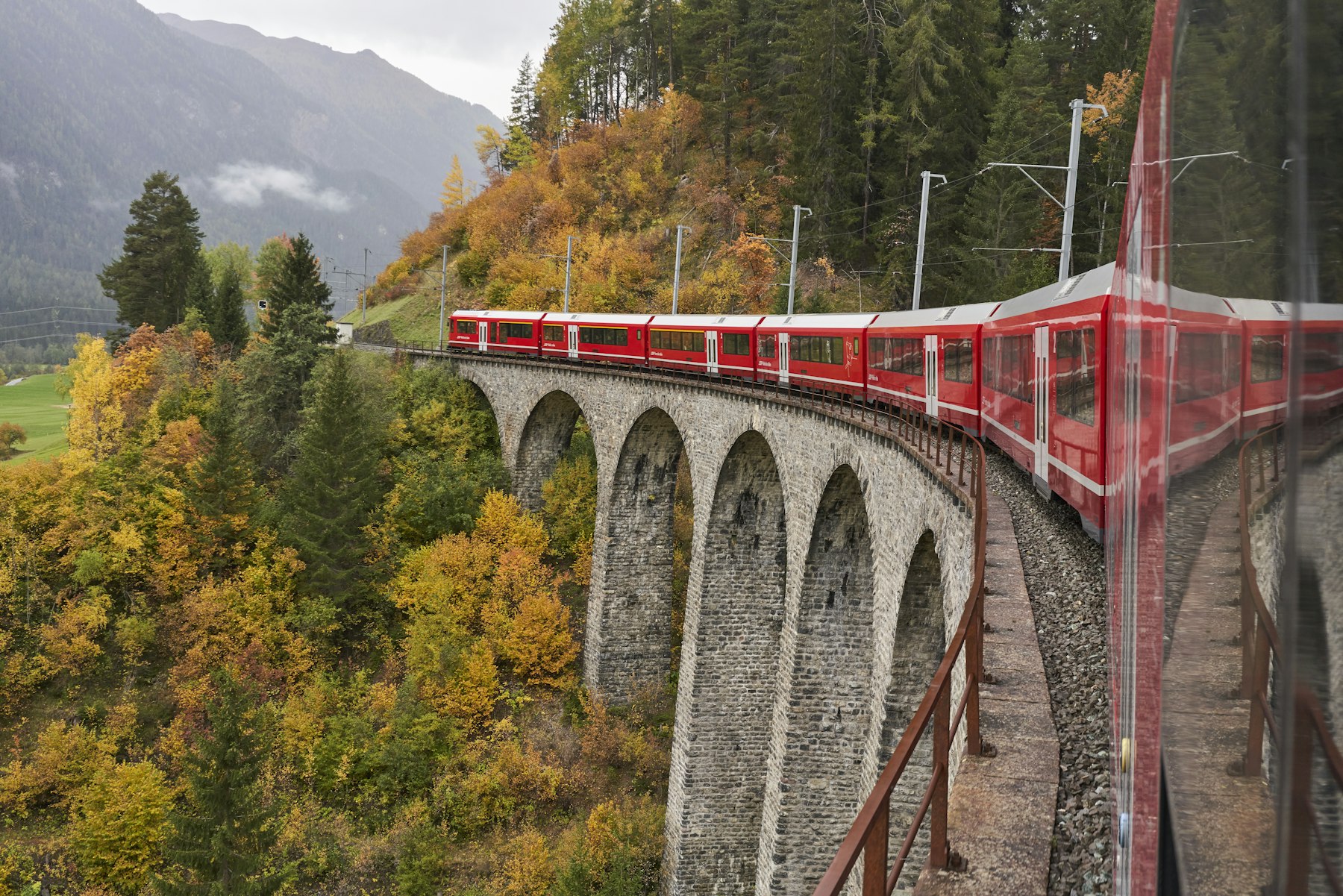
Plan Switzerland by train around the timetable, not the trophy trains →
Switzerland by train is the easiest trip in Europe to book and one of the easiest to book badly. The country markets four famous trains. The network runs several hundred ordinary ones, on the same rails, through the same gorges, and for most travellers they are the better ride.
Every few weeks a client forwards us a Swiss plan that turns out to be a list of seat reservations with a country arranged around it. Day three is a panoramic train. Day five is another one. The hotels sit near the stations those trains leave from, and the days in between have quietly become transfers. It is an expensive way to see a place through sealed glass.
Every property figure below — inscription year, criteria, hectares — comes from the UNESCO World Heritage Centre’s record for Switzerland, which lists thirteen inscribed properties. The operating detail on the two lines that are themselves inscribed comes from the Rhaetian Railway’s own pages, because the operator is the only honest source for how its trains are booked.
What we have not done is quote a fare or a departure time. Swiss timetables shift twice a year and prices move with the season, so anything printed here would be wrong by spring. Where this piece gives a night count or a seasonal call, that is our planning judgment from building these trips, and it is labelled as such rather than dressed up as data.
The organising idea is ours too, and it is worth stating plainly. We have sorted the country by two things nobody puts side by side: what the World Heritage register actually inscribed, and what the scheduled network actually reaches. That is an editorial choice, not a ranking, and a different axis would produce a different route.
The property is exemplary of the use of the railway to overcome the isolation of settlements in the Central Alps early in the 20th century, with a major and lasting socio-economic impact on life in the mountains.
— UNESCO World Heritage Centre, on the Rhaetian Railway in the Albula / Bernina Landscapes
What Switzerland by train actually buys you
Read that again: it is the whole argument. UNESCO did not inscribe the Albula and Bernina lines as a scenic attraction. It inscribed them as infrastructure — the thing that ended the isolation of mountain settlements and changed how people lived there. The lines are still doing that job. They still carry the people who live along them, and they will carry you for the price of an ordinary ticket.
The panoramic trains run on top of that. The Rhaetian Railway is clear about the difference on its own site: the regional trains, it says, operate on the same line as the Bernina Express but offer a more frequent service throughout the day, in regular coaches whose windows can be opened. The Bernina Express needs a valid ticket plus a mandatory, chargeable seat reservation; a seat on the regional train can be reserved voluntarily on the St Moritz to Tirano stretch for five francs.
So the trade is not comfort against discomfort. It is a fixed seat on a sealed train once a day, against an openable window and a service you can step off whenever the valley looks interesting. Planning Switzerland by train around the second of those is what the rest of this piece does.
The route · In travel order, west to east then south · Tap a stop
- Lausanne · the Lavaux terraces · 2 nights
- Bern · the old city on the Aare · 2 nights
- Lauterbrunnen · the Jungfrau wall · 3 nights
- Chur · the Sardona arena · 1 night
- The Albula line · Thusis to St Moritz · 2 nights
- The Bernina line · St Moritz to Tirano · 1 night
- Bellinzona · the Ticino end · 2 nights
Thirteen nights. The shape is the point: this is not one long climb but four separate ones, each out of a valley floor you come back down to, because the valley floors are where the connections are.
1. Lausanne and the Lavaux terraces
Start at the lake, the lowest point of the route. Arriving into Geneva and heading straight for the mountains is how people miss what sits five minutes from the platform. UNESCO inscribed the Lavaux vineyard terraces in 2007 — 898 hectares of them, with a buffer zone of 1,408 — and they run for about thirty kilometres along the south-facing northern shore of Lake Geneva, from the Chateau de Chillon to the eastern edge of Lausanne.
The record traces the present terraces to the eleventh century, when Benedictine and Cistercian monasteries controlled the ground, and calls them an outstanding example of a centuries-long interaction between people and their environment. The local trains along that shore stop at villages inside the inscribed area. You can get off at one, walk down through the vines to the next station, and get on again. No reservation exists for any of it.
Best for: arriving slowly, and for anyone who thinks a Switzerland by train trip has to begin at altitude.
Go when: September and early October on a Switzerland by train route, when the terraces are being picked — our call, not a published season.
2. Bern, the old city on the Aare
Bern was inscribed in 1983 on a single criterion, and the property is small: 91.86 hectares. UNESCO’s description is unusually direct about why. The city was founded in the twelfth century on a hill inside a loop of the Aare and then developed, over centuries, according to what the record calls an exceptionally coherent planning concept — fifteenth-century arcades, sixteenth-century fountains, a medieval town largely restored in the eighteenth century that nonetheless kept its original character.
What that means on the ground is a centre you can cross under cover, which makes it the one Swiss city that works as well in rain as in sun. It is also the right junction for this route: the lines west to the lake and east toward the Oberland both run through it, which is why it earns two nights rather than a change of trains.
Best for: a weather day, and for the one city stop on a Switzerland by train route that never feels like a compromise.
Go when: any season on a Switzerland by train route — the arcades are the point, and they are indifferent to the weather.
3. Lauterbrunnen and the Jungfrau-Aletsch wall
This is the one leg where the famous thing is genuinely the thing. Swiss Alps Jungfrau-Aletsch was inscribed in 2001 and significantly enlarged in 2007, taking it from 53,900 hectares to 82,400, and it holds three criteria at once — beauty, geology and ecology. UNESCO calls it the most glaciated part of the range and home to the largest glacier in Eurasia, and notes that glacial retreat has left the site showing successional stages of plant life.
Three nights, not two, and base in the valley rather than on the shoulder above it. The cog railways up from Lauterbrunnen are the costliest rails you will buy on this trip, in our experience, and worth exactly one day of the three. Spend the other two on the valley line and the footpaths, which cost nothing beyond an ordinary fare and put you under the wall rather than on top of it.
Best for: the one leg of a Switzerland by train route where you should let the scenery lead.
Go when: late June to September, once the high paths are reliably open — our judgment, not a timetable.
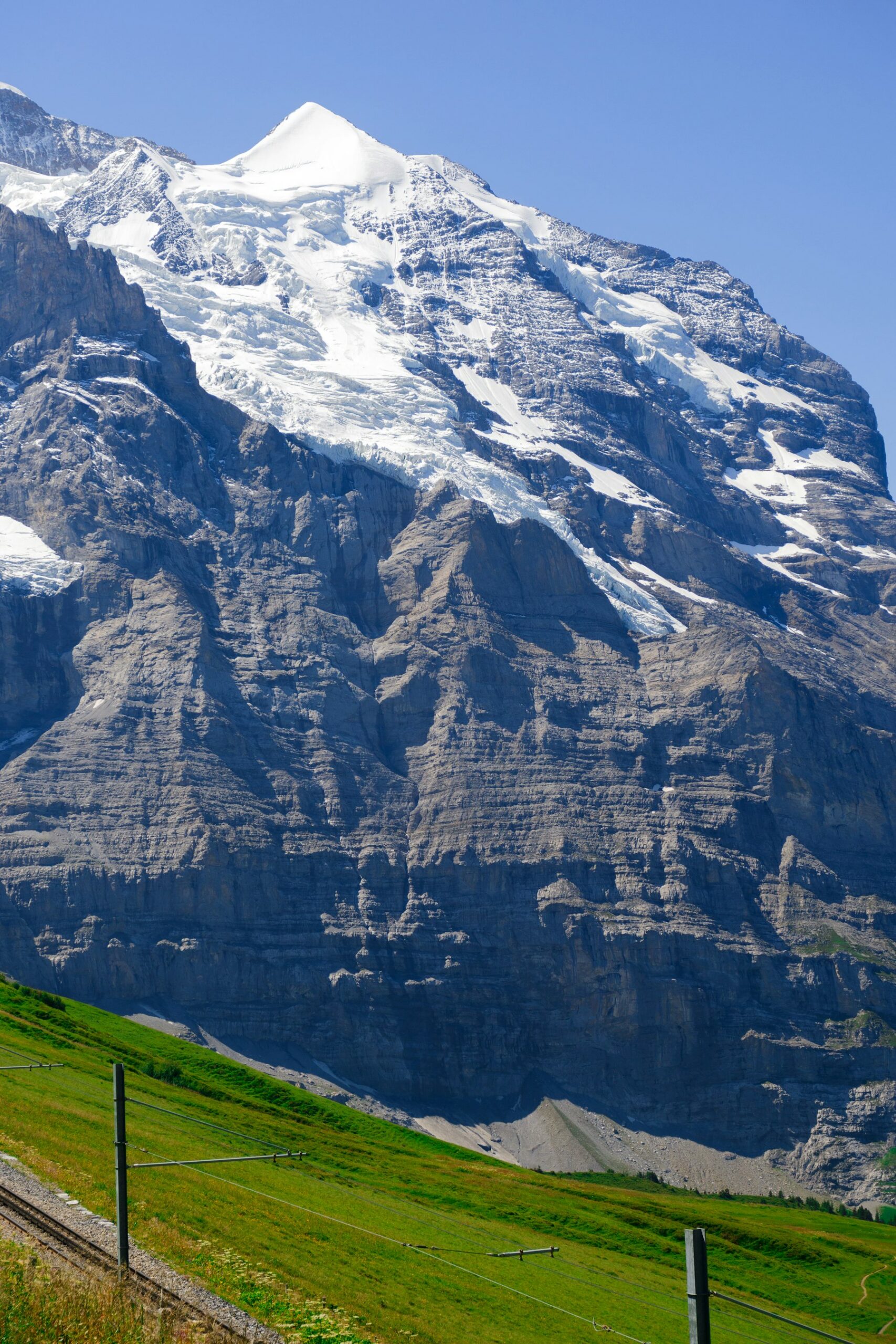
4. Chur: the hinge of any Switzerland by train route
Chur is where most itineraries change trains and almost nobody sleeps. Give it one night and it stops being a corridor. It is the gateway to the Swiss Tectonic Arena Sardona, inscribed in 2008 on the geology criterion alone: 32,850 hectares, seven peaks above 3,000 metres, and what UNESCO describes as an exceptional example of mountain building through continental collision.
The reason geologists have come here since the eighteenth century is visible from a train window. The record describes excellent sections through tectonic thrust — the process by which older, deeper rocks are carried up and over younger, shallower ones — exposed clearly in three dimensions. There is a visible line across those mountainsides where the old rock sits on top of the young.
Best for: breaking the longest transfer on a Switzerland by train route into something worth stopping for.
Go when: any shoulder month in a Switzerland by train year; this is a low-altitude town and it stays open.
5. The Albula line, Thusis to St Moritz
Here is the number that reframes the whole country. The Rhaetian Railway in the Albula / Bernina Landscapes was inscribed in 2008 under criteria two and four, and the property itself measures 152.42 hectares. The buffer zone around it measures 109,385.9. The inscribed thing is a ribbon — the railway, its tunnels, its bridges, its stations — and everything you see from the window is the setting granted to protect it.
The Albula half opened in 1904 and runs 67 kilometres. Into that distance it fits 42 tunnels and covered galleries and 144 viaducts and bridges, which by our arithmetic is a major structure roughly every 360 metres. The Rhaetian Railway notes that it was built as a classic mountain railway for steam, with its route layout and its structures made of local stone, and that those remain among the finest examples of historic railway construction anywhere.
Two nights, and here is where the argument of this piece earns its keep. Base at Bergun or Filisur rather than running straight through to St Moritz. The ordinary regional service stops at both. The panoramic train does not stop at either in any way that lets you sleep there, which means the two villages built by and for this railway — the ones UNESCO is describing when it talks about ending the isolation of mountain settlements — are invisible from the train most visitors book.
This is the clearest case on the route for doing Switzerland by train on the scheduled service. Walk a section of the line between them on the footpath that follows it, and then ride the same section. You will have understood more of Switzerland in a day than a week of panoramas would give you.
Best for: the single best two days available anywhere on a Switzerland by train route.
Go when: late September for autumn colour on the viaducts, or February for snow — our call, from building Switzerland by train both ways.
6. The Bernina line, St Moritz to Tirano
The second inscribed half is 61 kilometres, with 13 tunnels and galleries and 52 viaducts and bridges, and it is the one that climbs. Its operator calls it the highest transalpine railway route and one of the steepest adhesion railways in the world — no rack, no cable, just wheels gripping rail over the pass and down the far side into Italian-speaking Valposchiavo and, finally, into Italy at Tirano.
One night, in Poschiavo rather than at the top. This is where the booking choice is sharpest: the Bernina Express requires a ticket plus a mandatory paid reservation, while a seat on the regional train over exactly the same rails can be reserved for five francs if you want one at all. The regional coaches have windows that open. At the pass, that is not a small thing.
Best for: the highest ground on a Switzerland by train route, taken on a service that still stops for the people who live there.
Go when: June to October for the open window on a Switzerland by train leg; the line runs year-round.
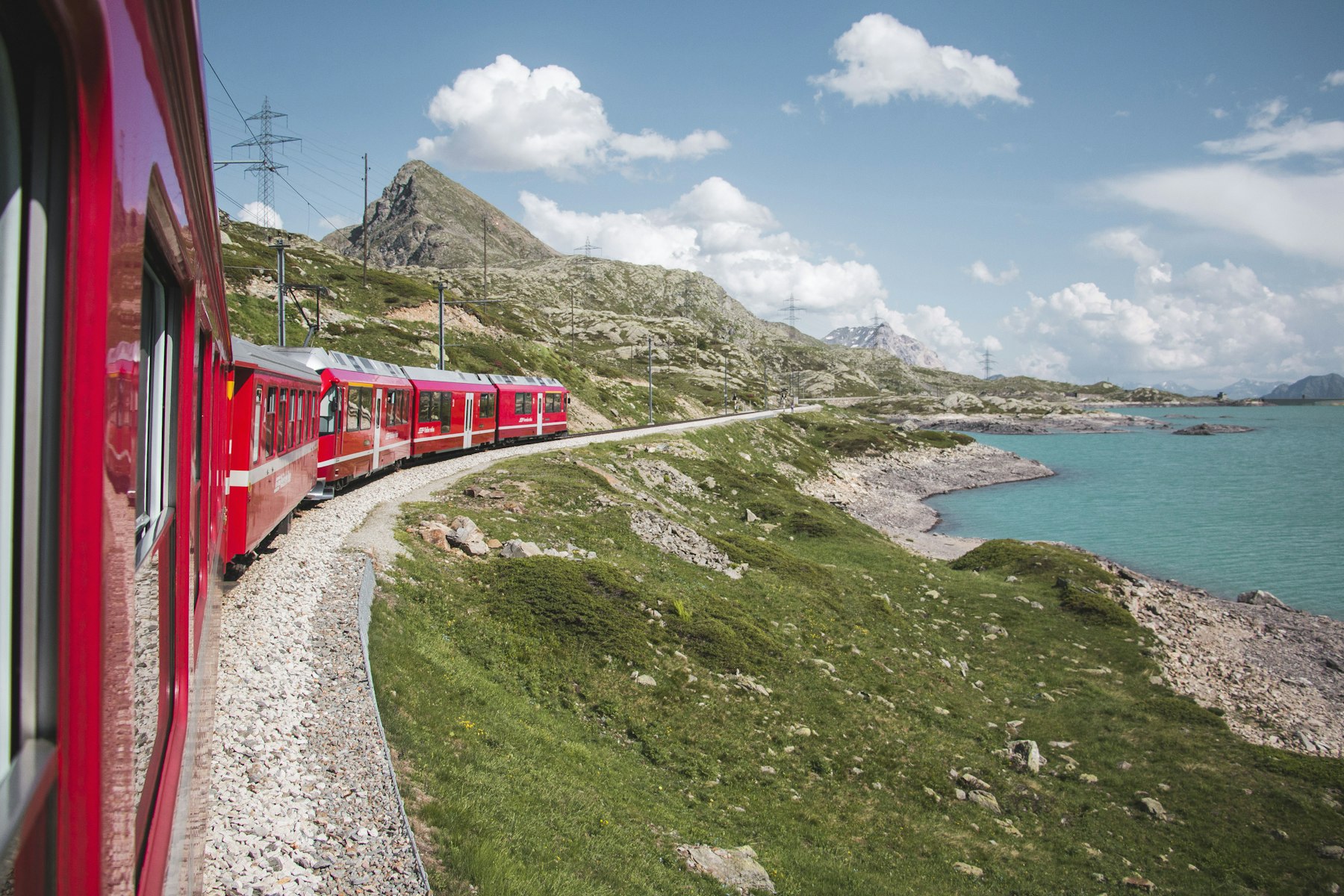
7. Bellinzona and the Ticino end
Switzerland does not stop at the Alps; it falls off the back of them into palm trees and Italian. Bellinzona was inscribed in 2000, with a minor boundary change in 2023, and the property is tiny at 14.698 hectares — three castles and the walls between them. UNESCO describes Castelgrande standing on a rocky peak over the whole Ticino valley, with fortified walls running from it to block the passage through that valley, Montebello forming an integral part of the system, and Sasso Corbaro built separately on an isolated promontory to the south-east.
Forty minutes away is Monte San Giorgio, inscribed in 2003 on the geology criterion: 1,089.34 hectares that UNESCO calls the best fossil record of marine life from the Triassic, 245 to 230 million years ago, laid down in a tropical lagoon sheltered from the open sea by a reef. Two nights. One warning, ours rather than any timetable: from Tirano you are in Italy, and the tidy way to reach Ticino is to treat it as its own run down the Gotthard rather than assume a neat link across the bottom of the map.
Best for: ending a Switzerland by train route somewhere that looks nothing like the brochure.
Go when: April to June, before the Italian lakes fill up — our judgment on where Switzerland by train should end.
More from Dorian Destinations
European River Cruise: Choose the River Before the Ship — the same argument on water: pick the corridor first, and the vessel stops being the decision.
The rest of the register: what else Switzerland by train can reach
Thirteen properties are inscribed in Switzerland. This Switzerland by train route touches seven of them, which is a deliberate limit rather than an accident — the remaining six sit on different lines and would turn a coherent fortnight into a scavenger hunt. The table is here so you can see what you are leaving, and decide for yourself whether to trade a leg for it.
| Property | Inscribed | Size, per UNESCO | On this route? |
|---|---|---|---|
| Rhaetian Railway, Albula / Bernina | 2008 | 152.42 ha, buffer 109,385.9 ha | Legs 5 and 6 |
| Swiss Alps Jungfrau-Aletsch | 2001, enlarged 2007 | 82,400 ha | Leg 3 |
| Lavaux, Vineyard Terraces | 2007 | 898 ha | Leg 1 |
| Old City of Berne | 1983 | 91.86 ha | Leg 2 |
| Swiss Tectonic Arena Sardona | 2008 | 32,850 ha | Leg 4 |
| Three Castles of Bellinzona | 2000 | 14.698 ha | Leg 7 |
| Monte San Giorgio | 2003 | 1,089.34 ha | Leg 7, as a day |
| Benedictine Convent of St John, Mustair | 1983 | 2.036 ha | No — a road link from the Engadine |
Inscription years and areas are UNESCO’s published figures. The final column is our routing judgment, not a UNESCO classification, and a property being off this route says nothing about its interest.
Making Switzerland by train work in practice
Book the beds before you book any seat
Bergun, Filisur and Poschiavo are small villages with small inventories, and they are the three places this route depends on. Settle those nights first and the whole Switzerland by train booking arranges itself around them. Do it the other way round and you will find yourself sleeping in St Moritz and commuting to the thing you came for.
Treat a reservation as the exception
On the stretch between St Moritz and Tirano the Rhaetian Railway offers a voluntary seat reservation on regional trains at five francs a person per leg, and says it recommends one because demand is high. That is the one place on this route we would take it. Elsewhere, turning up is the method.
Give each high leg a spare day
Legs 3, 5 and 6 are the ones a weather front can flatten. Our habit is to build a Switzerland by train itinerary so that each of them has somewhere to put a lost morning — which is why Lauterbrunnen gets three nights and the Albula gets two. It is judgment rather than a rule, but it has saved more trips than any other habit we have.
Have us build the fortnight before you book a single seat →
Frequently Asked Questions
Is Switzerland worth doing by train rather than by car?
For this route, yes. Two of the seven legs on a Switzerland by train plan are inscribed railways, so the train is the attraction rather than the transport. The valley roads are slower than the rails in winter, and parking in Bern, Lauterbrunnen and Bellinzona ranges from awkward to pointless.
How many days do you need for Switzerland by train?
Thirteen nights covers the seven legs of this Switzerland by train route without rushing any of them. Ten is the realistic floor: drop Chur and Ticino and you still get the lake, the city, the wall and both inscribed lines. Under a week, pick one half of the country and do it properly rather than crossing the whole thing.
Do you have to book the Bernina Express in advance?
Yes. The Rhaetian Railway states that travelling in the Bernina Express panoramic car needs two things, a valid ticket and a mandatory seat reservation that costs extra, and that seats are often fully booked well ahead. The regional trains over the same line carry no such requirement, which is why most of our Switzerland by train plans skip it.
Is the Bernina Express better than the regular train?
It is different, not better. You get a panoramic car with windows curving to the roof, on-board service and a guaranteed seat. You give up frequency, the ability to get off where you like, and windows that open. The operator itself describes the regional trains as running the same line more often, and on a Switzerland by train itinerary that frequency is worth more than the glass.
What is the best time of year for Switzerland by train?
Late June to early October is the widest window, because the high footpaths are open and the Bernina rewards an open window. Late September adds autumn colour on the Albula viaducts. February works if snow is the point. These are our seasonal calls, not published advice.
The Dorian Destinations Verdict
Skip the panoramic trains. All of them. Bluntly, the arithmetic is not close: the supplement and the reservation on one famous crossing costs roughly what two nights in Bergun or Filisur cost, and those two nights are the part of this trip people still talk about a year later.
The reason sits in UNESCO’s own wording. The Albula and Bernina lines were not inscribed for being beautiful to ride. They were inscribed for ending the isolation of the settlements along them, and for the socio-economic consequences that followed. A train you cannot get off is a train that cannot show you any of that. The ribbon is 152.42 hectares; the buffer zone around it is more than a hundred thousand. You are meant to be in the buffer zone.
So build Switzerland by train the way you would build a walking trip: fix the beds in the small places first, let the timetable fill in around them, and keep a day spare where the weather can take one. We have argued the same thing about a four-day walk in New Zealand and about which river to choose before which ship, and it holds here too. The fixed points are never the transport.
Talk to a Dorian Destinations advisor about Switzerland →
Sources: UNESCO World Heritage Centre, Switzerland; Rhaetian Railway in the Albula / Bernina Landscapes; Swiss Alps Jungfrau-Aletsch; Lavaux, Vineyard Terraces; Old City of Berne; Swiss Tectonic Arena Sardona; Three Castles of Bellinzona; Monte San Giorgio; Convent of St John at Mustair; Rhaetian Railway, UNESCO railway lines; Rhaetian Railway, Bernina Express and regional trains compared. Related reading: Best Places to Visit in Europe, Spain and Portugal Itinerary and Peru Itinerary.
Itineraries · Switzerland · Europe · Luxury Rail