

The Perfect Itinerary
How Dorian Would Do It
Peru Itinerary: Climb Slowly and Leave Cusco Until Last

Co-Founder & Travel Advisor, Dorian Destinations · Published September 29, 2026 · ET
Plan a trip that climbs in the right order →
Almost every Peru itinerary we are asked to fix has the same fault, and it has nothing to do with which sights are on it. It is the order.
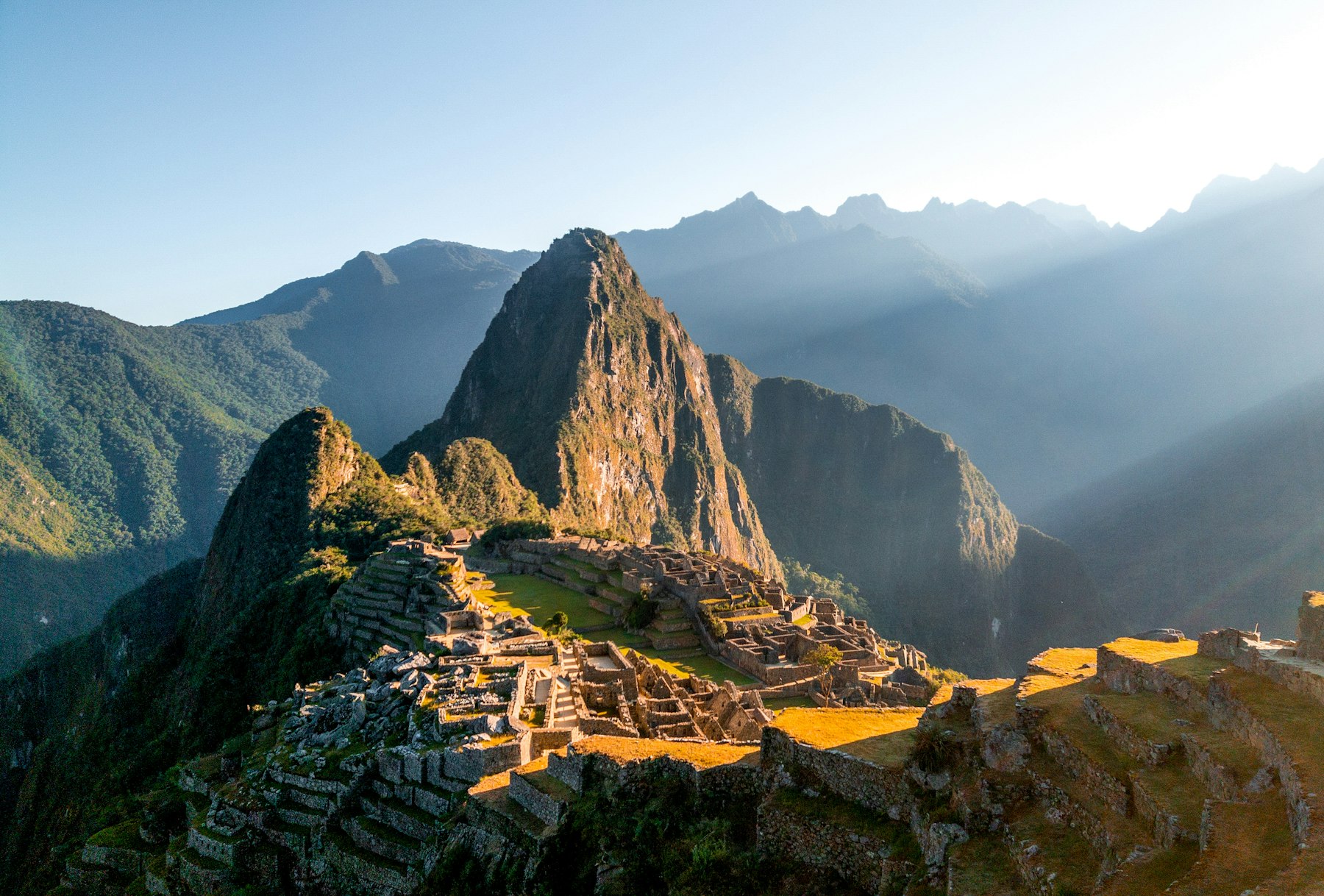
Here is the thing people book without noticing. UNESCO’s record for the City of Cuzco places the city at 3,400 metres above sea level. The record for the Historic Sanctuary of Machu Picchu places its Citadel at more than 2,400. So the ruin that everybody treats as the thin-air, hard-breathing summit of the trip actually sits around a kilometre below the city where most travellers spend their first two nights straight off an overnight flight.
That single inversion is why so many people remember the first days of a Peru itinerary as a headache in a nice hotel room. It is also the easiest thing in the world to fix, and fixing it costs nothing but sequence.
Where this comes from. Every factual claim below – inscription years, areas, altitudes and quoted descriptions – comes from the UNESCO World Heritage Centre’s property records for Peru, linked at the foot of this page. UNESCO’s descriptive prose is published under CC-BY-SA IGO 3.0, so where we use its words we have put them in quotation marks and said so.
What is not sourced is the shape of the Peru itinerary. The night counts, the running order and the month attached to each stop are our judgment as advisors, and we have labelled them as judgment everywhere they appear. UNESCO publishes no itineraries and no calendars. It tells you what a place is and how high it sits; what to do with that is our job, and you are entitled to know which half is which.
And the limits. We are travel advisors, not a mountain medicine service and not a rail operator. We hold no permits on the Inca Trail, no allocation on the Machu Picchu buses and no beds in Aguas Calientes that we do not buy like anyone else. Nothing in this Peru itinerary is medical advice about altitude.
Embedded within a dramatic landscape at the meeting point between the Peruvian Andes and the Amazon Basin, the Historic Sanctuary of Machu Picchu is among the greatest artistic, architectural and land use achievements anywhere and the most significant tangible legacy of the Inca civilization.
— UNESCO World Heritage Centre
Why This Peru Itinerary Runs the Other Way
The standard Peru itinerary goes Lima, then straight up to Cusco, then out to the Sacred Valley once you have recovered, then Machu Picchu, then home. It is not a stupid route. Cusco is the hub – UNESCO notes that the four main routes of the Inca road network all “originate from the central square of Cusco” – so every operator’s logistics point there first, and the flights are cheap and frequent.
The problem is that it asks your body to do the hardest thing on day two, before you have any reason to be there. You spend your best days flat and feel human again just in time to be bussed to the thing you came for.
So we run the Peru itinerary as a ladder instead. Sea level, then desert, then a mid-altitude colonial city, then a valley, then the Citadel, and only then Cusco. You arrive at the highest point of the trip on night ten rather than night two, having spent a week earning it. Everything else – the food, the ruins, the drive over the altiplano – is the same. The order is the whole intervention.
The Route · Coast to Andes, in travel order · Tap a stop
- Lima — 2 nights, at sea level
- Nasca and Palpa — 1 night, on the desert coast
- Arequipa — 3 nights, plus the Colca day trip
- The Sacred Valley — 3 nights, below Cusco
- Machu Picchu — 1 night, at the foot of the Citadel
- Cusco — 2 nights, at 3,400 m, last
Twelve nights. The dip at stop five is real: Machu Picchu is the lower of the two, by UNESCO’s own records.
1. Lima: Two Nights at Sea Level
Lima gets treated as an airport with restaurants attached, and two nights is the smallest worthwhile correction. UNESCO inscribed the Historic Centre in 1988 - 277.99 hectares of it - and its record calls the city the "Ciudad de los Reyes", founded by Francisco Pizarro in January 1535 in the Rimac valley. For two centuries this was, in the record's phrasing, "the political, administrative, religious and economic capital of the Viceroyalty of Peru".
What arrived with that was a building programme nowhere else on the continent matched: churches and convents "of great extension and sophistication", hospitals, schools, and San Marcos University, built in 1551. Walk the centre in the morning, eat through Barranco and Miraflores in the evening.
The practical reason to stay, though, is that these are the only two nights of the whole Peru itinerary where altitude is simply not a variable. Sleep badly, eat too much, get over the flight. You will not have that luxury again for ten days.
Best for: eating, and the only nights of the Peru itinerary where your body is asked for nothing.
Go when: any month - our judgment is that Lima's grey coastal season matters so little across two nights that you should let the rest of your Peru itinerary choose the dates.
2. Nasca and Palpa: One Night in the Desert
South from Lima the land turns to sand and stays that way. The Lines and Geoglyphs of Nasca and Palpa were inscribed in 1994 and cover, by UNESCO's figure, 75,358.47 hectares of the Rio Grande de Nasca basin - "some 400 km south of Lima", in a plain the record describes as arid coastal.
The scale is the point, and the numbers beat the mythology. For "nearly 2,000 uninterrupted years", between roughly the 8th century BC and the 8th century AD, people drew "thousands of large scale zoomorphic and anthropomorphic figures and lines or sweeps with outstanding geometric precision" onto the desert floor. UNESCO calls them "the most outstanding group of geoglyphs anywhere in the world".
Most people see them from a light aircraft, and that is a question to put to whoever is selling you that leg of your Peru itinerary: ask what aircraft they operate, the pilot's hours, and their cancellation policy in poor visibility. Those are things an operator can answer precisely. They are not numbers we would ever assert on their behalf.
Best for: the one stop on this Peru itinerary that is about scale rather than stonework.
Go when: first thing in the morning, and - this is judgment - early in the trip, while you are still low and sleeping well.
3. Arequipa: Three Nights Below the Volcanoes
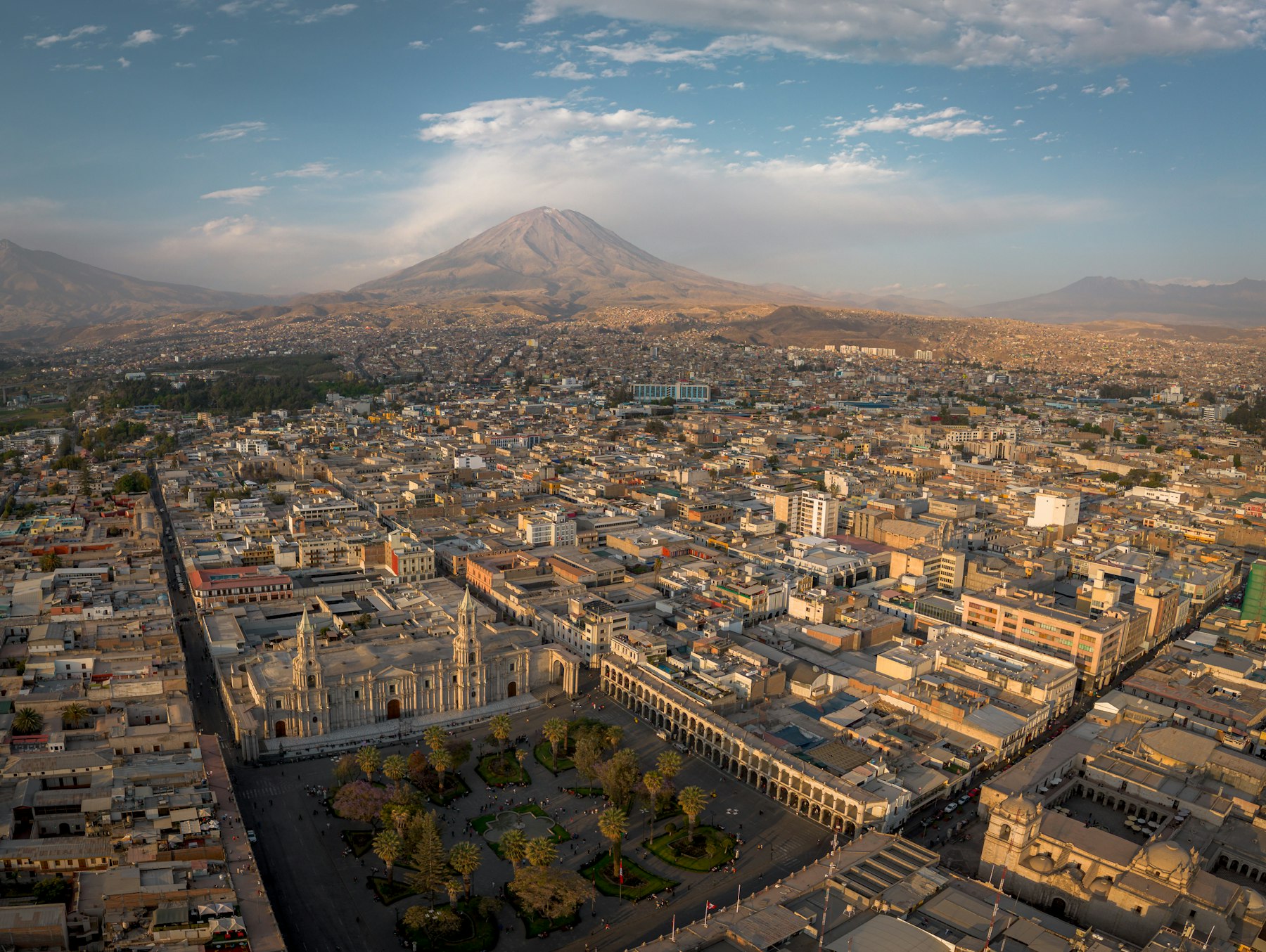
This is the leg people cut from a Peru itinerary, and it is the one that makes the rest of it work. Arequipa's historical centre was inscribed in 2000, 166.52 hectares, and UNESCO places it "at the foot of three snow-covered volcanoes". The city is built largely from sillar, a white or pink volcanic rock, which is why it photographs like nowhere else in the country.
The record is unusually good on why it looks the way it does: an "integrated response of native hands and building techniques" to European design, worked out on ground that keeps moving. Robust walls, archways, porticos, vaults and courtyards are earthquake answers first and Baroque flourishes second. The inscribed area covers 49 original blocks of the 1540 Spanish layout, plus 24 later ones.
One honest caveat: UNESCO's record does not state Arequipa's elevation, so we will not quote one. What matters for this Peru itinerary is only the relative position - well above the coast, well below Cusco. Three nights here, with the Colca day trip on the middle one, is our judgment about the cheapest possible insurance against losing days later.
Best for: acclimatising without it feeling like acclimatisation.
Go when: our judgment is the drier months of the southern winter, when the Colca drive is most reliable - ask whoever is quoting your Peru itinerary what they actually ran last season.
4. The Sacred Valley: Three Nights on the Inca Road
From Arequipa you cross to the valley, and you do not stop in Cusco on the way. That is the discipline the whole Peru itinerary rests on, and the instruction clients push back on hardest.
The valley is where the Inca road system is at its most legible. Qhapaq Ñan, inscribed in 2014, is an "extensive Inca communication, trade and defence network of roads and associated structures covering more than 30,000 kilometres", at its widest extent in the fifteenth century. The inscribed portion is serial: "137 component areas and 308 associated archaeological sites, covering 616.06 kilometers".
UNESCO calls it "an extraordinary road network through one of the world's most extreme geographical terrains". Walking even an hour of it reframes everything you are about to see. The valley also sits below Cusco, which means three nights here are doing physiological work while you think you are sightseeing.
Best for: the stretch of a Peru itinerary where you stop feeling like a visitor.
Go when: judgment again - we favour the shoulder either side of the driest months, for light rather than for weather.
5. Machu Picchu: The Lowest Night of the Peru Itinerary
Here is the payoff for everything above in this Peru itinerary. The Historic Sanctuary was inscribed in 1983, a mixed cultural and natural property of 38,160.87 hectares as the record states it, and UNESCO puts the Citadel "at more than 2,400 meters above sea level". That is lower than Cusco, lower than the pass you crossed to get to the valley, and lower than most people's mental picture of it by a wide margin.
What is up there is roughly 200 structures - religious, ceremonial, astronomical and agricultural - "set on a steep ridge, crisscrossed by stone terraces", laid out to a plan that splits farming from living with a large square between them. It was built in the fifteenth century, abandoned after the Spanish conquest, and, in the record's flat phrasing, "it was not until 1911 that the archaeological complex was made known to the outside world".
Sleep in Aguas Calientes so you are at the gate early rather than arriving with the day-trip buses. One night is enough, and by this stage you will climb the terraces without noticing.
Best for: the single morning this Peru itinerary was built around.
Go when: as early in the day as the gate allows - our judgment, and the one piece of advice here nobody disputes.
6. Cusco: Two Nights at 3,400 Metres
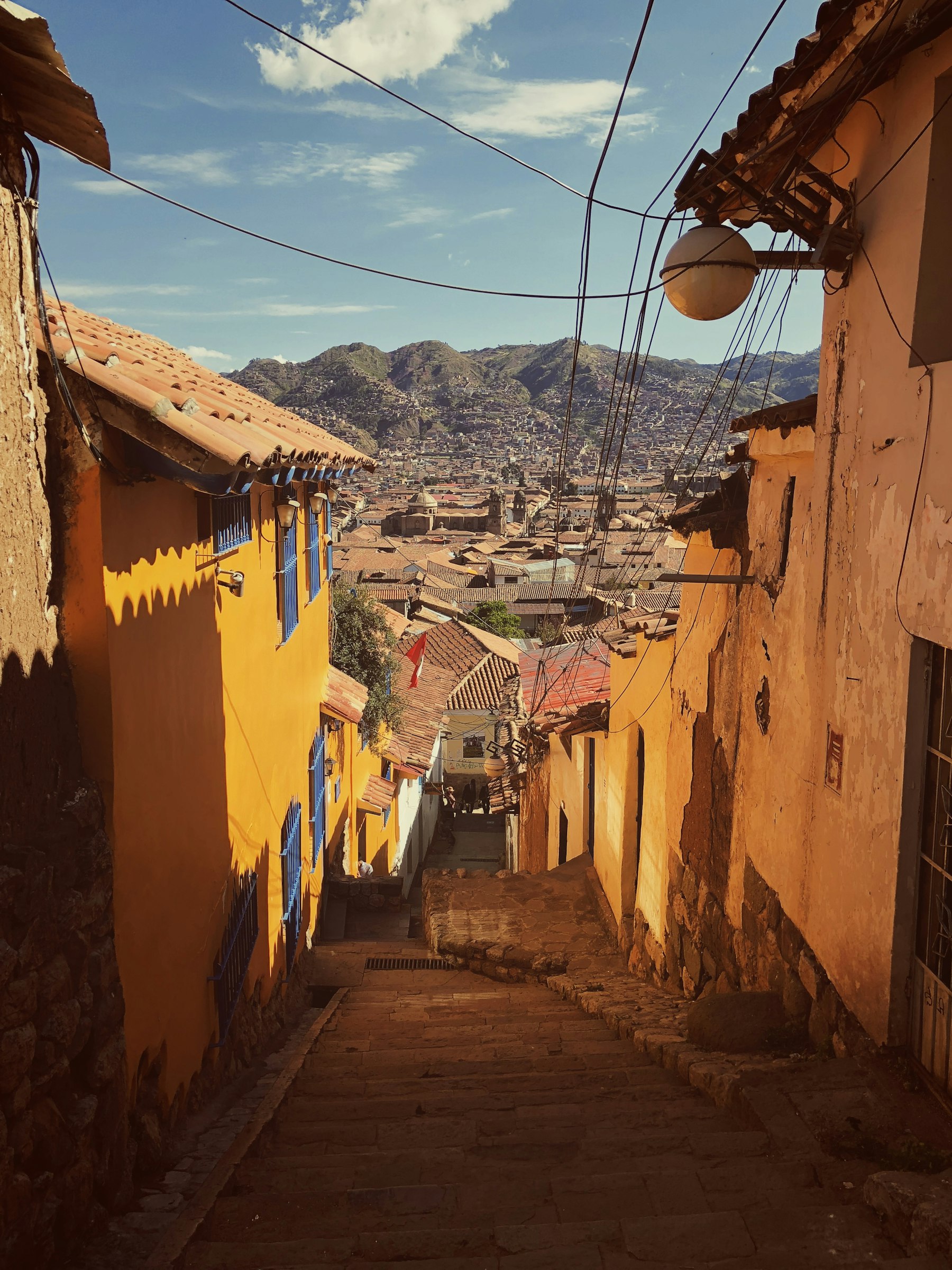
You arrive in Cusco on night ten with a week of altitude behind you, and the difference is stark. UNESCO's record puts the city "at 3,400 m above sea level... in a fertile alluvial valley fed by several rivers in the heart of the Central Peruvian Andes". The inscribed area is 142.48 hectares, listed in 1983.
The layers are the pleasure. Under Inca Pachacuteq in the fifteenth century the city was redesigned "after a pre-Inca occupation process of over 3,000 years" and became the capital of the Tawantinsuyu - an empire that, the record notes, covered much of the South American Andes. What went up was "a complex urban centre with distinct religious and administrative functions", including the Temple of the Sun, or Qoricancha, in a stone technology UNESCO calls "exceptional".
Then the Spanish built on top of it and did not quite erase it: "the pre-Hispanic patterns and buildings that shaped the Imperial city of the Incas are visible today". Two nights, walking, eating, and buying things you will regret at customs.
Best for: the city your Peru itinerary has spent ten days earning.
Go when: last. That is the entire argument of this Peru itinerary in one word.
What We Cut From This Peru Itinerary, and Why
Three things come up in almost every Peru itinerary conversation, and we leave all three off the twelve nights. None is a criticism of the experience - only of where it sits in the sequence.
The Inca Trail. Permit-locked and sold out months ahead, which is a nuisance rather than an objection. The real problem is that it front-loads days of serious altitude onto the start of a trip, to deliver you to a site that is lower than the city you would otherwise be acclimatising in. If the trail is what you want, build the trip around it and give it its own run-up. Do not bolt it onto this one.
Lake Titicaca and Puno. Routinely added between Arequipa and Cusco, and it sits higher than Cusco does. Dropping it in mid-route breaks the ladder at the point it is doing its work. If you want it, put it after Cusco, at the end, when you are fully adapted.
Rainbow Mountain. Sold hard as a Cusco day trip, often to people on their third day in the country. At the end of this route it is a reasonable ask; at the start it is the most predictable way to lose two days.
More from Dorian
Hiking Patagonia: The Seven Trails That Earn the Long Flight - the other South American route where altitude and sequencing decide whether the trip works.
| Stop | Nights | World Heritage property | Inscribed | Inscribed area | Best for |
|---|---|---|---|---|---|
| 1. Lima | 2 | Historic Centre of Lima | 1988 | 277.99 ha | Food, and no altitude at all |
| 2. Nasca and Palpa | 1 | Lines and Geoglyphs of Nasca and Palpa | 1994 | 75,358.47 ha | Scale rather than stonework |
| 3. Arequipa | 3 | Historical Centre of the City of Arequipa | 2000 | 166.52 ha | Acclimatising in disguise |
| 4. The Sacred Valley | 3 | Qhapaq Ñan, Andean Road System | 2014 | 3,642.81 ha | Walking the Inca road |
| 5. Machu Picchu | 1 | Historic Sanctuary of Machu Picchu | 1983 | 38,160.87 ha | One early morning |
| 6. Cusco | 2 | City of Cuzco | 1983 | 142.48 ha | The city you have earned |
Property names, inscription years and areas are taken verbatim from the UNESCO World Heritage Centre's records. Areas are the inscribed core property only, as each record states it; buffer zones are larger and are not counted here, which is why a city of 142 hectares sits in the same column as a desert of 75,358. The night counts and the running order are our judgment, not UNESCO's.
Booking a Peru Itinerary: The Practical Part
Getting between the stops
Lima to Nasca and on to Arequipa is a long overland run down the coast, and most people fly at least one leg of it. Arequipa across to the valley is the other decision point. We will not quote a journey time for either, because the times move with the operator, the season and the road - but they are the two questions to settle before anything else in a Peru itinerary is booked.
Altitude, honestly
Nothing on this page is medical advice, and we are not qualified to give it. What we can tell you is structural: the two sourced numbers in this article - Cusco at 3,400 metres and the Machu Picchu Citadel at more than 2,400 - are the reason the route is shaped the way it is. Talk to a doctor about the rest, and do it before you book.
What to ask before you pay a deposit
Ask any operator quoting you this Peru itinerary how many nights you will have slept above 2,000 metres before your first full day in Cusco. That is a number they can answer precisely from their own itinerary, and it tells you more about the quality of the plan than any hotel list will. We would never assert it on their behalf. If the answer is nought, you are being sold the standard route with the stops rearranged.
See how we build a twelve-night route →
Frequently Asked Questions
How many days do you need for a Peru itinerary?
Twelve nights is the shortest version of this route we would build without cutting something that matters. Eight is possible if you drop Nasca and shorten Arequipa, but you lose most of the acclimatisation margin, which is the thing the twelve nights are buying you in the first place.
Is Machu Picchu higher than Cusco?
No, and this surprises almost everyone. UNESCO's record places the City of Cuzco at 3,400 metres above sea level and the Machu Picchu Citadel at more than 2,400. The site most people brace themselves for is roughly a kilometre below the city they fly into first.
What is the best month to visit Peru?
Our judgment is to build a Peru itinerary around the drier months of the southern winter for the Andean legs, with the shoulder either side giving better light and thinner crowds. UNESCO publishes no calendar and we would not pretend otherwise - ask your operator what they actually ran last season rather than trusting a chart.
Do you need to acclimatise before Machu Picchu?
You need to acclimatise before Cusco, which is the higher of the two. That is the entire premise of this Peru itinerary: spend the first week climbing gradually through Lima, the desert, Arequipa and the Sacred Valley so that both Machu Picchu and Cusco arrive after your body has adjusted rather than during.
Is the Inca Trail worth it on a first trip to Peru?
As an experience, yes. As a component of a first twelve-night Peru itinerary, we leave it out. It is permit-locked months ahead and it front-loads hard altitude onto the earliest days, which is the one thing this route exists to avoid. Build a separate trip around it instead.
How many World Heritage sites does Peru have?
Thirteen, on the UNESCO World Heritage Centre's own list for Peru. This twelve-night Peru itinerary visits six of them. The remaining seven include Huascarán National Park, the Sacred City of Caral-Supe, Chan Chan, Manú National Park, Chavín, Chankillo and Río Abiseo.
The Dorian Destinations Verdict
Run it as a ladder: Lima, the desert, Arequipa, the valley, the Citadel, Cusco last. It is the same twelve nights and nearly the same money as the Peru itinerary every operator will quote you, and it is the difference between spending your first week recovering and spending it travelling.
And if twelve nights is not what you have, here is the position we will take that costs us money. Do not compress this into a week. Go to Arequipa and the Colca for six nights, and come back for Machu Picchu another year. An eight-night Machu-Picchu-first trip is a faster and easier sale for us than a twelve-night one, and telling you to skip the most famous ruin in South America is not a commercial decision anybody makes lightly. We would still rather do that than sell you a headline sight you will remember mostly as a headache.
Whenever you do come back, there are seven more inscriptions here that this Peru itinerary does not touch. Huascarán protects, in UNESCO's words, "the heart of the World's highest tropical mountain range", with 27 snow-capped peaks above 6,000 metres and Peru's highest at 6,768. Caral-Supe is described as "the earliest known manifestation of civilisation in the Americas". Either is a second trip, and a better argument for one than anything we could invent.
Talk to a Dorian travel advisor →
Sources: UNESCO World Heritage Centre property records for Historic Centre of Lima, Lines and Geoglyphs of Nasca and Palpa, Historical Centre of the City of Arequipa, Qhapaq Ñan, Andean Road System, Historic Sanctuary of Machu Picchu, City of Cuzco, Huascarán National Park and Sacred City of Caral-Supe, together with the Centre's state party listing for Peru, all read 29 September 2026. UNESCO descriptive text is published under CC-BY-SA IGO 3.0 and is quoted here in quotation marks with attribution. Night counts, running order and seasonal judgment are our own.
Itineraries · Peru · Adventure Travel · Cultural Travel