

The Perfect Itinerary
How Dorian Would Do It
Spain and Portugal Itinerary: Give It 12 Days, Not Seven

Co-Founder & Travel Advisor, Dorian Destinations · Published September 22, 2026 · ET
Have us build this route around your dates
Most people try to squeeze a Spain and Portugal itinerary into a week. It doesn’t work, and the reason isn’t the mileage. It’s that the good part of this trip is what happens between the cities, and a week leaves you no room to have it.
So here is the version we actually sell. Twelve nights, six bases, one land border crossed deliberately rather than flown over. This Spain and Portugal itinerary runs east to west and then turns north, which is the direction the history runs too: out of Castile, down through al-Andalus, across the Alentejo, and onto the Atlantic at the point where Portugal started sending ships at the rest of the world. Nobody has to explain the theme to you. You drive it.
Every place named below is grounded in the UNESCO World Heritage Centre’s own records — the state party listings for Spain and Portugal, plus the individual property files for each of the nine inscriptions this route passes. Spain has 50 properties on the List. Portugal has 17. This Spain and Portugal itinerary collects nine of the 67 without detouring once.
What we can’t do is pretend to be something we aren’t. We’re travel advisors, not historians, and we hold no rail allocation and no hotel inventory of our own in Iberia. Where this piece gives you pacing, seasonality or a judgment about how long a city is worth, that is our opinion from building these trips, clearly labelled as such, and not something UNESCO or anyone else said.
On Córdoba at its height, UNESCO writes that “some 300 mosques and innumerable palaces and public buildings were built to rival the splendors of Constantinople, Damascus and Baghdad.”
Why This Spain and Portugal Itinerary Runs East to West
Iberia is not a loop. It’s a slope. Start in Madrid, finish on the Atlantic, and every leg is shorter than the one before it while the weather gets softer and the food gets stranger. Run this Spain and Portugal itinerary the other way and you spend the last three days driving back across the meseta in the dark.
The two cuts people argue with us about are Barcelona and Granada. Barcelona sits on the other side of the country and has nothing to do with the thread this route follows; adding it turns a twelve-night Spain and Portugal itinerary into a fourteen-night one, with two of those nights spent in transit. Granada deserves better than the day and a half you’d give it here.
Both cuts cost us money, because clients who want the famous list booked elsewhere. We make them anyway. A trip that holds together is worth more to you than a trip that ticks boxes, and we’d rather send you back for Andalusia properly than sell you a blur.
The Route · East to West, Then North · Tap a Stop
- Madrid — 2 nights, with Toledo as a day out
- Córdoba — 1 night
- Seville — 2 nights
- Elvas and Évora — 2 nights, the border itself
- Lisbon — 3 nights, with Sintra as a day out
- Porto and the Douro — 2 nights
1. Madrid: Where Every Spain and Portugal Itinerary Should Start
Two nights, and the first one is a write-off because of the flight. That's fine. Madrid is the only city on this route that rewards doing nothing in particular — eat late, walk the Prado in one focused hour rather than four exhausted ones, and go to bed.
Day two belongs to Toledo, which UNESCO places 70 km south of Madrid, built on a steep rock skirted by the Tagus. The record describes a city shaped by twenty centuries and, in the Middle Ages, a place of coexistence of Christian, Jewish and Muslim cultures. It was a Roman municipium, then capital of the Visigothic kingdom, then a fortress of the Umayyad realms of Córdoba — which is neat, because Córdoba is where you're headed next.
The detail that makes Toledo land is what happened to it. Between 1519 and 1561 it held the temporary seat of supreme power under Charles V. Then Philip II chose Madrid, and Toledo simply stopped. That's why the old city survives: nothing came along to knock it down. Spain has two more inscribed properties in Madrid's orbit — the Escurial and the Aranjuez Cultural Landscape — and both are good. Neither is Toledo.
Best for: starting a Spain and Portugal itinerary without wrecking yourself, and getting the whole arc of the trip explained in a single afternoon.
Go when: our judgment — late April to mid-June, or the second half of September. Toledo in August is a rock in a furnace, and we move a Spain and Portugal itinerary out of July whenever a client lets us.
2. Córdoba, One Night, and Why One Is Enough
Córdoba gets a single night on this Spain and Portugal itinerary and people push back on that until they've done it. The inscribed area is small — UNESCO puts the Historic Centre at just over 80 hectares, essentially the streets surrounding the Great Mosque and the blocks around it. You can walk the whole thing twice in a day.
What you're walking through is the residue of the most important city in Europe for a stretch of the tenth century. UNESCO records that Córdoba was founded by the Romans in the 2nd century BC and became capital of Baetica; that in the 8th century it was capital of an emirate answering to Damascus; and that in 929 Abderraman III made it the seat of an independent Caliphate.
Then, in the 13th century under Ferdinand III, the Great Mosque was turned into a cathedral. It was not replaced. It was converted, and the conversion is still visibly a conversion. That building is the single strongest argument for this whole route, and it's an hour of your life.
Best for: the one unforgettable building every Spain and Portugal itinerary needs, and an early night before Seville.
Go when: our judgment — go first thing in the morning, whatever the month. The courtyard is a different place before the coaches arrive.
3. Seville, Two Nights, and the Smallest Big Site in Spain
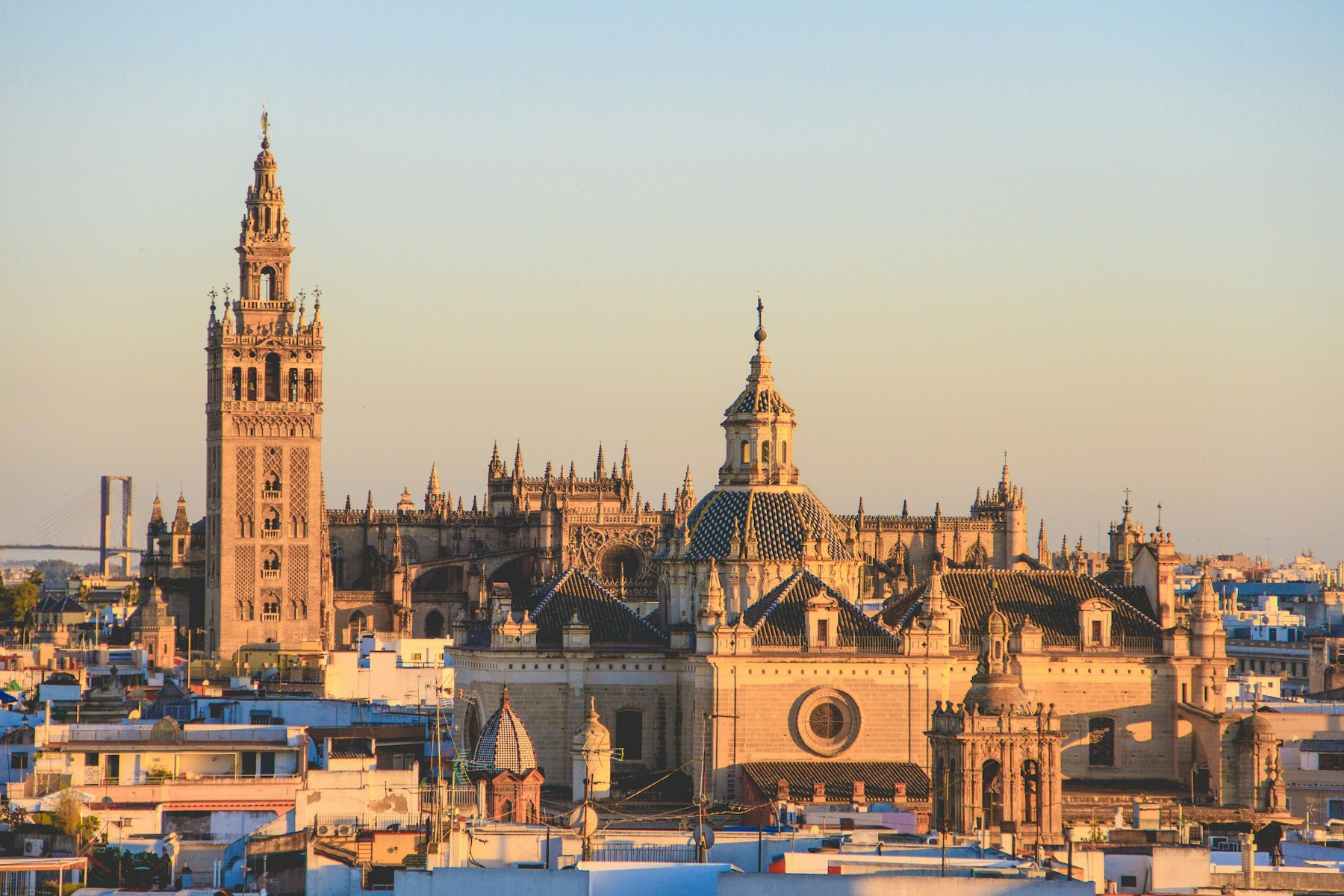
Here is the fact that reframes Seville: the inscribed property — Cathedral, Alcázar and Archivo de Indias together — covers 12 hectares. Twelve. UNESCO calls the three of them a remarkable monumental complex in the heart of the city, and says they epitomise the Spanish Golden Age, carrying vestiges of Islamic culture, centuries of ecclesiastical power, royal sovereignty, and the trading power Spain acquired through its colonies in the New World.
The Cathedral was founded in 1403 on the site of a former mosque, and UNESCO notes that with its five naves it is the largest Gothic building in Europe. The Giralda beside it was the mosque's minaret, a masterpiece of Almohad architecture, finished off at the top in the Renaissance by Hernán Ruiz. The chapter house is recorded as the first known use of an elliptical floor plan in the western world.
Two nights on this Spain and Portugal itinerary, because you want one evening that isn't spent queueing. If you want the full day-by-day treatment of the city on its own, we've written a dedicated Seville itinerary that goes deeper than this leg can.
Best for: travellers who want one stop on their Spain and Portugal itinerary to feel like a holiday rather than a march.
Go when: our judgment — avoid Semana Santa and the Feria unless those are the trip, in which case book a year out and accept that you'll see less of everything else.
4. Elvas and Évora: Cross the Border on Purpose
This is the leg people want to delete from a Spain and Portugal itinerary, and it's the one that makes the trip make sense. Elvas is inscribed, and UNESCO's description of why is almost comically on-theme: it guards the key border crossing between Portugal's capital Lisbon and Spain's capital Madrid. You are not skipping past the border. You are stopping at it.
Fortified from the 17th to the 19th centuries, Elvas became what UNESCO calls the largest bulwarked dry ditch system in the world, with outlying forts on the surrounding hills. The property has seven components, including the Fort of Santa Luzia, the Fort of Graça, three fortlets, and the 7 km Amoreira Aqueduct — built in the late 16th and early 17th centuries, and the thing that let the town survive a long siege.
Sleep in Évora. UNESCO traces it back more than twenty centuries, as far as Celtic times, through Roman rule — the Temple of Diana is still standing — and Moorish rule that ended in 1165. Its golden age came in the 15th century, when Portuguese kings began living there and the convents and royal palaces went up.
Best for: anyone who has ever felt that a border was just an airport queue — the most-cut leg of any Spain and Portugal itinerary.
Go when: our judgment — the Alentejo is at its best in May and October. In high summer it is genuinely hot and very empty, which some people love.
5. Lisbon, Three Nights, and the Day You Give to Sintra
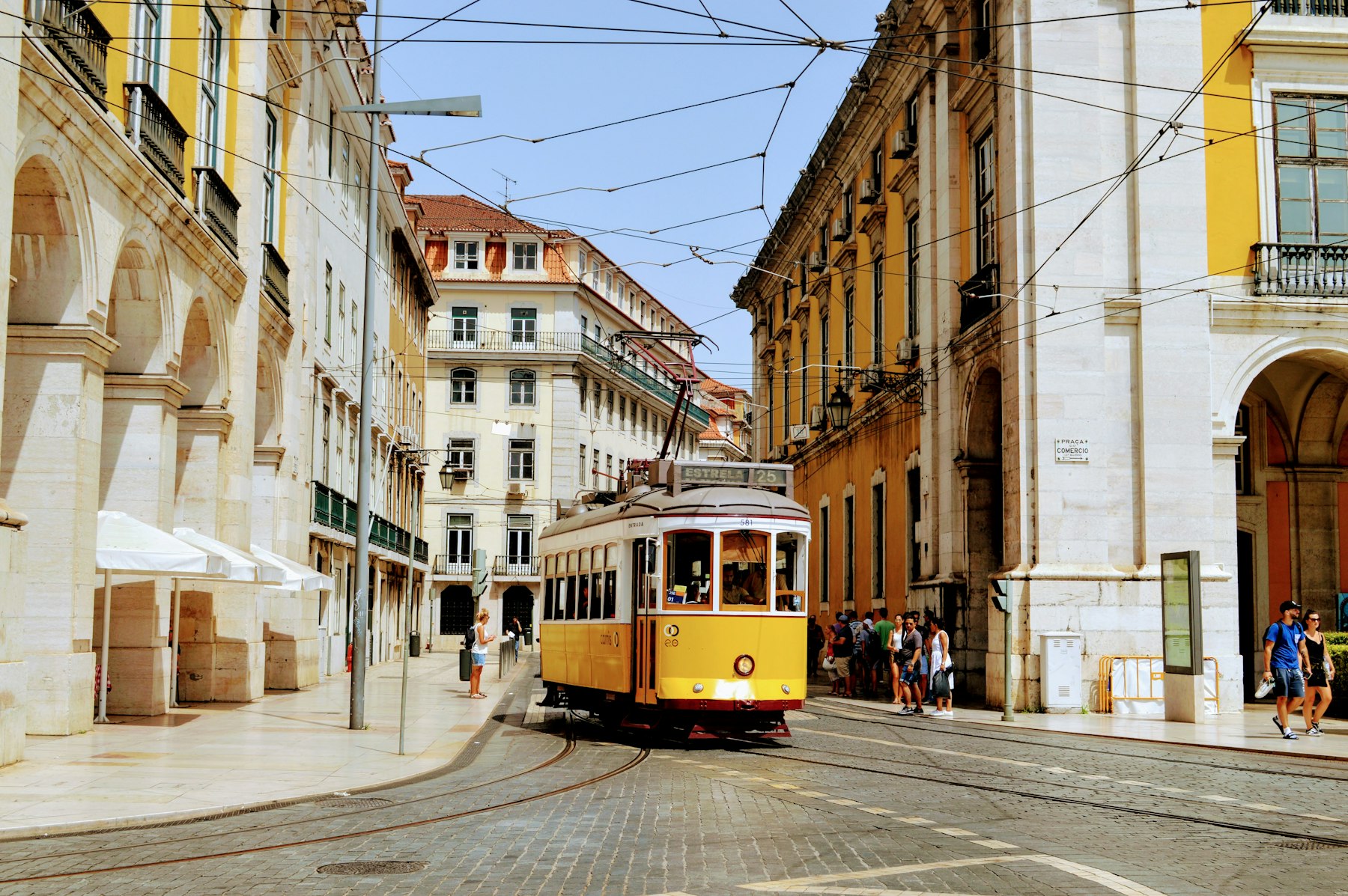
Lisbon gets the most time on this Spain and Portugal itinerary, and the reason isn't that it has the most to see. It's that it has the most to do nothing in. Three nights buys you two full days plus an arrival evening, and you want that slack after four days of moving.
The inscribed property here is tiny and specific: the Monastery of the Hieronymites and the Tower of Belém, 2.66 hectares between them, on the shore of the Tagus at the entrance to the port. UNESCO records that the monastery was commissioned by King Manuel I and given to the monks of Saint Hieronymus so they would pray for the king and give spiritual assistance to seafarers leaving Lisbon in quest for the new world, and that it was built to perpetuate the memory of Prince Henry the Navigator.
Give the second day to Sintra. UNESCO's line on it is the one I quote to clients: in the 19th century Sintra became the first centre of European Romantic architecture. Ferdinand II turned a ruined monastery into a castle, mixing Gothic, Egyptian, Moorish and Renaissance elements, and planted a park of local and exotic trees. The property runs to 946 hectares — 355 times the size of Belém — and UNESCO credits it with influencing landscape architecture across Europe.
Best for: the part of this Spain and Portugal itinerary you'll actually describe to people when you get home.
Go when: our judgment — Sintra is a serra, and it makes its own weather. Go early, take a layer even in July, and don't plan anything for the evening afterwards.
6. Porto and the Douro: Where a Spain and Portugal Itinerary Should End
End here, and fly home from Porto rather than backtracking to Lisbon. That single decision saves a travel day and is the most common change we make to a client's own draft.
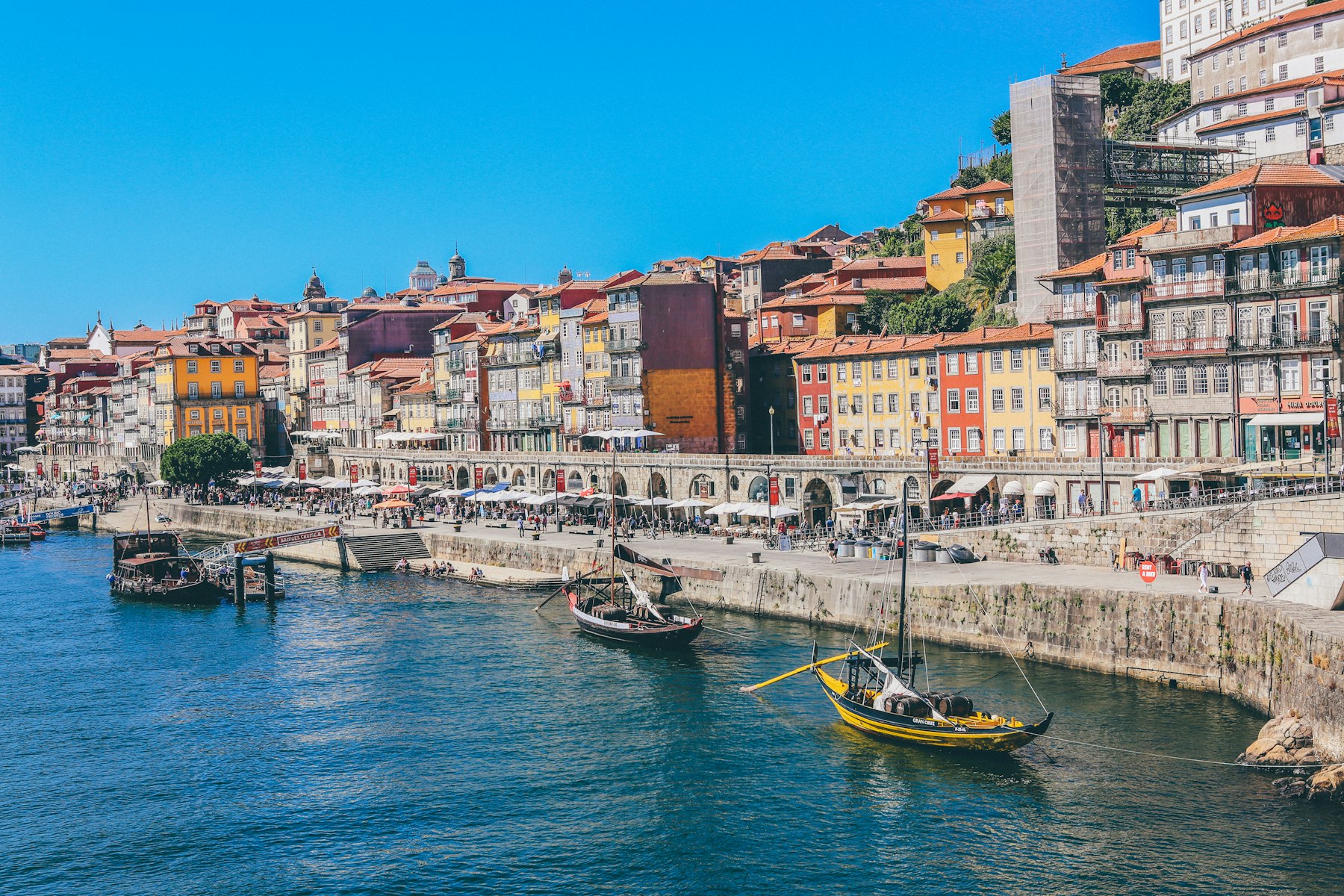
Two inscriptions close the route. The first is what UNESCO lists as the Historic Centre of Oporto, Luiz I Bridge and Monastery of Serra do Pilar, on the List since 1996 — the city as seen from the far bank, which is where you should look at it from. The second is the Alto Douro Wine Region, inscribed in 2001 and running to 24,600 hectares of terraced hillside upriver.
One night in Porto, one night up the valley. Do not try to see the Douro as a day trip from the city; the drive is the good part and you will resent doing it twice in a day. We have two deeper pieces if this last leg is the one that grabs you — a five-day Porto and Douro Valley itinerary and, if you would rather be on the water than behind a wheel, our guide to sailing the Douro.
Best for: finishing a Spain and Portugal itinerary on a high instead of on a motorway.
Go when: our judgment — late September into October, for the harvest, is the single best window for a Spain and Portugal itinerary. It is also the hardest to book, so decide early.
MORE: Porto and the Douro Valley in five days — the slow version of this route's final leg, for travellers who would rather do one country properly.
| Stop | Nights | World Heritage property (year inscribed) | Inscribed area | Our read |
|---|---|---|---|---|
| Madrid & Toledo | 2 | Historic City of Toledo (1986) | 259.85 ha | The whole trip explained in one afternoon |
| Córdoba | 1 | Historic Centre of Córdoba (1984) | 80.28 ha | One building. One night is genuinely enough |
| Seville | 2 | Cathedral, Alcázar and Archivo de Indias (1987) | 12 ha | Smallest property on the route, biggest city feel |
| Elvas & Évora | 2 | Garrison Border Town of Elvas (2012); Historic Centre of Évora (1986) | 179.36 ha; not stated | The leg clients cut, and the one that makes it cohere |
| Lisbon & Sintra | 3 | Hieronymites & Tower of Belém (1983); Cultural Landscape of Sintra (1995) | 2.66 ha; 946 ha | Where the slack in the schedule belongs |
| Porto & the Douro | 2 | Historic Centre of Oporto (1996); Alto Douro Wine Region (2001) | 24,600 ha (Alto Douro) | Fly home from here, not from Lisbon |
Property names, inscription years and areas are UNESCO's, taken from the individual property records; where the record we read states no area, the cell says so. The night counts and the right-hand column are ours, and they are opinion, not fact.
Booking This Spain and Portugal Itinerary: The Practical Part
Fly into Madrid, fly home from Porto
An open-jaw ticket is the whole game here. Returning to Madrid to fly home costs you a day and a night, and that is the single most expensive mistake in the draft itineraries clients send us. Price the open jaw first; if it is genuinely unaffordable, reverse the route and fly out of Madrid instead rather than doubling back.
One car, and only for the middle
You do not want a car in Madrid or in Lisbon, and you very much do want one between Seville and Évora and again up the Douro. Our usual shape is rail for the long southern hop, a car picked up for the border section, and rail again at the end. Taking a rental across the Spain–Portugal frontier needs to be declared at the counter, and the supplement for doing so is one of the few line items we tell clients to just accept.
The order to book things in
Flights first, then the Évora and Douro properties, then the cities. That is backwards from how most people do it, and it is the right way round: the small places on this route sell out long before Lisbon does.
Frequently Asked Questions
How many days do you need for a Spain and Portugal itinerary?
Twelve nights is our working minimum for both countries at a pace that still feels like a holiday. Ten is possible if you drop Córdoba. Under nine, our honest advice is to pick one country and do it properly, because the border crossing stops paying for itself.
Is it better to start in Spain or Portugal?
Start in Spain. Madrid has the widest choice of long-haul arrivals, and running east to west means each leg gets shorter as you tire. Starting in Lisbon works, but it loads your longest driving day onto the end of a Spain and Portugal itinerary, which is when you want it least.
Can you drive a rental car from Spain into Portugal?
Yes, and the border itself is unremarkable to cross. What matters is telling the rental desk at pickup that you are taking the car into the other country, because cross-border use generally carries a declared supplement and affects your cover. Do not skip that conversation to save a few euros.
What is the best time of year for a Spain and Portugal itinerary?
Our judgment: late April to mid-June, or the second half of September into October. The autumn window has the Douro harvest in it, which is the single best thing on the route. July and August are hot inland and busiest everywhere, and we steer clients away from them.
Should I add Barcelona to a Spain and Portugal itinerary?
Not on this route. Barcelona is on the far side of the country and shares nothing with the thread this itinerary follows, so it costs you two travel days for a city that deserves its own trip. We say the same about Granada, and both answers cost us bookings.
Do you need to speak Spanish or Portuguese?
No. English is widely spoken along this route, especially in Lisbon, Porto and Seville. That said, the smaller stops — Elvas and Évora in particular — are where a few words of Portuguese noticeably change how the day goes, which is another argument for keeping them in your Spain and Portugal itinerary.
The Dorian Destinations Verdict on This Spain and Portugal Itinerary
Do it in twelve nights or don't do both countries. That is the whole position, and we will keep giving it even when a client has already bought a seven-night window and wants us to make it fit. We can make it fit. It will be a worse trip.
The reason this particular Spain and Portugal itinerary works is that it has an argument in it. Nine World Heritage properties, in the order history put them, ending at the river that paid for the ships at the start. Cut Barcelona. Cut Granada, and come back for Andalusia another year. What you are left with is a route that explains itself while you are driving it, which is the only kind of itinerary worth handing to somebody.
Sources: UNESCO World Heritage Centre — state party listings for Spain and Portugal; and the property records for Historic City of Toledo, Historic Centre of Córdoba, Cathedral, Alcázar and Archivo de Indias in Seville, Garrison Border Town of Elvas, Historic Centre of Évora, Monastery of the Hieronymites and Tower of Belém, Cultural Landscape of Sintra, Historic Centre of Oporto and Alto Douro Wine Region. UNESCO descriptive text is used under CC-BY-SA IGO 3.0 and quoted rather than reproduced. All pacing, seasonality and routing judgments are our own.
ITINERARIES · SPAIN · PORTUGAL · EUROPE