

Adventure & Expedition Travel
Travel Beyond the Ordinary
Antarctica Expedition Cruise: The Ship Decides If You Land

Co-Founder & Travel Advisor, Dorian Destinations · Published September 14, 2026 · ET
Have Us Plan Your Antarctica Season
An Antarctica expedition cruise is sold on the photographs. It is delivered by the rulebook, and the rulebook was written long before your ship was.
Somebody asks us about Antarctica roughly once a fortnight, and it is nearly always September when they do. They arrive with a shortlist of three sailings and a spreadsheet comparing prices, and the spreadsheet is nearly always missing the column that decides the holiday. Not the cabin grade. Not the length of the crossing. Whether the ship puts them on the continent at all.
Everything below about visitor numbers and conduct comes from IAATO, the International Association of Antarctica Tour Operators, read on September 14, 2026, and from the Antarctic Treaty framework IAATO publishes against. Where I am talking about which ship suits which traveller, or how a season feels from the deck, that is our judgment as advisors rather than data, and I will flag it each time. One thing we should be straight about: we are not an expedition operator and we hold no berths, so nothing here is written to move a cabin. If the honest answer is that you should wait a year and put the difference into a smaller ship, that is what we will tell you.
Do not expect a rescue service. Self-sufficiency is increased and risks reduced by sound planning, quality equipment, and trained personnel. — IAATO, guidance for visitors to the Antarctic
In this guide
What an Antarctica Expedition Cruise Actually Is
Antarctica has no ports. There is no pier, no terminal, no gangway onto a quay. Every landing anywhere on the continent happens by inflatable boat, in weather that gets a vote, at a site that has to be free of other ships when you arrive. That single fact shapes everything else, and it is why the industry calls these sailings expeditions rather than cruises even when the ship has a spa.
It also means the phrase Antarctica expedition cruise covers two genuinely different products sold at similar prices. One puts you ashore most days. The other sails past the scenery and never lowers a boat. Both are legal, both are advertised with the same photographs, and IAATO counts them separately for exactly that reason.
The Numbers IAATO Publishes Give the Game Away
For the 2025–26 season IAATO reports 85,195 landed visits, 27,217 cruise-only visitors and 1,106 deep field visitors. Those are the association’s own headline figures and they are worth reading slowly, because the middle one is the number nobody quotes in a brochure.
Cruise-only means precisely what it sounds like. More than twenty-seven thousand people went all the way to Antarctica last season and never once stood on it. They saw it from a rail, through glass, at whatever distance the bridge chose. For some travellers that is genuinely the right trip and I will make that case below. For most of the people who ring us, it is the exact opposite of what they think they are buying.
Note also that the 85,195 figure counts landed visits, not people. One passenger going ashore six times is six visits. It is a measure of activity rather than headcount, and any article that reports it as the number of visitors has not read the label. The practical takeaway stands either way: on an Antarctica expedition cruise, landings are the product, and some ships sell the product without delivering it.
1. The Classic Drake Passage Crossing
Best for: first-timers who want the whole experience, including the bit that tests them.
Go when: late November for ice and courtship, January for chicks and the longest days, February and March for whales.
You sail from Ushuaia, you cross the Drake, and roughly two days later the Peninsula appears. Ten to twelve days door to door, of which four are ocean. This is the trip most people picture and it remains the best value in the Antarctica expedition cruise category, because the crossing that everyone dreads is also the thing that keeps the price honest and the ship small.
The Drake is not always brutal. It is always unpredictable, which is a different problem, and it is the reason we ask clients how they feel about losing a day to weather before we ask them about cabins. An Antarctica expedition cruise that builds in no slack is an Antarctica expedition cruise that will disappoint you the first time the barometer drops. That is judgment, not data, but it is judgment earned from watching itineraries bend.
2. The Fly-Cruise, Which Buys Back Four Days
Best for: travellers short on annual leave, or anyone who knows they are a poor sailor.
Go when: December and January, when the weather windows over Drake Passage are most reliable.
You fly from Punta Arenas to King George Island and join the ship there, skipping the crossing in one or both directions. It turns a twelve-day Antarctica expedition cruise into a six- or eight-day one and it removes the single most-feared element of the whole undertaking.
The trade is real, though, and it is not just money. You are now dependent on a flight into one of the least reliable airstrips in commercial use, and when it goes down you wait. We have written about this trade-off in detail in our Antarctica fly-cruise guide, and the short version is that it suits a specific traveller rather than a better one.
3. The Big Ship That Never Lands
Best for: travellers with genuine mobility limits, or those for whom the continent is one stop on a longer South American voyage.
Go when: January and February, the calmest stretch of the season.
This is where those 27,217 cruise-only visitors come from. A large vessel sails the Gerlache Strait, everyone crowds the rail, and the ship turns north again. Nobody goes ashore. On the right ship it is comfortable, stabilised and considerably cheaper per night than anything with Zodiacs on the davits.
I have no quarrel with it as a product. My quarrel is with how it is sold. If you are buying an Antarctica expedition cruise and the word expedition is doing decorative work in the brochure, ask one question before you pay: how many landings are scheduled. If the answer is none, that is fine, but you should know it now rather than from the rail.
4. Small Ships, and Why the Number on the Manifest Matters
Best for: anyone whose priority is time ashore rather than time aboard.
Go when: any time in the season; small ships are less season-sensitive because they can move.
Every Antarctica expedition cruise shares the same landing sites, and they are small, fragile and few. The fewer people on your ship, the more of the day each of them gets on land, and the arithmetic is brutally simple once you see it. A ship of a hundred rotates everyone ashore comfortably in a morning. A ship of five hundred does not, and it will spend the difference on lectures.
This is the single biggest lever on an Antarctica expedition cruise and it is the one clients most often discover too late. It is also why the small ships cost more per night and are worth it, which is not a sentence we enjoy writing given we earn nothing either way.
5. South Georgia and the Falklands, Added On
Best for: returning polar travellers, and anyone who came for the wildlife rather than the ice.
Go when: October and November for king penguin colonies and elephant seal haul-outs at their noisiest.
Bolting South Georgia onto the front of a Peninsula sailing turns ten days into around twenty and roughly doubles the cost. It also produces the wildlife density that most people imagine Antarctica has and that the Peninsula, frankly, does not.
Our honest read, and this is judgment rather than data: if you only ever do one Antarctica expedition cruise, the Peninsula alone is enough and the money is better spent on a smaller ship. If you already know you will go back, do South Georgia first, because it is the harder one to schedule twice.
6. Deep Field, and the 1,106
Best for: a very small number of travellers with the time, the budget and the medical clearance.
Go when: the narrow late-December to mid-January window, which is the only one that exists.
The 1,106 deep field visitors IAATO counted last season are the people who flew inland: the emperor colonies, the Ellsworth Mountains, the Pole itself. It is a different undertaking from anything with a ship attached, priced accordingly, and it comes with medical screening that turns people away.
We mention it because clients ask, and because the number is a useful corrective. Against 85,195 landed visits, deep field is roughly one per cent of Antarctic tourism. It is not the next step up from an Antarctica expedition cruise; it is a different sport.
7. The Activities That Change the Trip
Best for: reasonably fit travellers who want the continent at ground level rather than through a long lens.
Go when: mid-season, when conditions are most likely to allow the optional programmes to run at all.
Sea kayaking, a night camping on the ice, snowshoeing up a col above the landing beach. These are booked separately, they cost extra, they fill early, and every one of them is weather-dependent and may simply not happen.
Book them anyway if they appeal. The refund is automatic if the programme does not run, and the difference between watching a bay and paddling across it is the difference most people remember. What we would not do is choose an Antarctica expedition cruise because of an activity, since no operator can promise the weather that makes it possible.
MORE: Once you have picked a ship, the route is the next decision. Our guide to Antarctica itineraries, Peninsula to deep field, walks through what each region actually gives you.
Antarctica Expedition Cruise Options Compared
| Option | Typical length | Goes ashore? | Best for | The catch |
|---|---|---|---|---|
| Classic Drake crossing | 10–12 days | Yes, most days | First-timers | Four days at sea, weather-dependent |
| Fly-cruise | 6–8 days | Yes, most days | Short on leave or poor sailors | Flight delays into King George Island |
| Large ship, scenic only | Varies, often part of a longer voyage | No | Mobility limits; Antarctica as one stop | You never set foot on the continent |
| Small ship, roughly 100–150 guests | 10–14 days | Yes, and more of it | Maximum time ashore | Highest cost per night |
| Peninsula plus South Georgia | 18–22 days | Yes | Wildlife above all else | Roughly double the price and the leave |
| Deep field / interior | Varies, narrow window | Yes, by air | Emperor colonies, the Pole | Medical screening; about 1% of all visits |
What the Rules Will Ask of You on an Antarctica Expedition Cruise
Antarctic tourism runs under the Antarctic Treaty of 1959 and the 1991 Protocol on Environmental Protection, which designates the whole continent a natural reserve. IAATO members operate to that framework and brief every passenger on it. None of this is onerous, but it does mean your day ashore is structured in ways a Caribbean beach day is not.
How close you can get to the wildlife
Taking or harmfully interfering with Antarctic wildlife is prohibited except under a national permit. In practice that means no feeding, no touching, no handling, and no approaching or photographing an animal in a way that changes its behaviour. IAATO asks for special care when animals are breeding or moulting, which is most of the season.
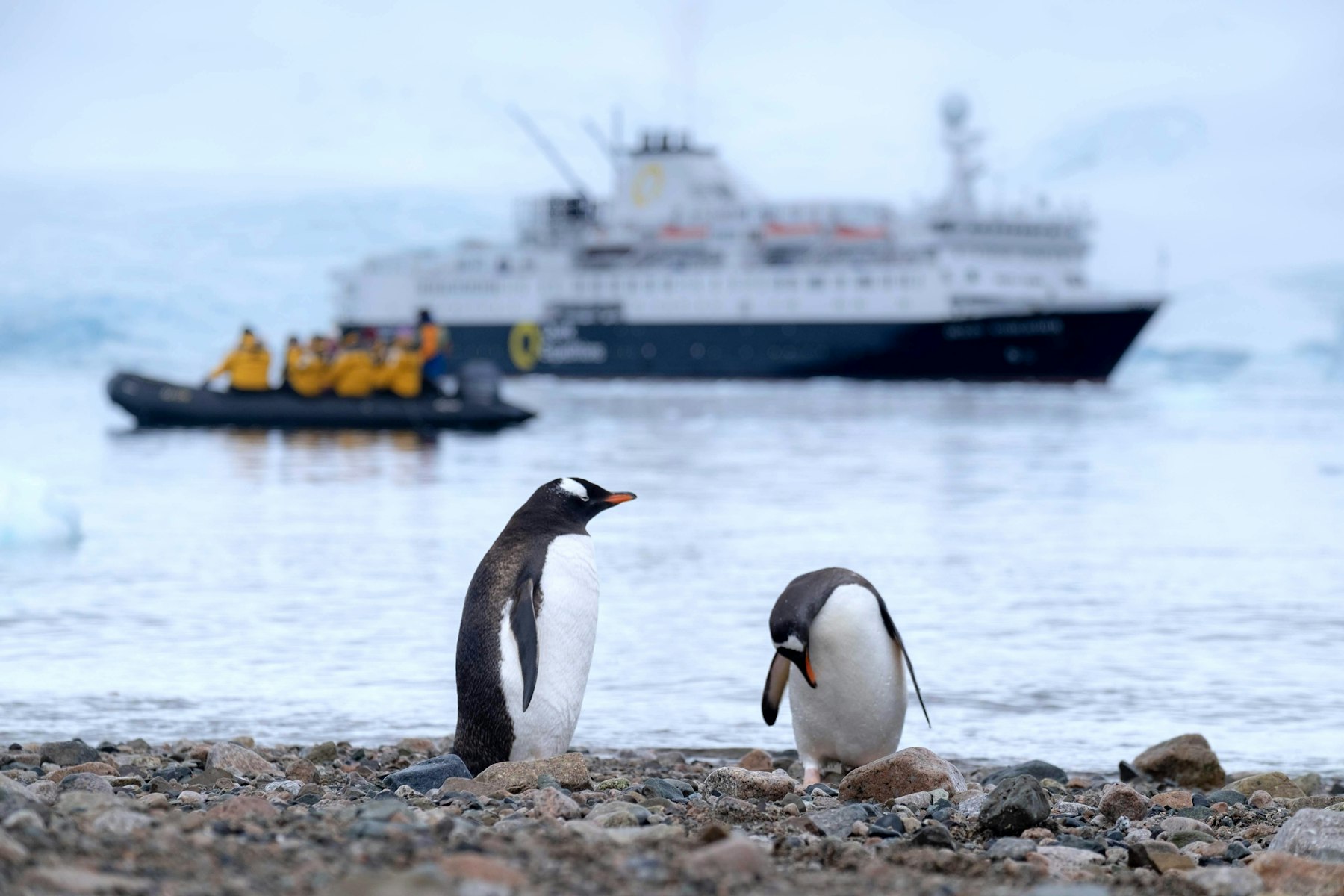
The good news is that the animals have not read the rule and routinely close the distance themselves. Sit still and a gentoo will walk past your boot.
Biosecurity, and the bird flu protocols
Every visitor is expected to avoid introducing non-native species, which is why boots, poles and Velcro get vacuumed and scrubbed before each landing. IAATO publishes avian influenza protocols for the 2026–27 season, and they can and do close individual landing sites at short notice.
This is the most likely reason a specific site drops off your itinerary, and it is worth understanding before you sail so it reads as competence rather than a let-down.
Places you simply cannot go
Certain areas carry special protection for ecological, scientific or historic reasons and entry may require a permit from a national authority. Historic Sites and Monuments have their own restrictions. If you want to visit a research station, permission has to be obtained in advance and arrangements reconfirmed 24 to 72 hours before arrival.
Why self-sufficiency is your problem too
IAATO’s guidance is blunt: do not expect a rescue service. You are days from meaningful help, and the mitigation is planning, equipment and trained people rather than a phone number. It is the strongest argument we know for choosing your Antarctica expedition cruise on the strength of its expedition team rather than its cabin photography.
Frequently Asked Questions
How much does an Antarctica expedition cruise cost?
It depends almost entirely on ship size, season and cabin, and anyone quoting you a single figure has not asked when you want to go. The variables that actually move the number are guest count, whether you cross the Drake or fly it, and whether South Georgia is attached. We will price a real shortlist rather than guess.
When is the best time to go to Antarctica?
The Antarctica expedition cruise season runs roughly November to March. Late November gives you pristine ice and courtship displays, January the longest days and penguin chicks, February and March the best whale watching and the cheapest fares. There is no bad month inside the season, only different trade-offs, and that is our judgment rather than data.
Do you actually get off the ship in Antarctica?
Only if your ship is built and scheduled to do it. IAATO counted 27,217 cruise-only visitors in 2025–26 against 85,195 landed visits, so a substantial share of people who travel to Antarctica never go ashore. Ask your operator how many landings your Antarctica expedition cruise has scheduled before you book, not after.
How bad is the Drake Passage?
Unpredictable rather than reliably terrible. It can be glassy and it can be genuinely rough, usually within the same week, and modern stabilised expedition ships handle it far better than their predecessors. If seasickness worries you, the fly-cruise exists precisely for that, and medication from your doctor helps most people.
Is an Antarctica expedition cruise worth it?
For most people who genuinely want it, yes, provided the ship lands. The regret we hear is almost never about the money or the crossing. It is from travellers who watched the continent through a window because nobody told them their vessel was not going ashore.
How long do you need for an Antarctica expedition cruise?
Budget ten to twelve days for a classic Antarctica expedition cruise across the Drake, plus two either side for flights and a night in Ushuaia or Punta Arenas. A fly-cruise compresses that to six or eight. Adding South Georgia takes you to around three weeks and should be treated as a separate trip.
The Dorian Destinations Verdict
Buy the landings. Everything else on an Antarctica expedition cruise is negotiable, and the landings are not.
If your budget forces a choice between a larger ship this season and a smaller one next season, wait. That is genuinely the advice, and it costs us a booking to give it. The continent is not going anywhere on a twelve-month horizon, the difference between a hundred guests and five hundred is the difference between standing on Antarctica and queueing for it, and nobody has ever come back wishing they had gone sooner on a worse ship.
And if a vessel schedules no landings at all, it is a scenic voyage, which is a perfectly good thing to buy on purpose and a miserable thing to discover by accident. Ask the question in writing. Any operator worth your deposit will answer it in one line.
Talk to a Dorian Destinations Advisor
Sources, all checked 14 September 2026: IAATO 2025–26 visitor figures, Data & Statistics; conduct, wildlife and protected-area guidance, During Your Visit; biosecurity and 2026–27 avian influenza protocols, Preparing For Your Expedition. Seasonality, ship-size and value judgments are our own and are labelled as such. We are not an expedition operator and hold no berths.
Adventure TravelExpedition CruiseOcean CruisesAntarctica