

Curated Travel
The Dorian List
Things to Do in Turkey: Skip the Coast, Read the Register

Co-Founder & Travel Advisor, Dorian Destinations · Published October 19, 2026 · ET
Plan the things to do in Turkey around the register →
Türkiye has 22 World Heritage properties. Twenty of them are cultural, two are mixed, and not one is purely natural. That one line reorders almost every list of things to do in Turkey you have ever read.
We build a lot of trips to this country, and the brief almost always arrives the same way: a week, maybe ten days, a balloon flight, a gulet, and “whatever else we should see.”
It is a perfectly reasonable brief, and it is how most lists of things to do in Turkey are built. It is also the reason so many people come home having seen the two most photographed landscapes in Anatolia and almost nothing of the civilisation that makes the place extraordinary. The fix is not a longer list. It is a better sorting rule — and one already exists, published, free, and almost entirely ignored.
Every property, inscription year and category below comes from UNESCO’s own file for Türkiye and from the individual property records on the World Heritage List. The counts behind every claim we make about the things to do in Turkey are the register’s, not ours: 22 inscribed properties, 20 cultural, two mixed, zero natural, and 80 further sites sitting on the country’s Tentative List. Every record we used is linked below.
What the register cannot tell you is what any of these places feels like in August. UNESCO publishes boundaries, criteria and conservation files — not crowd counts, opening hours or ticket prices, and we have invented none. Where this piece says a month is better than another month, that is our judgment from building these itineraries, and we have labelled it as judgment every time.
We have no commercial relationship with any operator named or implied here, and there are no affiliate links in this piece. The order below is the register’s chronology, not a popularity contest and not a paid placement.
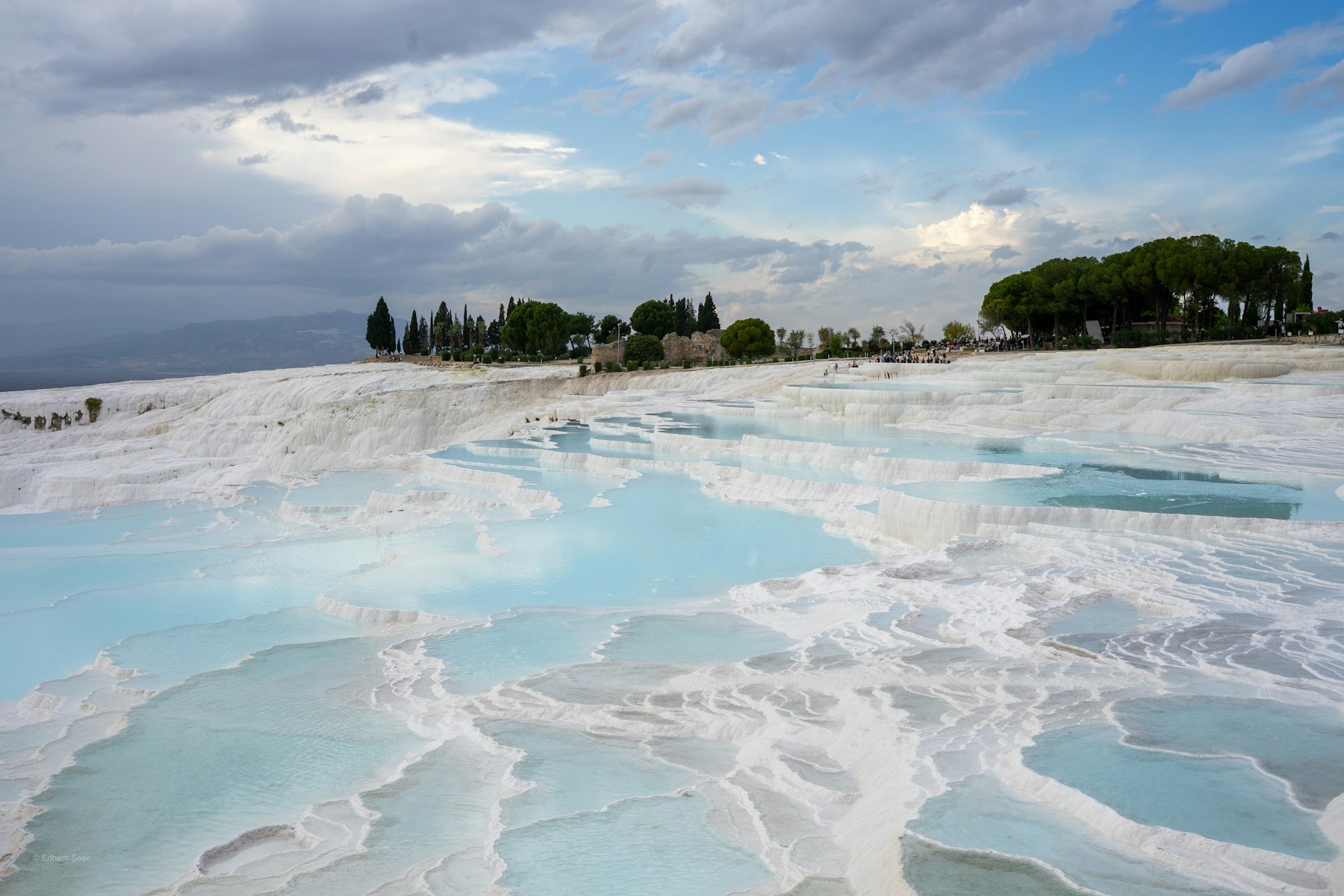
“Deriving from springs in a cliff almost 200 m high overlooking the plain, calcite-laden waters have created at Pamukkale (Cotton Palace) an unreal landscape, made up of mineral forests, petrified waterfalls and a series of terraced basins.” — UNESCO World Heritage Centre, on Hierapolis-Pamukkale
The Best Things to Do in Turkey Hide Inside One Public Register
Türkiye ratified the World Heritage Convention on 16 March 1983 and has been adding to its list ever since. Read that list in the order it was written and something useful happens. Every stop on the standard tourist circuit — Istanbul, Cappadocia, Nemrut Dağ, Pamukkale — was inscribed in the 1980s, and almost everything added in the four decades since is somewhere most visitors have never heard of. The register is, in effect, a forty-year record of a country arguing with its own postcard, and it is the single most useful sorting rule for the things to do in Turkey that we know of.
It is also overwhelmingly a record of people rather than landscape. Twenty of the 22 properties are inscribed as cultural. The only two that carry any natural listing at all are Cappadocia and Pamukkale — which is to say, the two places already on every shortlist. Everything else the register protects is something somebody built, carved, buried or wrote. If you rank the things to do in Turkey as scenery, you are planning against the grain of the country’s own account of itself.
So here are seven properties in the order UNESCO inscribed them, from 1985 to 2025. It is not a ranking of things to do in Turkey by beauty, and it is deliberately not a ranking by Instagram. It is the order a country chose to make its case to the world, and it turns out to be a far better itinerary than the one the search results give you.
1. Historic Areas of Istanbul — four zones, not a city (1985)
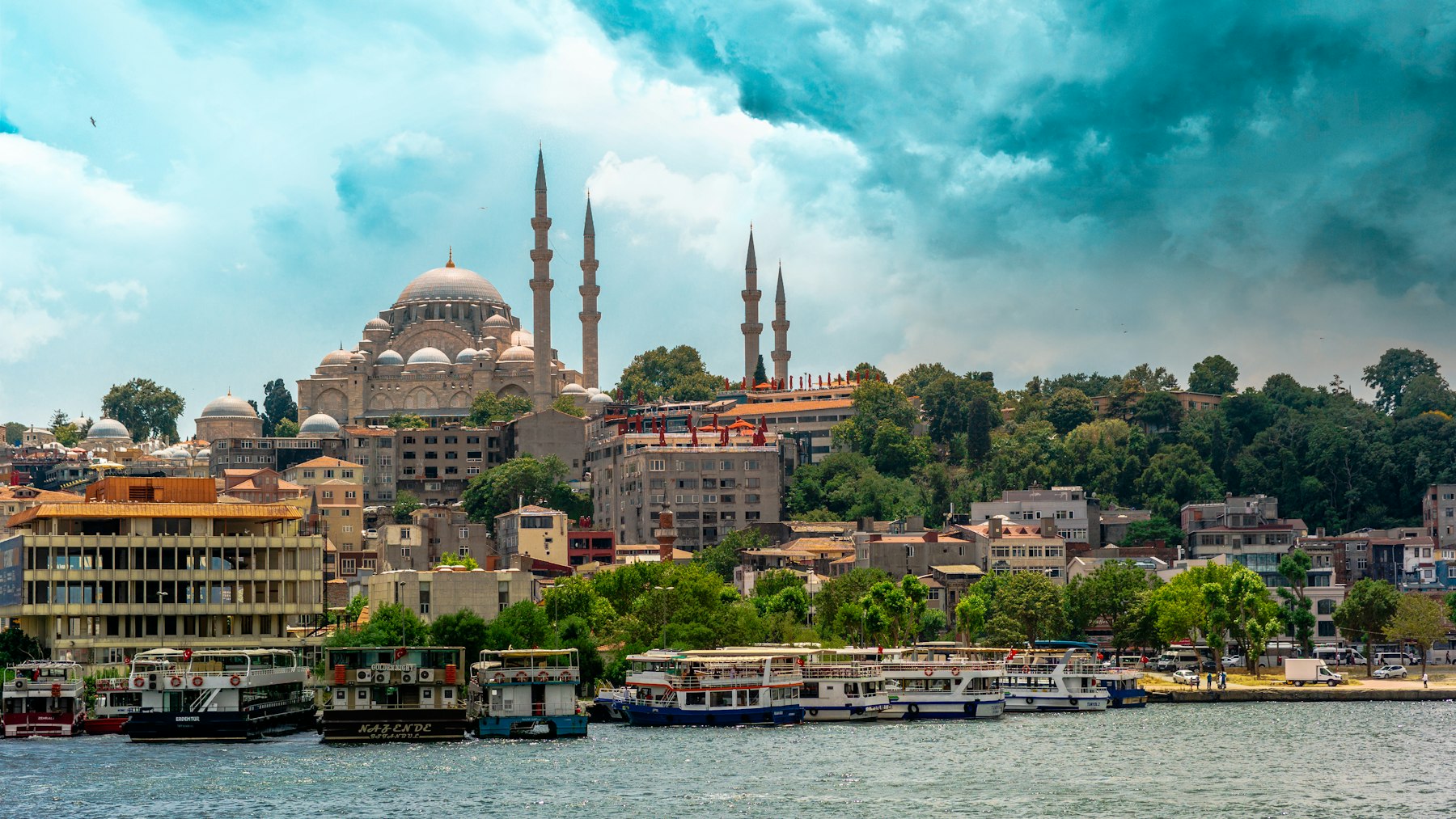
The thing to understand about Istanbul is that the World Heritage property is not Istanbul. UNESCO inscribed four defined areas: the Archaeological Park at the tip of the historic peninsula, the Süleymaniye quarter with its mosque complex and surrounding bazaars and houses, the Zeyrek settlement around the former church of the Pantocrator, and the corridor along both sides of the Theodosian land walls.
That boundary changes how you spend a day. Most visitors do the Archaeological Park and leave, which is one quarter of the property. The Zeyrek area and the land walls are where the city stops performing and starts being lived in, and both sit inside the same inscribed property. UNESCO’s own record describes the value as the meeting of Europe and Asia over many centuries and an “incomparable skyline” built by Byzantine and Ottoman architects — Hagia Sophia’s sixth-century dome, Sinan’s Süleymaniye and Şehzade complexes, the seventeenth-century Blue Mosque, the New Mosque finished in 1664.
Best for: anyone whose list of things to do in Turkey currently has one line that says “Istanbul”.
Go when: late March to mid-May, or October — the window we use for most things to do in Turkey. Our judgment, based on heat and cruise-ship arrivals rather than any published figure.
2. Göreme National Park and the Rock Sites of Cappadocia — one of only two (1985)
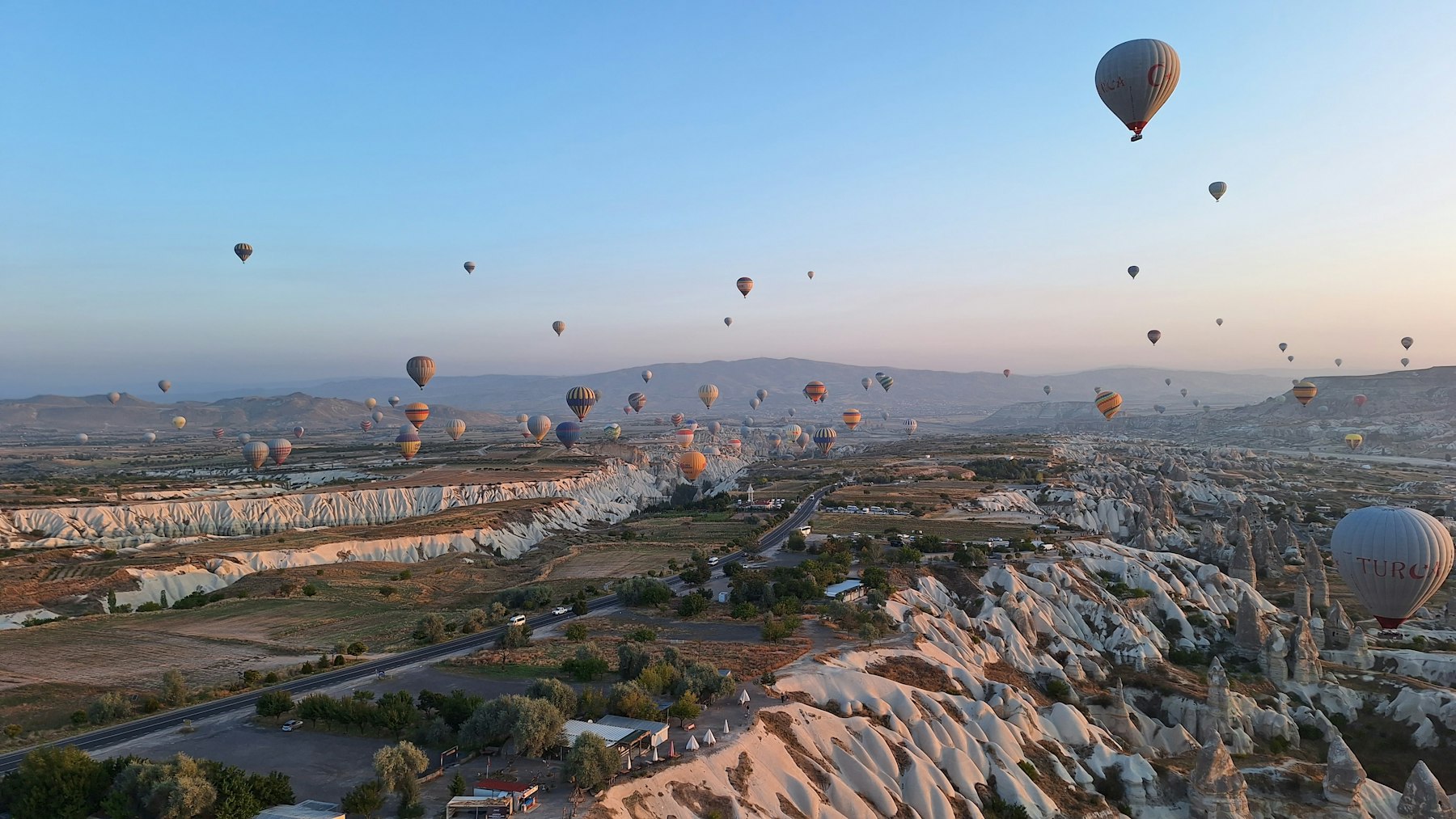
Inscribed the same year as Istanbul, and one of just two Türkiye properties the register treats as mixed rather than purely cultural. The record describes a volcanic plateau sculpted by erosion into ridges, valleys and the pinnacles known as fairy chimneys, bounded by extinct volcanoes — Erciyes Dağ at 3,916 m at one end and Hasan Dağ at 3,253 m at the other.
What gets missed is the second half of the citation. The property runs between Nevşehir, Ürgüp and Avanos and takes in Karain, Karlık, Yeşilöz and Soğanlı plus the subterranean cities of Kaymaklı and Derinkuyu. UNESCO calls it one of the world’s largest cave-dwelling complexes and rates the post-Iconoclastic Byzantine painting in its rock-hewn churches as its leading claim. The balloon is the advertisement. The churches are the property.
Best for: the one entry on everybody’s list of things to do in Turkey that genuinely earns its reputation.
Go when: April to early June, or September to October. Balloons fly on the weather, not the calendar, so build in a spare morning — that is our planning rule, not a published statistic.
3. Nemrut Dağ — a king’s private pantheon (1987)
High on one of the peaks of the Eastern Taurus, Antiochos I of Commagene (69–34 BC) built himself a hierotheseion: a temple-tomb and house of the gods, in UNESCO’s phrasing, erected as a monument to himself. The funerary mound of stone chips is 145 m across and 50 m high, with terraces on the east, west and north sides and two ancient processional routes radiating from the east and west.
Five colossal seated limestone deities face outward from the upper terraces, each pair flanked by a guardian lion and eagle. Their heads have fallen to the lower level and sit among rows of sandstone stelae, which is why every photograph here looks like a sculpture garden assembled by an earthquake. Commagene was founded after Alexander’s empire broke up, and its pantheon fuses Greek and Persian lineages — the register calls that syncretism evidence of the kingdom’s dual origin.
Best for: travellers who want the things to do in Turkey that almost nobody else on their flight will have done.
Go when: May to early October, which is a narrower window than most things to do in Turkey allow. It is a mountain summit, and our judgment is that shoulder-season mornings beat midsummer ones for light and temperature.
4. Hierapolis-Pamukkale — the register’s other half-natural site (1988)
The second and last of the mixed properties. Springs emerging from a cliff almost 200 m high have deposited calcite down the slope into what UNESCO describes as mineral forests, petrified waterfalls and terraced basins. That is the white hillside on the brochure, and the photographs do not exaggerate.
The part the brochure usually drops is that the Attalid kings of Pergamon founded a thermal spa here at the end of the second century BC, and that the ruins of its baths, temples and other Greek monuments stand on top of the terraces. Hierapolis and Pamukkale are one inscription because they are one thing: a geological process people have bathed in and built on for over two thousand years. Visit the travertines and skip the city and you have seen half a property.
Best for: anyone whose list of things to do in Turkey has this down as a photo stop rather than a half-day.
Go when: spring and autumn, and early in the day. Judgment again — the terraces are walked barefoot and the surface gets punishing in full summer sun.
5. Ephesus — the most famous ruin on the list, and inscribed only in 2015
Here is a fact that surprises almost everyone we tell: Ephesus was not inscribed until 2015. The Library of Celsus has been on the cover of Turkish tourism for decades, and yet the register took it in thirty years after Divriği, twenty-nine after Hattusha and twenty-one after Safranbolu.
The record is worth reading because it explains what Ephesus actually is. The city sat in the estuary of the River Kaystros and was rebuilt in successive Hellenistic and Roman locations, following the coastline as it retreated westward.
UNESCO singles out the Library of Celsus and the Great Theatre, notes that little survives of the Temple of Artemis — one of the Seven Wonders, and a pilgrimage magnet across the Mediterranean — and records the House of the Virgin Mary, a domed cruciform chapel seven kilometres away, as a major Christian pilgrimage site since the fifth century. The property is also cited as an outstanding example of a Roman port city, sea channel and harbour basin included.
Best for: the one entry in the things to do in Turkey that everybody books anyway, done properly.
Go when: April, May or October, and at opening time. Our judgment: this is the one site on the list where arriving an hour early changes the experience most.
6. Göbekli Tepe — the one that should be first (2018)
If the list were sorted by age rather than by inscription date, this would open it by a margin of several thousand years. In the Germuş mountains of south-eastern Anatolia stand monumental round-oval and rectangular megalithic structures raised by hunter-gatherers in the Pre-Pottery Neolithic, between 9,600 and 8,200 BCE. UNESCO puts it plainly: these give insight into the way of life and beliefs of people living in Upper Mesopotamia about 11,500 years ago.
Hold that against the dates you already carry. Stonehenge is roughly five thousand years old and the Great Pyramid about four and a half thousand; Göbekli Tepe was ancient, and abandoned, before either was begun. And it was built by people who had not yet settled down to farm, which is the ordering that makes the site argued over: monuments before agriculture, rather than after it.
The site is a field of enclosures organised around T-shaped limestone pillars, some 5.5 m tall. The register reads them as abstract human forms: some carry low reliefs of belts and loincloths, others reliefs of wild animals. Recent excavation has found non-monumental structures that look domestic, which complicates the tidy “temple built by nomads” headline.
It is also, bluntly, not a spectacle in the way the travertines are. What you get instead is the rarest thing on any itinerary: the oldest monumental architecture anyone has found, sitting in front of you, undramatised. We put it late in a trip rather than early, because it lands harder once you have spent a week watching this country stack civilisations on top of one another.
Best for: the traveller who wants the things to do in Turkey that change what they think they know.
Go when: March to May, or October to November. Summer on the Şanlıurfa plain is severe, and that is a planning judgment rather than a published figure.
7. Sardis and the Lydian Tumuli of Bin Tepe — the newest entry (2025)
Added in 2025, which makes it the freshest line in the register and almost certainly absent from the guidebook on your shelf. Sardis was the Lydian capital, an Iron Age civilisation of the eighth to sixth centuries BCE known for its wealth and for early coinage. If you have ever repeated the phrase “rich as Croesus”, this is where it comes from.
UNESCO describes a distinctive urban structure of fortified walls, terraces and separate zones for settlement, sanctuaries and cemeteries, and singles out the cemetery at Bin Tepe for holding some of the largest tumulus tombs in the world. The Lydians left their own language and religious system and turn up repeatedly in Greek, Roman and later European texts; after they fell, the city stayed significant under Persian, Greek, Roman and Byzantine rule.
Best for: pairing with Ephesus, and for the traveller who wants things to do in Turkey that no guidebook has printed yet.
Go when: spring or autumn, like most inland things to do in Turkey. Judgment, on the same heat reasoning as Ephesus.
More from The Dorian List: we built the same argument for a different coastline in Things to Do in Croatia, and for a country most people plan as islands in Best Tourist Cities in Greece.
| Property | Inscribed | What the register says it is |
|---|---|---|
| Arslantepe Mound | 2021 | A state society and a bureaucracy that predate writing — and the earliest swords so far known in the world |
| Gordion | 2023 | Capital of Phrygia: citadel mound, lower town, outer town and fortifications, burial mounds and tumuli |
| Wooden Hypostyle Mosques of Medieval Anatolia | 2023 | Five mosques, each in a different province, with rows of wooden interior columns under a flat wooden ceiling |
| Sardis and the Lydian Tumuli of Bin Tepe | 2025 | The Lydian capital and the Bin Tepe cemetery, holding some of the largest tumulus tombs in the world |
The four most recent inscriptions, 2021–2025. Property names, years and descriptions are UNESCO’s; the decision to group them as “the part no guidebook has caught up with” is ours. None of these four appears on a standard two-week route, and three of them were inscribed after most current guidebooks went to press.
How to Plan the Things to Do in Turkey Around the Register
Pick two inscriptions per base, not six per week
The failure mode we see most often is a list of things to do in Turkey built from a map rather than from the register, which produces a great deal of driving and about forty minutes at each stop. Istanbul and Cappadocia alone absorb five days if you treat their boundaries seriously, and each record states exactly what is and is not inside the property.
Put the famous two in the middle, not at the start
This is a judgment, not a finding. Cappadocia and Pamukkale are the two mixed properties and the two things to do in Turkey everybody already has on the list; open with them and everything after reads as an anticlimax. Open in Istanbul and close at Göbekli Tepe or Sardis and the trip runs forwards rather than downhill.
Read the Tentative List before you assume somewhere is minor
Türkiye has 80 sites on its Tentative List against 22 inscribed, which is a long queue by any measure. Sümela Monastery, Harran and the Seljuk caravanserais all sit in that queue, which means the country rates them nationally significant without an inscription. Not inscribed is not the same as not worth it.
Expect conservation files, and read them as information
UNESCO has logged 57 state-of-conservation reports for Türkiye, and the 2025 batch alone covers Arslantepe, Göbekli Tepe, Aphrodisias, Diyarbakır, the Historic Areas of Istanbul and the Wooden Hypostyle Mosques. A conservation file is not a warning not to visit. It is usually a sign that somebody is paying attention, and when you are sequencing the things to do in Turkey it often tells you which part of a site is under scaffolding this year.
Have us build the route before you book the balloon →
Frequently Asked Questions About Things to Do in Turkey
What are the best things to do in Turkey for a first visit?
Istanbul and Cappadocia, properly, plus one inland property almost nobody books. UNESCO inscribed Istanbul as four separate areas and Cappadocia as a mixed property covering underground cities as well as rock churches, so each absorbs more time than a shortlist suggests. Add Ephesus or Nemrut Dağ and you have a complete first set of things to do in Turkey.
How many UNESCO World Heritage Sites does Turkey have?
Twenty-two, as recorded in UNESCO’s file for Türkiye. Twenty are inscribed as cultural properties and two — Cappadocia and Hierapolis-Pamukkale — are mixed. None is inscribed as purely natural. A further 80 sites sit on the country’s Tentative List awaiting nomination, nearly four times the inscribed count.
Are the famous things to do in Turkey worth it, or overrated?
Worth it, and usually under-visited rather than over-visited. The problem is rarely the site and almost always the hour. Cappadocia’s rock churches and Pamukkale’s Hierapolis ruins sit a short walk from the viewpoints everybody photographs, and both are routinely skipped by visitors who have already decided the picture is the point.
How many days do you need to see the main things to do in Turkey?
Ten to twelve for four properties at a civilised pace, in our experience of building these routes. Three nights in Istanbul, three in Cappadocia, and the rest split between the Aegean sites and one inland journey. Anything under a week forces a choice between Anatolia and the coast, and the register puts most of the things to do in Turkey inland.
When is the best time of year to visit Turkey?
Our judgment is April to early June and mid-September to late October. Inland Anatolia is severe in midsummer and the archaeological sites offer almost no shade, while winter closes some mountain approaches including Nemrut Dağ. UNESCO publishes no seasonality guidance, so treat this as planning experience rather than a sourced figure.
The Dorian Destinations Verdict on the Things to Do in Turkey
Plan this country from the register and you get a better trip than the search results will give you. That is the whole argument for ranking the things to do in Turkey this way, and the evidence is public: 22 properties, 20 of them cultural, two mixed, none natural, and a 40-year inscription order that reads like an argument between a country and its own postcard.
The consequence is a reordering, not a longer list. Keep Cappadocia; keep Istanbul, but treat it as four areas rather than one neighbourhood. Then spend the days you were going to give a second stretch of coast on Göbekli Tepe, Nemrut Dağ or Sardis instead — the things to do in Turkey nobody has got round to marketing yet.
Building it tomorrow, we would open in Istanbul, go inland rather than down to the sea, and finish at something 11,500 years old. It costs no more than the version with an extra beach day, and people still talk about it a year later.
Talk to a Dorian Destinations travel advisor →
Sources: UNESCO World Heritage Centre — Türkiye state party file, Historic Areas of Istanbul, Göreme National Park and the Rock Sites of Cappadocia, Nemrut Dağ, Hierapolis-Pamukkale, Ephesus, Göbekli Tepe, Sardis and the Lydian Tumuli of Bin Tepe, Arslantepe Mound, Gordion and Wooden Hypostyle Mosques of Medieval Anatolia. Seasonality and routing are Dorian Destinations’ own planning judgment and are labelled as such throughout.
Best of Travel · Turkey · Europe · Cultural Travel