

Curated Travel
The Dorian List
Best Tourist Cities in Greece: Start in Thessaloniki, Not Athens

Co-Founder & Travel Advisor, Dorian Destinations · Published October 5, 2026 · ET
Plan your Greece trip with us →
Greece has twenty-one World Heritage properties. Athens holds exactly one of them, and it covers three hectares. That single number is why most lists of the best tourist cities in Greece are built the wrong way round.
Ask ten people to name the best tourist cities in Greece and nine will say Athens, then reach straight for a ferry. Athens has earned its place — UNESCO calls the Acropolis the most striking and complete ancient Greek monumental complex still existing in our times. But it is one property on one hill, and the register that inscribed it lists twenty more across the country. Sort the cities by what is actually inscribed in them, and in reach of them, and the order changes completely. The city that comes out on top is the one most American travellers fly over on their way to the islands.
Every inscription year, criterion and hectare figure below comes from the UNESCO World Heritage Centre’s Greece listing and from the individual property records behind it. Nothing here is estimated. Where a city is described as the base for a property rather than as the property itself, that framing is ours — the register inscribes archaeological sites and monuments, not holiday towns, and it draws no line between the two.
The ranking is judgment, and we would rather say so plainly than dress it up. UNESCO publishes no league table of the best tourist cities in Greece and would not thank anyone for inventing one. What we have done is sort Greek cities by how much inscribed heritage sits inside them or within a comfortable drive, then weighted that by whether the place is somewhere you would genuinely want to sleep, eat and spend an evening. The seasonality calls are judgment too, drawn from the way we build trips, and they are labelled as judgment everywhere they appear.
The continual use of the buildings (from their foundation until today) proved beneficial to their state of conservation.
— UNESCO World Heritage Centre, on the Paleochristian and Byzantine Monuments of Thessalonika
What makes the best tourist cities in Greece worth the detour
That line from the Thessalonika record is the whole argument of this piece in one sentence. The monuments survived because the city never stopped using them. A church built in the fifth century that is still a parish church in the twenty-first has had eighteen hundred years of somebody noticing when the roof leaks. That is a different proposition from a fenced archaeological park.
So the test we applied is simple. Does the city hold an inscribed property, or sit within about an hour of one? Is the heritage woven into ordinary streets rather than sold at a gate? And is there a reason to stay a second night? Seven of the best tourist cities in Greece pass all three. Athens passes two, which is why it is third.
1. Thessaloniki — our pick of the best tourist cities in Greece
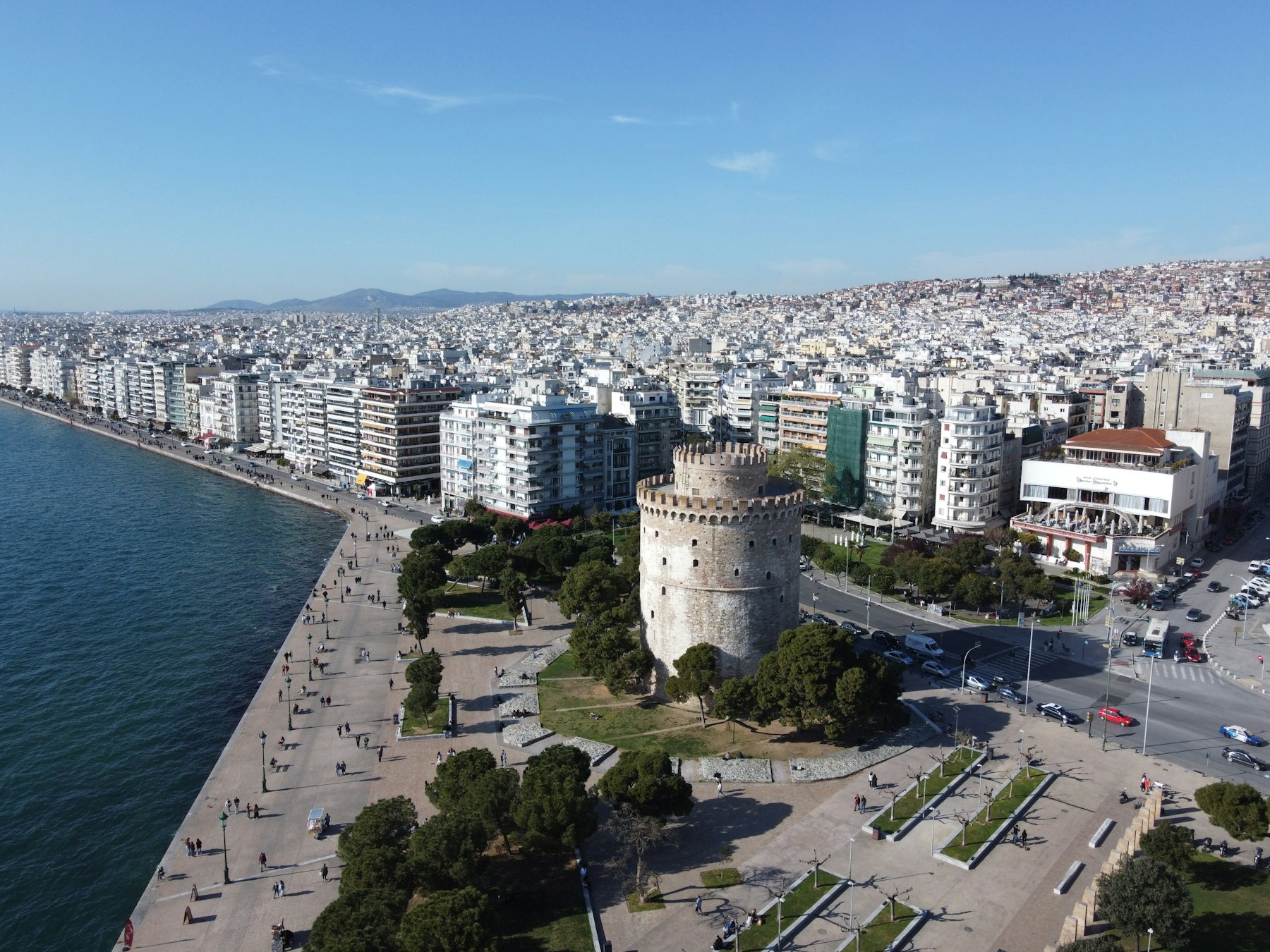
Thessaloniki is the only entry on this list that is itself a World Heritage property. UNESCO inscribed the Paleochristian and Byzantine Monuments of Thessalonika in 1988 under criteria (i), (ii) and (iv), as a serial property covering 5.327 hectares — not one site but a scatter of them threaded through a working city of a million people.
The register dates the city’s foundation to 315 BC and calls it one of the first bases for the spread of Christianity. The inscribed monuments were constructed over a span from the fourth to the fifteenth century, which UNESCO describes as a diachronic typological series — a phrase that means, in plain words, that you can walk a thousand years of architectural argument in an afternoon. The mosaics of the Rotunda, Saint Demetrius and Hosios David are, in the register’s own assessment, among the great masterpieces of Early Christian art.
What makes it a city break rather than a site visit is the spread. The inscription takes in public edifices of various functions — religious, secular and military — including the four-kilometre city walls. You do not queue for any of it. You come out of a bar on Valaoritou at one in the morning and there is a fourth-century rotunda across the road, lit and locked and entirely unbothered. No other Greek city does this, and almost nobody books it.
Best for: travellers who want one of the best tourist cities in Greece to behave like a city first and a monument second.
Go when: late April to early June, or September into October — our judgment, not UNESCO’s, and it is as much about the city’s own evening rhythm as about the heat.
2. Nafplio — two inscribed properties inside an hour
No other base in Greece puts two World Heritage properties this close together. The Archaeological Sites of Mycenae and Tiryns, inscribed in 1999, are what UNESCO calls the imposing ruins of the two greatest cities of the Mycenaean civilization, a culture that spread around the Mediterranean between 1600 and 1100 BC and left the first testimonies of the Greek language on Linear B tablets. Mycenae is recorded as the kingdom of the mythical Agamemnon.
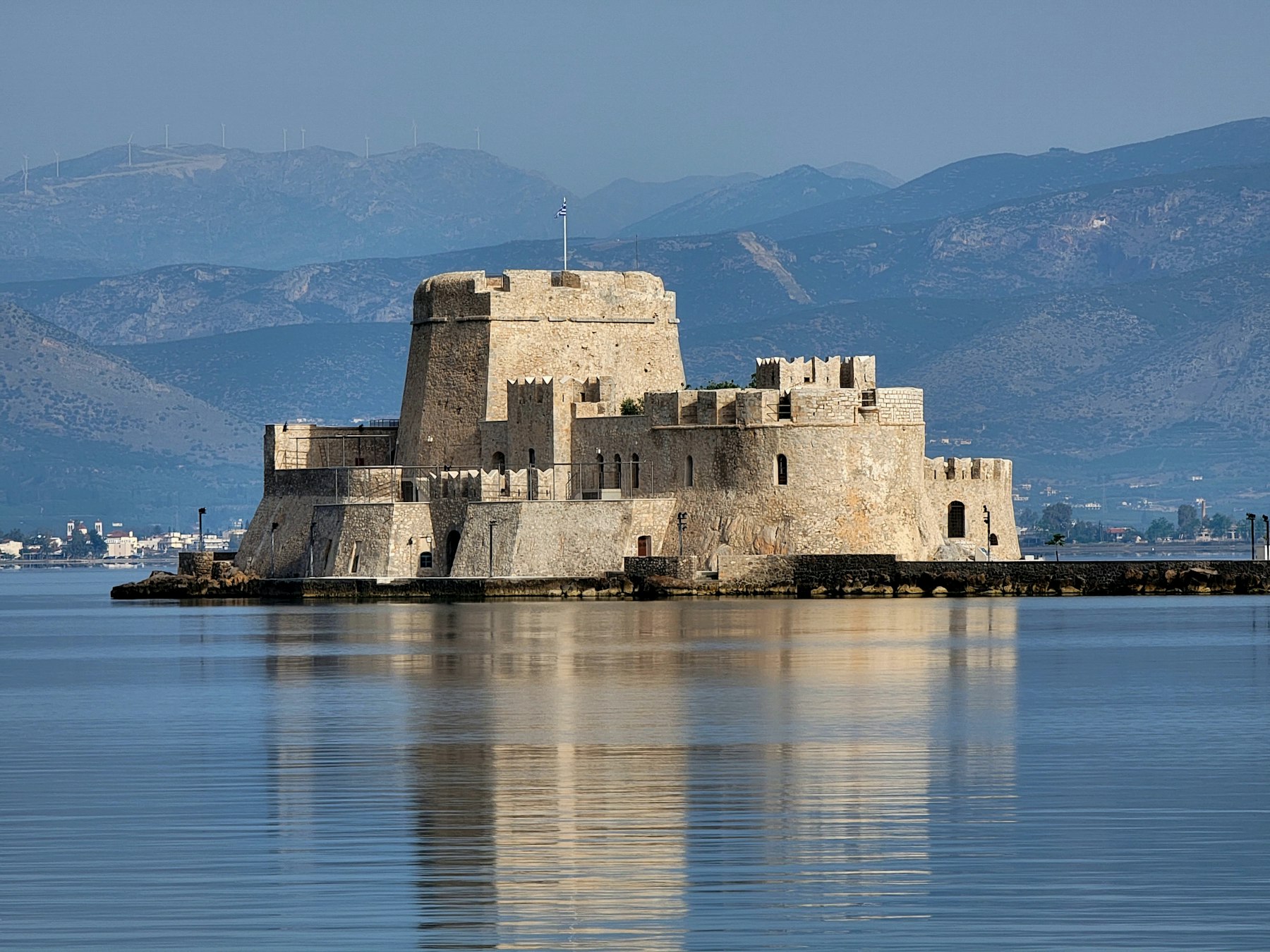
Half an hour the other way sits the Sanctuary of Asklepios at Epidaurus, inscribed in 1988 across 1,393.8 hectares with a buffer zone of 3,386.4. UNESCO calls it the earliest organized sanatorium and a witness to the emergence of scientific medicine; its theatre is renowned for perfect architectural proportions and exemplary acoustics. Nafplio itself is the sleeping half of the equation — Venetian, walkable, and built for an evening.
Best for: a first trip that wants Bronze Age and classical Greece without a second hotel.
Go when: May or late September. Of the best tourist cities in Greece, this is the one to plan around an Epidaurus festival night — judgment.
3. Athens — one of the best tourist cities in Greece, and three hectares
This is not a demotion so much as a measurement. The Acropolis was inscribed in 1987 under five criteria, and the property itself covers 3.04 hectares with a 116.71-hectare buffer zone. UNESCO records the hill at 156 metres, roughly 170 by 350 metres across the top, with fortification walls that have surrounded the summit for more than 3,300 years — the first built in the thirteenth century BC around the residence of a Mycenaean ruler.
The register traces the religious character to the eighth century BC and the cult of Athena, and the building programme everyone comes for to the fifth century, after the victory over the Persians. It is unimprovable and it is also, measured honestly, a single afternoon. Athens is third on this list because the rest of the city is a very good restaurant scene wrapped around one extraordinary rock, not because the rock is anything less than it is.
Best for: two nights bookending a run through the best tourist cities in Greece, never the whole of it.
Go when: March to mid-May, or November — our call, and the November one is the contrarian pick we stand behind.
4. Veria — the royal capital nobody has heard of
The Archaeological Site of Aigai, the ancient royal capital of Macedon, was inscribed in 1996 under criteria (i) and (iii) and covers 1,420.81 hectares with a buffer zone of 4,811.73 — a serial property an order of magnitude larger than the Acropolis. UNESCO records that it was only discovered in the nineteenth century, and that it lies between the modern villages of Palatitsia and Vergina.
This is where the Temenid dynasty was rooted: the family of Philip II and Alexander the Great. The monumental palace, dated to around 340 BC, is described in the register as the biggest and one of the most impressive buildings of classical Greece. Veria, twenty minutes away, is the town you stay in, and the fact that you have probably never considered it is the entire point of this list.
Best for: anyone who has done Athens and wants the half of the best tourist cities in Greece nobody sells.
Go when: spring or autumn, paired with Thessaloniki rather than visited alone — judgment.
5. Kalampaka — the town underneath Meteora
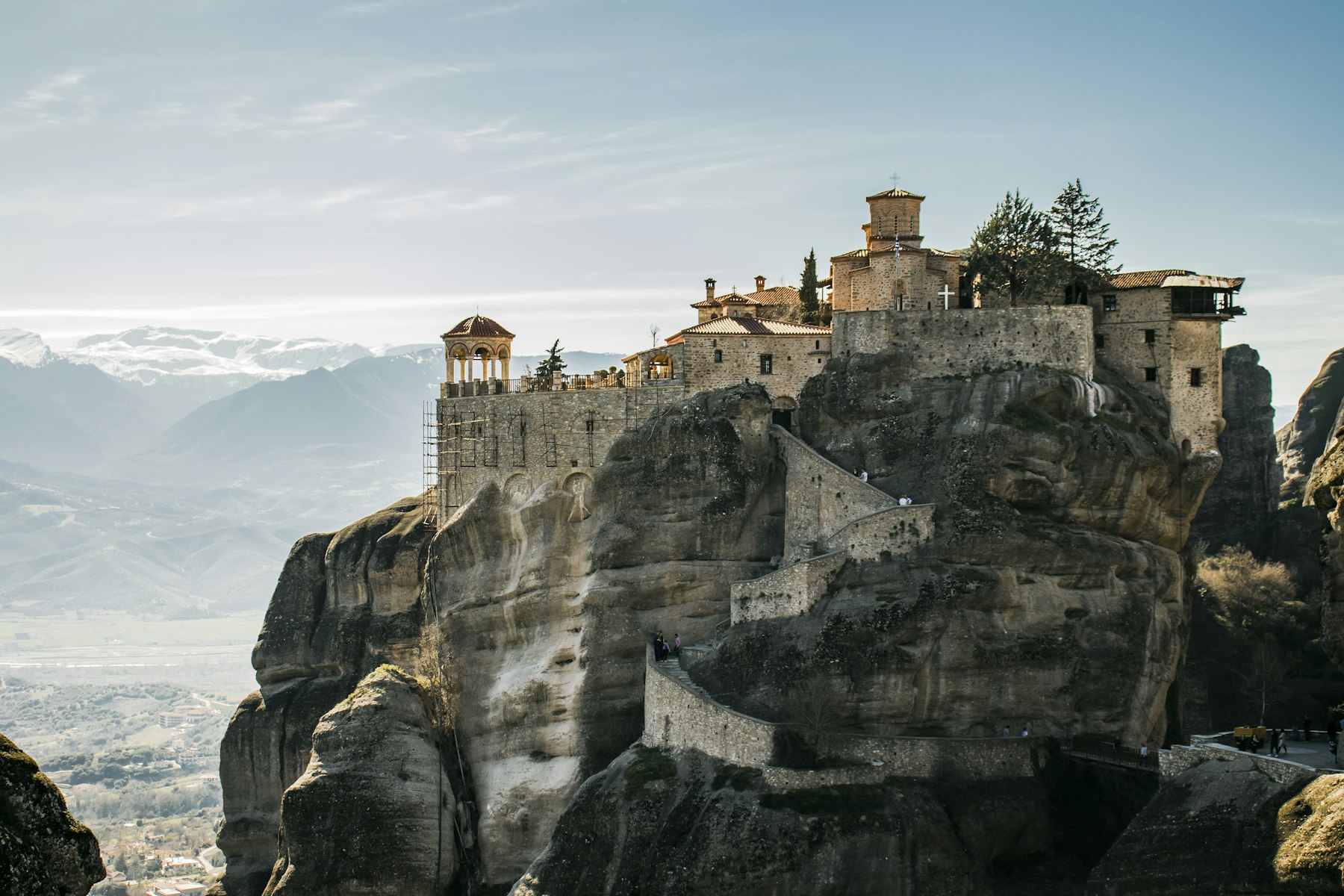
Meteora was inscribed in 1988 under five criteria including the rare (vii), for natural beauty, across 271.87 hectares with a 1,884.14-hectare buffer. UNESCO describes monks settling on these heavenly columns of sandstone from the eleventh century onwards, and records that twenty-four monasteries were built at the height of the fifteenth-century revival of the hermitic ideal, during a period of political instability in Thessaly.
Kalampaka sits directly beneath the rocks, which matters more than it sounds: the light on the pillars at six in the morning and again at dusk is the reason to sleep there rather than coach in from elsewhere. It is the smallest place on this list and the one that most rewards a second night.
Best for: travellers who want one genuinely astonishing landscape among the best tourist cities in Greece.
Go when: April to early June for green valleys, or late October for mist in the pillars — both judgment calls, and the mist is a gamble.
6. Ioannina — the gateway to Greece’s newest cultural landscape
The Zagori Cultural Landscape was inscribed in 2023 under criterion (v) alone, which is unusual and tells you what it is: not a monument but a way of living in a place. UNESCO describes villages known as Zagorochoria strung along the western slopes of the northern Pindus range, transformed in the eighteenth and nineteenth centuries by remittances that expatriates sent home to fund private and public infrastructure.
What that money built is an impressive network of stone-arched bridges, cobbled paths and stone staircases linking the villages of the Voidomatis River basin. Each village is organised around a central square with a plane tree, and some are still surrounded by sacred forests maintained by local communities. The register also notes the architecture has become vulnerable to socio-cultural and environmental pressures, which is a polite way of saying go soon. Ioannina, on its lake, is the base.
Best for: walkers, and anyone chasing the newest inscription among the best tourist cities in Greece.
Go when: June to September for the paths, and we would avoid deep winter entirely — judgment, and a firm one.
7. Kavala — a Roman city on the road between continents
The Archaeological Site of Philippi was inscribed in 2016 under criteria (iii) and (iv), covering 87.545 hectares with a 176.291-hectare buffer. UNESCO places it at the foot of an acropolis on the Via Egnatia, the ancient route linking Europe with Asia, and records that Philip II re-founded it on a former Thasian colony in 356 BCE.
The Romans then reshaped it into what the register calls a small Rome, with a forum and a monumental terrace of temples, after its elevation to a Colonia Augusta. Later it became a centre of Christian pilgrimage deriving from the Apostle Paul’s visit in 49 or 50 CE, and the basilicas and octagonal church are the evidence. Kavala, on the coast fifteen kilometres away, gives you a harbour and an aqueduct to sleep under.
Best for: the last of the best tourist cities in Greece before you fly home from Thessaloniki.
Go when: May, June or September — judgment; the site has very little shade.
MORE: If the islands are where you were headed anyway, read Best Greek Islands to Visit — the same register, sorted a different way, and the reason Santorini does not appear on either list.
The mainland properties none of these seven cities can claim
Seven of the best tourist cities in Greece do not exhaust the register. These six sit far enough from any city worth sleeping in that they are day trips rather than bases — useful to know before you build a route around one.
| Property | Inscribed | Area | Nearest sensible base |
|---|---|---|---|
| Archaeological Site of Delphi | 1987 | 51.04 ha | Arachova, or a long day from Athens |
| Archaeological Site of Olympia | 1989 | 105.608 ha | Katakolo or Pyrgos, western Peloponnese |
| Archaeological Site of Mystras | 1989 | 55.64 ha | Sparta, forty minutes from the gate |
| Temple of Apollo Epicurius at Bassae | 1986 | 20.46 ha | Nowhere close — Arkadian mountains |
| Mount Athos | 1988 | 33,042.3 ha | Ouranoupoli, and men only, by permit |
| The wider area of Mount Olympus | 2026 | 18,938 ha | Litochoro — inscribed this year |
Inscription years and areas are from the UNESCO World Heritage Centre property records. The “nearest sensible base” column is our judgment, not UNESCO’s, and assumes a hire car.
How to plan a run through the best tourist cities in Greece
Fly into the right airport
Thessaloniki airport opens five of these seven within a three-hour drive — Thessaloniki itself, Veria, Kavala, Kalampaka and, at a stretch, Ioannina. Flying into Athens and driving north is the commonest mistake we unpick on a half-built plan for the best tourist cities in Greece. Fly into one and out of the other; the one-way car drop costs less than the day you lose.
Give Nafplio its own leg
The Peloponnese does not combine neatly with the north. Treat Nafplio, Epidaurus and Mycenae as three or four nights hung off Athens rather than threading them into one loop — judgment, learned on other people’s itineraries.
Book the evening, not the site
Almost nothing on this list needs a timed ticket months out. What does need booking is the Epidaurus summer festival, the good rooms in Kalampaka facing the rocks, and a table anywhere in Thessaloniki on a Friday. Those three fill; the ruins do not.
Talk to an advisor about Greece →
Frequently Asked Questions
What are the best tourist cities in Greece for a first visit?
Thessaloniki, Nafplio and Athens, in that order, are the best tourist cities in Greece we would send a first-timer to. Thessaloniki is itself a World Heritage property; Nafplio puts Mycenae and Epidaurus within an hour; Athens holds the Acropolis. Between them they cover Byzantine, Bronze Age and classical Greece without ever needing a ferry or a third hotel.
Is Thessaloniki worth visiting instead of Athens?
Instead of, no. As well as, emphatically yes, and we would give it the longer stay. UNESCO inscribed its Paleochristian and Byzantine monuments in 1988 as a serial property spread through the living city, including the four-kilometre walls. Among the best tourist cities in Greece Athens gives you one extraordinary hill of 3.04 hectares.
How many UNESCO World Heritage sites does Greece have?
Twenty-one, according to the UNESCO World Heritage Centre’s Greece listing. Fourteen are on the mainland and seven are on islands. The most recent addition is the wider area of Mount Olympus, inscribed in 2026 under criteria (vi) and (x) across 18,938 hectares.
When is the best time to visit the best tourist cities in Greece?
Late April to early June, or September into October. That is our judgment rather than anything UNESCO publishes: the archaeological sites carry almost no shade, the northern cities are at their best in shoulder season, and and the island crowds that drive pricing across the best tourist cities in Greece have not yet arrived or have gone.
Can you see Meteora and Delphi on the same trip?
Yes, but not on the same day. They sit on opposite sides of central Greece, and the drive between them is a genuine half-day. Our advice is Meteora with a night in Kalampaka, then Delphi on the way south — judgment, and the sequence we build most often between the best tourist cities in Greece.
The Dorian Destinations Verdict
Greece is sold to Americans as an island country with a capital attached, and the register says otherwise: fourteen of the twenty-one properties are on the mainland, and the newest of them, Mount Olympus, was added only this year. The best tourist cities in Greece are not the ones with the most famous skylines. They are the ones where the inscribed thing is still being used — a church that is still a church, a square that is still a square, a wall that is still somebody’s back garden boundary.
If you take one thing from this list, make it the first entry on our list of the best tourist cities in Greece. Give Thessaloniki three nights rather than the overnight most itineraries allow it, and let Athens be the bookend instead of the backbone. The way we build trips, that one swap changes the whole shape of a Greek fortnight — and it costs nothing.
Build this trip with Dorian Destinations →
Sources: UNESCO World Heritage Centre — Greece State Party listing, Paleochristian and Byzantine Monuments of Thessalonika (456), Acropolis, Athens (404), Mycenae and Tiryns (941), Epidaurus (491), Aigai (780), Meteora (455), Zagori Cultural Landscape (1695), Philippi (1517) and the wider area of Mount Olympus (1719). Related reading: Best Places to Visit in Europe.
Best of Travel · Greece · Europe · Cultural Travel